Are swans more likely to die from bird flu?

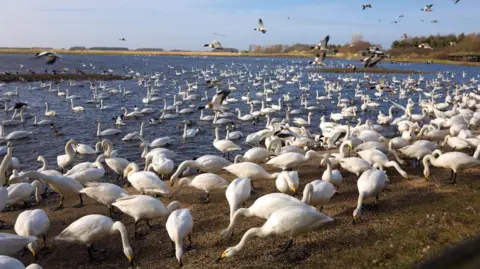 WWT Martin Mere
The south of England is no stranger to bird flu scares, with outbreaks among poultry affecting the livelihood of farmers in Hampshire and Dorset.
Now suspected cases among swans are reported to be on the rise, most recently across Berkshire, where about 30 swans died on the River Kennet in Newbury, along with about 12 on the River Thames in Windsor, two in Maidenhead and a further two found downstream.
Dr Teresa Frost, head of waterbird monitoring at British Trust for Ornithology (BTO), says there seems to be "genuine susceptibility" to the disease among the swan species, due to lifestyle and weather factors.
There are multiple signs of the highly pathogenic avian influenza (HPAI) in infected birds, including a swollen head, closed and runny eyes and disorientation.
Frost says they are "feeling generally unwell, just like we would".
"They can be very listless and not doing their normal behaviours, sometimes they can also preen more than usual."
She says people are "more likely to see dead swans than they are to see a bird that's more well camouflaged".
"But I think even despite that, there does seem to be genuine susceptibility and we are seeing at times large numbers of deaths in different places," she adds.
"It's not confined to just Southern England, for example we're seeing similar reports from Scotland."
Some species 'more susceptible'
 Dr Teresa Frost
Frost observes some bird species "seem to be more susceptible than others".
"We're still a bit unsure about how much of that is due to genetic differences or just the way that the birds are.
"But what does seem to be very clear is that wild fowl, like ducks and geese and swans, seem very susceptible."
She adds that with water birds, "it's also the environment that they live in and the way they behave".
Frost says that while the flu "can be destroyed by sunlight and warmth", during the winter "it can quite happily stay within still water for quite long periods of time".
"If you've got a bird species that usually lives in that kind of environment, then obviously they're going to be more likely to be exposed to the virus," she says.
She adds that in winter, water birds tend to congregate in certain places, "so they'll obviously be able to host the virus and transmit the virus to each other".
"And also from not only within their species, but also between species - you might get one species that perhaps is not that badly affected by it, [which] then might bring that virus to a species that is more susceptible to mortality and then you see deaths happening in that other bird species."
'It's very distressing'
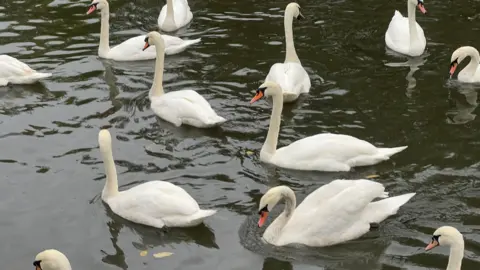
The mute swan is among the most recognisable species, but Frost also mentions the migratory wild swans Whooper and Bewick's swan populations.
"In Whooper swans in particular, early in the season this year, we did see some big mortality events and we think that, a bit like the mute swans, this was partly because they were all roosting together.
"[They form] these tight groups of individuals all close together and that was caused we think by weather conditions at the time - there wasn't as much places for them to roost so they were having to be more concentrated."
Frost says the case seems to be "a bit more random" with mute swans.
"You'll get it in one lake now and then you might see nothing but then in another town, in a couple of months time, you'll get a similar thing happening.
"It's very distressing for the people who are going there every day and seeing the swans get sick one day after the other and die quite often."
A recent case of suspected bird flu in the South closed Abbotsbury Swannery in Dorset a week earlier than planned.
Frost says the BTO has been doing work on the disease's impacts on wild birds.
"Thinking about the conservation implications is one of the things that we're working on."
She adds that they are collaborating with the Animal and Plant Health Agency (APHA) to "look at spatially which areas of the country you might expect more virus to be in".
"This matters because we think that there is a strong link between the number of water birds and the amount of virus in the environment and that has an impact then on the agricultural environment and poultry."
You can follow BBC Berkshire on Facebook, X (Twitter), or Instagram.
