Almost half of planned new social homes at risk of not being built

 Getty Images
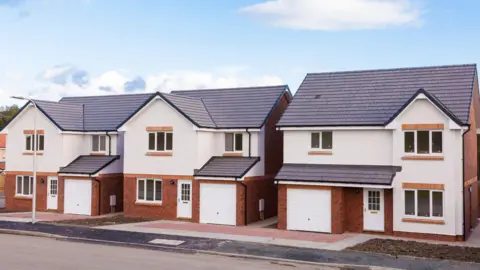
Hundreds of new social homes could be scrapped due to a cut in government funding, according to research by the Northern Ireland Federation of Housing Associations.
With 50,000 people on a waiting list for social housing, the cut to funding was announced by Communities Minister Gordon Lyons in October.
The research found that over the next two years, plans for 2,092 new social homes across Northern Ireland could fall to 1,100.
A Department for Communities (DfC) spokesperson said the report had not been shared but "an innovative and creative approach" was needed in terms of funding social housing.
Social housing in Northern Ireland is typically built by not-for-profit housing associations, supported by Department for Communities funding.
Building programme 'on brink'
According to the review, the biggest impact of the cut is expected to be in areas of highest housing need, including west and north Belfast and Lisburn.
In Belfast, with the newly reduced grant funding, just 373 homes are now likely to be built compared to the 1,026 homes which had been planned.
In Lisburn and Castlereagh, the situation is even more stark, which could see no homes built under the new funding regime, with the 291 planned homes now at risk of abandonment.
Seamus Leheny, chief executive of the Northern Ireland Federation of Housing Associations (NIFHA), said: "The new-build programme in Belfast and other high-need areas is on the brink of collapse.
"You cannot address urgent housing demand by making social housing more expensive to deliver."
However, it is not believed that the changes will affect all of Northern Ireland.
Fermanagh and Omagh, and Mid and East Antrim council areas will see no change in the number of housing schemes.
Causeway Coast and Glens will actually see about 50 additional homes built, bringing the total number of planned new homes in the area to 301.
Current building rates mean that target is likely to be missed.
Social housing funding
Up until now, the DfC paid an average of 54% of the total cost of a social housing scheme, under the new funding arrangement this would fall to an average of 46%.
In some areas already struggling with housing shortages, including parts of Belfast, that funding will now make up just 42% of the cost.
Alternative means of finance, like commercial loans, will be needed to make up the shortfall.
But they are more expensive than public funding and house builders have said that extra cost would make many new homes too expensive to build.
Mr Leheny said an additional £23m of funding would needed to close the gap.
"Our members are facing projects where the additional interest payments, maintenance and management costs combined are more than they will receive in rent, meaning they would make a loss from day one," he said.
Mr Leheny added that the impact of increased costs may have a wider implications.
"If delivering homes depends on significantly higher private borrowing, then serious discussions will be needed about rent levels and investment in existing properties because borrowing must be repaid," Mr Leheny said.
 PA Media
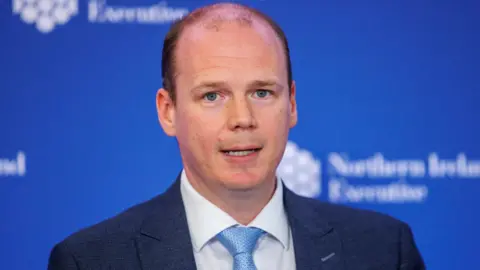
Communities Minister Gordon Lyons said he had yet to read the federation research but defended his funding decisions, saying the "status quo isn't good enough".
He said he would work with housing associations to "find efficiencies" and "make it as cheap as possible within current standards to build more homes".
"We have done extensive work and research on this to make sure that we are putting this grant where it can make the most impact," he told the Northern Ireland Assembly.
"I need to stretch this as far as possible and quite frankly the status quo isn't good enough."
The Democratic Unionist Party (DUP) minister was responding to questions from assembly member Mark H Durkan from the Social Democratic and Labour Party (SDLP).
Durkan acknowledged there were "varying opinions" on the impact of the minister's decision earlier this year.
"I sincerely hope that he is right, however I fear that he will be proven wrong," he added.
Capital budget of £270m
When the changes were announced the minister said it would "achieve better value and more social homes for those who need them".
The DfC has a total capital budget of about £270m, but most of that is already committed to existing projects.
The department said the purpose of the changes were to "secure the maximum possible number of new social homes", adding that any changes "take account of construction costs, inflation, rent levels and interest rates".
"The minister remains committed to achieving the targets in the Executive's Housing Supply Strategy; however, changes must be made," a DfC spokesperson added.
