Major reforms planned for schools exams

 Getty Images
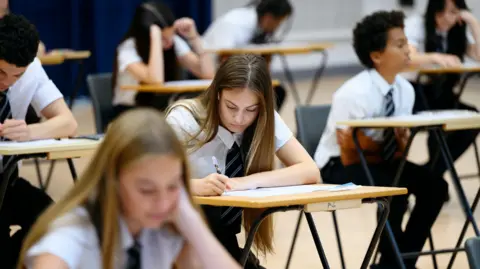
The way students are examined in Northern Ireland is set for a major overhaul.
Currently, AS-levels in each subject have to be taken halfway through the A-level course and count for 40% of the final grade.
Under new plans, they will be scrapped and replaced with a new two-year modular A-level, with three separate topics or sets of exams.
While the AS name will go, pupils will still have the option of sitting some tests at the end of Year 13, but the changes will not be fully introduced until September 2029.
Most GCSEs will also be examined at the end of the two-year course, with a maximum of two exam papers in most subjects.
In England, AS-level results have not counted towards A-level grades since 2017.
Pupils in Wales still sit AS level exams which count towards their final A-level grade, but a review is under way, while an entirely different system exists in Scotland.
Pupils in Northern Ireland, though, will be able to continue to take qualifications set by English and Welsh exam boards including AS-levels.
Education Minister Paul Givan said that the changes would cut the number of exams and give pupils more time to explore, understand, and enjoy learning.
All of the changes apply to qualifications run by the Northern Ireland exams board, the Council for the Curriculum, Examinations and Assessment (CCEA).
What do students think?

Sixth form students at Mercy College in Belfast had mixed views on the changes.
Caoimhin is due to take his A-levels in Science, Sport and ICT in May and June, he said sitting AS-levels last year "really helped" him prepare.
"They gave me a grade that I knew I had to work towards, especially for university."
While he felt AS-levels were valuable, he thought it was a good idea to retain some exams that count towards A-level grades at the end of year 13.
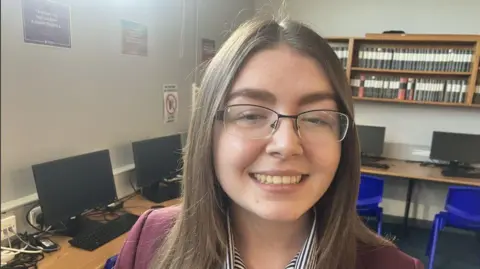
Aleigha said he AS-level results had motivated her, adding she prefers sitting exams to doing coursework throughout the year.
"Most kids would usually sit it out and say 'I'll leave it until next month, I'll leave it, I'll leave it,' but because it's at the end of the year you have something to work towards," she said.
"I still think the AS is important just for even a sense of achievement, that's more motivating."

For Patrick, the current system is "the best way".
"It provides students with a good backbone; it lets them - like it did for me - know where they're at," he said.
"Maybe some students are under-confident, but the AS will show them that they're actually doing quite well."
He also said that cutting coursework from a lot of subjects was "not exactly a good idea."
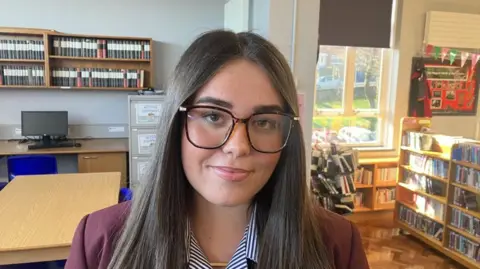
Meanwhile Sophie is taking a 'cache' course, which includes practical work two days a week in a primary school.
She agrees that some pupils are sitting too many exams.
"Based off hearing what my friends do there is a lot that goes into it, and there's a lot of tests," she said.
Sophie also felt that it would be good if the content of some courses was reduced.
"Thinking back on my GCSEs and how stressful it was there was a lot to take in," she said.
But overall she said that in many GCSEs "the workload is just right."
What are the main changes to AS and A-levels?
There will be a new two-year modular A-level, with three separate topics or exams.
All of the exams can be taken at the end of year 14, or one of the three sets of exams can be taken at the end of year 13.
The exam taken at the end of year 13 will be worth 30% of the final A-level grade, with exams taken at the end of year 14 worth the other 70%.
Once the new A-level is introduced for teaching in 2029, CCEA will no longer offer a separate AS-Level qualification.
Givan has therefore changed original proposals which would have seen students taking A-levels sit all of their exams at the end of their two-year course to decide their grade.
In a public consultation on the plans, there was little support for fully linear A-levels with all exams at the end of Year 14.
What changes are being made to GCSEs?
Most GCSEs, though, will be linear with two exams taken at the end of the course deciding a pupils grade.
The exceptions will be English Language, Mathematics, and Single and Double Award Science GCSEs where some exams will be taken during the course.
Givan has decided to retain the A*– G grades at GCSE in Northern Ireland, and is not following the grading system in England where grades are awarded on a scale from 9-1.
That echoes the decision taken by the then Education Minister John O'Dowd of Sinn Féin in 2015.
In some GCSEs, pupils will have fewer topics to study, to allow for deeper learning in each subject.
Coursework will be reduced at both GCSE and A-level and used only where essential, like practical experiments in science subjects for example.
Why are these changes being made?
 PA Media
Givan has previously told BBC News NI that he believed young people in Northern Ireland were "over-tested".
The changes for GCSE, AS and A-level are part of wider reform of education, called TransformED, which includes reviews of the curriculum, assessment and qualifications in Northern Ireland.
A review of the school curriculum - what is taught in schools in Northern Ireland - was recently completed.
Givan had said that he wanted the curriculum to "get into the detail of things, rather than a very wide range of issues that need to be covered in a short space of time".
The review of qualifications was linked to the curriculum review.
In a statement, Givan said that the reforms would reduce stress on young people, enhance the quality of education and ensure qualifications remained relevant and effective.
"Northern Ireland pupils currently take far more exams than their peers in England to achieve the same qualifications due to the AS structure," he said.
"These reforms address this unfairness and practices like using AS results to gatekeep Year 14 entry.
"They place learning, not testing, at the heart of education.
"Reducing controlled assessment and coursework will also help address workload burdens, equity issues, and the impact of AI on take-home tasks," Givan said
Separately, a review of the Religious Education (RE) syllabus is also under way and is expected to be completed by the summer.
Minister should 'accept he got it wrong' - Sinn Féin
Sinn Féin MLA Pat Sheehan said Givan's statement was "an attempt to repackage proposals that were already overwhelmingly rejected by the public".
"The education minister's original plan to scrap AS-levels was clearly opposed by pupils, parents and teachers," he said in a statement.
"Rather than listening, he has simply redesigned the model while still removing AS as a standalone qualification."
Speaking on the BBC's Talkback programme, Givan said the consultation did "impact the outcome".
"What was proposed was the abolition of AS-levels completely and a fully linear approach and that is not the approach I have taken in terms of what was consulted upon."
