NI leaders differ in views to GB election results

 Brian Lawless/PA Wire
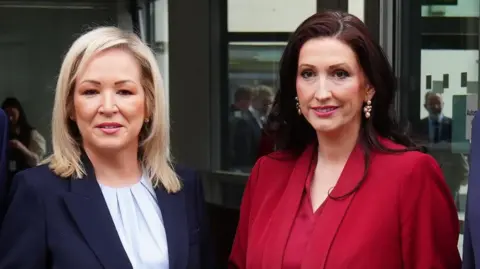
Election results in Great Britain send a message that voters are "tired of the shackles in Westminster", First Minister Michelle O'Neill has said.
The SNP have won in Scotland while Plaid Cymru have won in Wales, meaning pro-independence parties could have the first minister role across all three devolved nations for the first time.
O'Neill said her party, Sinn Féin, shares common ground with the SNP and Plaid Cymru on "national self-determination", but would work in good faith with all political parties.
Deputy First Minister Emma Little-Pengelly, of the Democratic Unionist Party (DUP), said while the results may indicate a desire for change it is not on the "constitutional question".
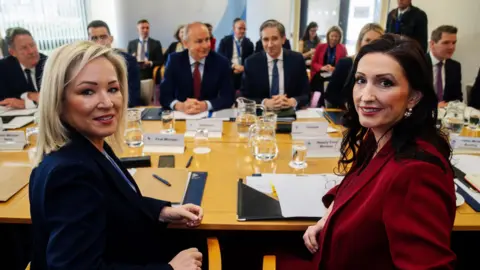
The first and deputy first ministers were speaking at the latest meeting of the North-South Ministerial Council (NSMC) in Armagh.
They hosted ministers from the Irish government at the event, including the Taoiseach (Irish PM) Micheál Martin.
O'Neill said that regardless of the outcome of the elections, they marked a "seismic" change in politics across the UK.
She also said the "desire for independence cannot be ignored".
Little-Pengelly said there was a sense of "frustration" from voters at the slow pace of delivery from governments in Great Britain, but dismissed any suggestion that it brought the potential of independence any closer.
 Brian Lawless/PA Wire
Asked how he viewed the results and the prospect of a government in Westminster with Reform UK, which has performed well in the council elections in England, Martin urged caution when comparing local results to a general election.
"They are two different beasts, we know that. But there is an increasing fragmentation with politics everywhere," added the taoiseach.
He said he retained a "very good relationship" with the UK government and that would continue in a sensible and pragmatic way.
Tánaiste (Irish deputy PM) Simon Harris said the relationships between Ireland and the UK, and UK and the EU, were at the "best they'd been since Brexit" and that he expected that to remain the case.
"Often the day after an election politicians, pundits and journalists can become all-knowing in deciding what the people of any jurisdiction has said and often it's more complicated than that," added Harris.
What is the North-South Ministerial Council?
It was set up under the 1998 Good Friday Agreement and involves ministers from Dublin and Stormont working together on "matters of mutual interest".
The council covers six areas of co-operation: agriculture, education, environment, health, tourism and transport.
Common policies and approaches are agreed, but implemented separately in each jurisdiction.
It meets in plenary form several times a year, rotating between Dublin and Armagh.
