Education minister 'sympathetic' to calls for social media ban
 PA
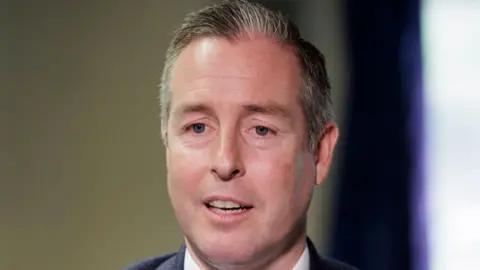
PAEducation Minister Paul Givan has said he is "sympathetic" to calls for social media to be banned for under-16s in Northern Ireland.
The UK government recently launched a public consultation on whether to ban social media for under-16s ahead of a government decision on the proposal.
The debate over a minimum age for social media use has been fired up by Australia's decision last year to ban children from a range of platforms including Instagram, Snapchat, YouTube and TikTok.
Any decision to enact a ban in Northern Ireland lies with Westminster, not Stormont, as regulation of social media is not devolved.
Democratic Unionist Party (DUP) minister Givan said his party has not made a "clear policy decision" on the issue.
In September 2025, Givan began a phone-ban pilot in nine schools in Northern Ireland.
"I introduced a clear policy for all schools that we shouldn't have smart phones being accessed in our post-primary settings from when you arrive in school until you leave school," he told BBC News NI's Sunday Politics.
"We need to see effective implementation of that policy."
The pilot scheme, which aimed at restricting pupils from using their mobile phones during school hours, was hailed as "very beneficial" among those participating in the scheme in September.
The pilot, which will aim to explore the benefits of a phone-free school day, runs until March.
Last September, Fiona Kane, principal at St Ronan's College, said the scheme had "transformed learning and teaching".
"Phones are a massive distraction during the day and there would have been incidents where pupils would have a sneaky look during lessons," she added.
What have they done in Australia?
The government took action, it said, in order to reduce the negative impact of social media encouraging young people to "spend more time on screens, while also serving up content that can harm their health and wellbeing".
Its ban covers 10 platforms: Facebook, Instagram, Snapchat, Threads, TikTok, X, YouTube, Reddit and streaming platforms Kick and Twitch.
YouTube Kids, Google Classroom and WhatsApp have not been included as they were not deemed to meet criteria laid down by the Australian government.
The ban is enforced on social media companies, who face fines of up to A$49.5m (£25m) for serious or repeated breaches.
The government says firms must take "reasonable steps" to keep kids off their platforms, and should use multiple age assurance technologies.
'Important to keep close eye on Australia'
In January 2026, First Minister Michelle O'Neill said there are both positive and negatives regarding the impact social media has on young people and that it was important to keep a "close eye" on the laws introduced in Australia.
"If there are positive outputs from that, and it actually improves young peoples' lives and takes them out of the murky world that can be sometimes online, then that's something I think we have to keep under review."
Givan said he has been observing the impact of the social media ban in Australia, but added that a similar policy in Northern Ireland does not "strictly sit" within his "ministerial remit in terms of taking this policy forward".
"We would need to look at the detail of exactly how this would work."
Sinn Féin MLA Cathy Mason told the Sunday Politics programme: "The focus on this needs to be our children and young people.
"They need to be at the heart of every decision that is made here."
The Department of Justice told BBC News NI: "Telecommunications legislation, including the regulation of social media platforms, are reserved matters and the responsibility of the UK government."
You can watch Sunday Politics Northern Ireland on BBC iPlayer.
