Police initially believed Noah Donohoe was 'missing voluntarily'

 Pacemaker
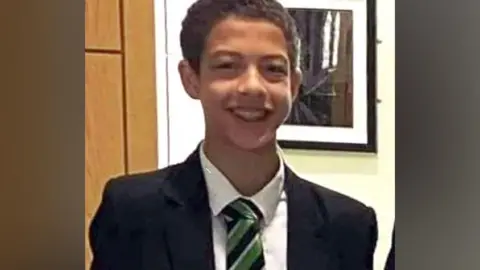
The Police Service of Northern Ireland (PSNI) initially believed schoolboy Noah Donohoe was "missing voluntarily", an inquest into his death has been told.
Sergeant Barry Hutchings, who was the lead police adviser during the search for the 14-year-old, appeared as a witness at the inquest on Tuesday.
Noah's body was found more than 600 metres downstream from a culvert entrance close to where he was last seen alive in north Belfast in June 2020.
The discovery, in a water tunnel close to the M2 motorway, was made almost a week after he disappeared.
Fall from bicycle
Giving evidence at the inquest into the boy's death, Hutchings explained that his role in the investigation was to help to establish the strategy for the search in conjunction with the senior investigating officer.
He said he tasked a specialised tactical support team to search the culvert two days after Noah went missing and he was aware that it was a "hazardous" environment and involved significant risks.
He explained that a search of the tunnel had to be stood down because tidal water levels were "too high", and a diving team was subsequently brought in to conduct the underground search.
The witness also said he recorded in the early stages of Noah's disappearance that the young boy "fell heavily" from his bicycle, prior to his disappearance, because that was "just what I was told" by a colleague.
Hutchings also recorded notes stating that Noah's mother had been "worried about his mental health" in the time before her son's disappearance.
'Inconsistencies in CCTV'
His notes from the time outlined how "scenario number one" was that Noah was "missing voluntarily" and he also stated that investigators initially had "very little information" about his disappearance.
Hutchings said the initial search had a focus on Cave Hill, because Noah had indicated his intention to meet friends in that area.
But he said the police had an initial expectation that a missing 14-year-old would be found around the streets of Belfast.
Asked about his reference in notes at the time to "inconsistencies in CCTV", he explained that he had been told that other officers "believed" Noah had been captured on CCTV images.
He said his comments indicated that he did not want to hear that colleagues "believed" Noah appeared in the images and wanted certainty so that investigators would not embark on "a wild goose chase".
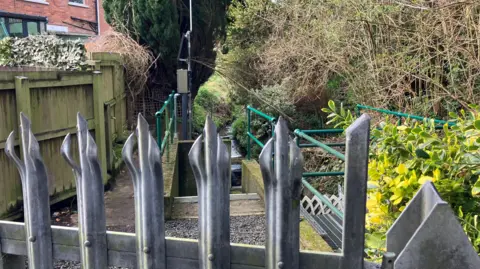
The witness also described how he went to Northwood Road in north Belfast after the police received a report that Noah's bike had been found.
He said he went behind one of the houses and found a culvert and then discovered that the hatch on the culvert was not secured.
He indicated that he subsequently requested a specialised team to conduct a search of the culvert.
The witness said he was of the view that because it was beside Noah's last known location, they should expect to find him "close to" that area.
However, he added that "there was nothing to suggest that Noah was in there [the culvert]".
He explained that he believed there were other nearby places, include foliage, sheds, and back gardens where the boy could be found.
He said: "I did not expect to find Noah in that culvert."
Hutchings said he subsequently asked for the Criminal Investigation Department(CID) to review the case, and he also sought the appointment of a family liaison officer.
'Complete and utter darkness'
Earlier, a witness spoke about the "utter darkness" inside the culvert close to where Noah Donohoe disappeared.
Owen McGivern was giving evidence on behalf of the Department for Infrastructure.
He said it is "black" from within a short distance of the culvert entrance.
The inquest has also been told that police made enquiries about potential toxic gases in the underground tunnel during their investigations into the boy's death.
A PSNI officer conducted enquiries in which he explored if Noah could potentially have lost consciousness by the presence of gases.
McGivern explained how there can be a risk of gases being released and detected when silt at the bottom of the tunnel is "agitated" by any movement.
The hearing was told that gas detectors have gone off on "a number of occasions" during desilting work and contractors had to withdraw.
Asked if gas detections in the pipe can be triggered by "low level" gases, the Department for Infrastructure witness explained that the build-up of gases in silt is not as hazardous as those found in a sewer.
