'Moral imperative' to reintroduce at-risk species

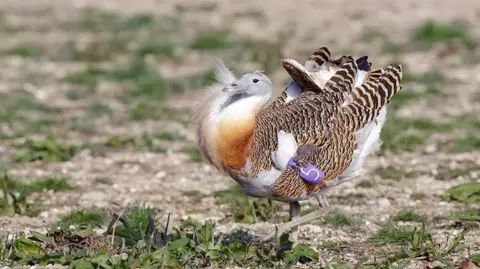 Great Bustard Group
Conservationists undertaking wildlife restoration projects say there is "a moral imperative" to reintroduce endangered species into the wild.
From beavers reshaping rivers on Exmoor to white-tailed eagles reclaiming the skies over Somerset and great bustards now thriving in Wiltshire, reintroductions have been transforming the local landscape.
It requires enormous commitment and often years of perseverance, but organisations such as the Great Bustard Group (GBG), said it was worth the huge effort to protect globally endangered species.
"It would be wrong of me to depart this world, whenever that may be, with fewer species or less wildlife around me than when I joined this earth," said executive officer of GBG, David Waters.
'Cultural restoration'
The Great Bustard was a fixture in British skies until the mid 1800s, when the species became a target for trophy hunters, and its natural habitat was destroyed by farmers.
The bird is at risk of global extinction - the only British bird to hold this status.
Since 2004, conservationists at GBG have released hundreds of Great Bustards onto Salisbury Plain and there are currently about 50 bustards established across south Wiltshire, with successful breeding every year since 2009.
Waters said Salisbury Plain was an ideal environment for the birds.
"They did well in farmlands for hundreds and hundreds of years, but it is the big, wide, open area they like - what I call big sky country," he said.
"Also, within Wiltshire, [the bustard] has always been the symbol of the county, on our coat of arms, the main feature of the Wiltshire flag and the county badge of many organisations including girl guides and army cadets.
"So there's a cultural restoration as well as an extra tick on the biodiversity sheet."
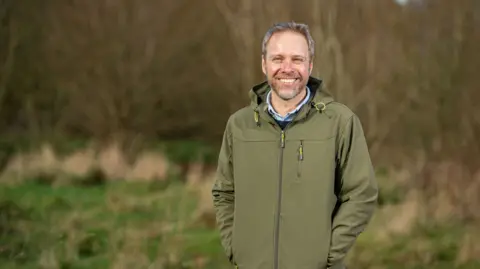 Simon Clarke
Simon Clarke, head of recovery at Somerset Wildlife Trust, said a key reason for reintroducing species was to restore ecosystems which have been damaged by human activity.
"This enables improvements in biodiversity for a whole range of flora and fauna - it's about restoring balance," he said.
"The wider ecological benefits that these species bring is that they will be part of the natural trophic system and have a unique role, providing a function, perhaps a predator which will control numbers of other species that may be detrimental."
Clarke said success was dependent on working in partnership with the local community to address concerns before any project is undertaken.
One such success for the Somerset Wildlife Trust has been the reintroduction of the large blue butterfly, which was declared extinct in the UK in 1979, but has had a resurgence.
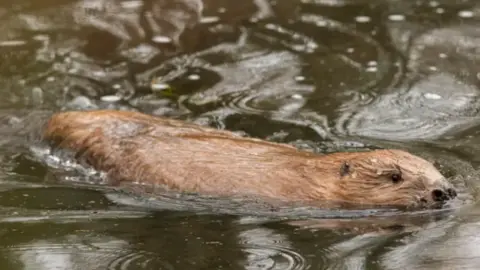 James Beck
Conservationists agree that reintroducing species into the wild has benefits for humans, such as cleaner air and water, and flood prevention.
Just this week, beavers were released into the wild in Somerset for the first time.
National Trust project manager Ben Eardley said: "These ecosystem engineers play a vital role in helping slowing water flow, creating and holding wetland habitats, reducing erosion [and] improving water quality.
"So that means as well as delivering for nature, those nature-based solutions are really delivering for people and helping to reduce downstream flood risk."
The National Trust recognises farmers and landowners may have "understandable concerns" about the risks of reintroducing species, but Eardley said the key was to continue monitoring.
"Part of it is having volunteers and rangers who are skilled, identifying activity and dealing with it accordingly," he said.
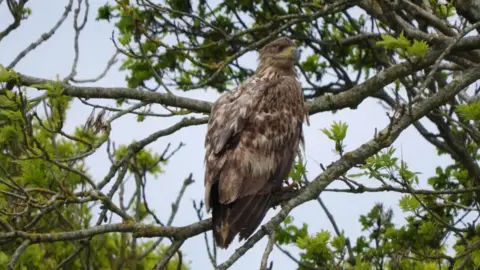 Exmoor National Park
The Roy Dennis Wildlife Foundation and Forestry England have been reintroducing Britain's largest bird of prey - the white-tailed eagle - into southern England since 2019, and in 2023 a pair bred successfully for the first time.
About five of the birds have been visiting Exmoor regularly and now the foundation is preparing to release some 12-week old chicks there this summer.
"By choosing a big, obvious bird, we've found so many ordinary people - not all birdwatchers or those going to reserves - can see the eagles flying over different parts of the south and it's proved we can restore nature," said Roy Dennis OBE.
"There's been a tremendous response from the public and [that] has given them hope for the future," the conservationist added.
Follow BBC Somerset on Facebook and X. Send your story ideas to us on email or via WhatsApp on 0800 313 4630.
