Great bustards found breeding in new location

 Cranborne Chase National Landscape
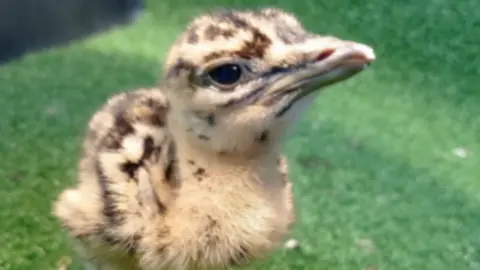
Great bustard nests have been found for the first time on Cranborne Chase.
This week, Cranborne Chase Landscape Trust confirmed that bustard chicks had been found in the designated National Landscape last May.
The bustard - the world's heaviest flying bird - was hunted to extinction in the 19th century, but the species was secretly reintroduced to Wiltshire in 1998 using chicks from Russia.
The two new nests were found in a field of sainfoin north of the Wylyle Valley, after a farmer informed the Great Bustard Group (GBG) that he was about to start mowing a crop.
 Cranborne Chase Landscape Trust
Since 2004, the GBG has released hundreds of chicks on Salisbury Plain in Wiltshire.
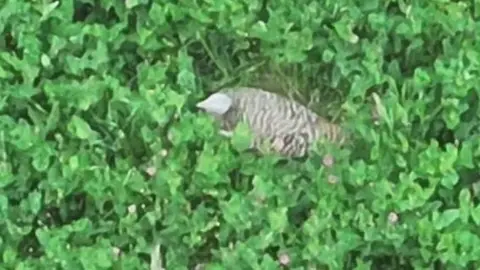
As a precaution, two volunteers used drones funded by the government-backed Farming in Protected Landscapes programme to check the field.
The eggs were rescued under licence, incubated and hand-reared. The birds have since been released back onto nearby Salisbury Plain.
The trust released a drone image of a bustard sitting on its nest, camouflaged amongst the tall crop.
"What it shows is the slow, but steady, expansion of the breeding range of the great bustard - and that the bustards had a good year last year," said David Waters from the GBG.
The bird has been Wiltshire's county emblem since Wiltshire Council was established in 2009.
Speaking to BBC Radio Wiltshire, Waters said the UK population, which is all in Wiltshire, are doing well.
"The numbers are going up slowly. But in the rest of the world, many of the Great Bustard species are not doing well," he added.
"They're the only bird in the UK which is globally endangered."
Follow BBC Wiltshire on Facebook, X and Instagram. Send your story ideas to us on email or via WhatsApp on 0800 313 4630.
