Pre-made sand martin burrows ready for visitors

 BBC
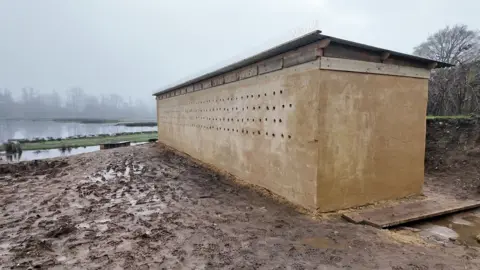
BBCA new nesting bank for sand martins is set to welcome its first residents later this month.
The purpose built structure at Testwood Lakes Nature Reserve in Hampshire hopes to secure the long term future of the summer vistor at the site.
Sand martins are the smallest member of the swallow and swift family and are one of the earliest spring migrants to return to the UK.
The new bank has nearly 180 nest chambers and is designed to mimic the natural steep sandy cliff face the birds prefer.
"It is a massive build" says Ben Pickup who is reserves officer for the Lower Test Valley with Hampshire and Isle of Wight Wildlife Trust.
"We had a very generous grant from Hampshire Ornithological Society and we had a really fantastic team of volunteers who built this thing from the ground up and without them we couldn't have done this project."
Sand martins have been nesting at Testwood Lakes for more than two decades.
The new build replaces a sandy bank that had begun to deteriorate and fail over recent years.
The colony is one of only three that are known of in Hampshire.
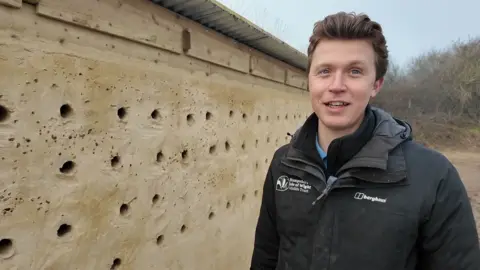
"It's really important we continue that because populations are declining across Hampshire unfortunately" Pickup explains.
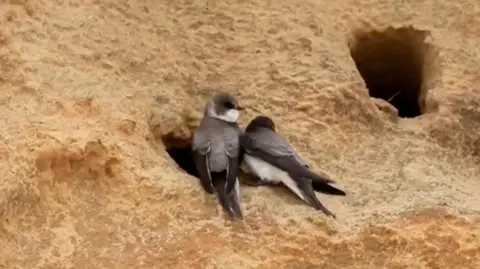
Sand martins choose steep sandy cliff faces or river banks to create burrows and dig out a small nesting chamber.
The pre-made burrows mimic their natural habitat.
"They're all facing upwards which means rain can't get in because the sand martins are quite fussy they don't want any moisture getting into their nests."
Access behind the bank will allow conservationists to accurately monitor and record the colony.
Before the birds arrive each nest needs to be prepared.
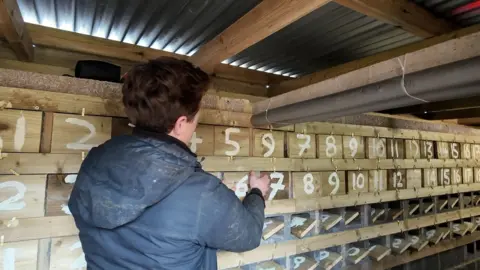
Volunteers have been carefully heaping sand into each of the chambers before sealing them up with a small numbered wooden door.
The birds will mould the sand into cupped shape nest.
The martins usually lay one or two clutches of four or five eggs .
UK populations remain broadly stable but Hampshire Ornithological Society (HOS) reports that numbers in south-east England have declined.
In Hampshire, the species is now almost entirely confined to sand and gravel pits, with just 318 active holes recorded.
It is hoped the new sand martin bank will secure the future of the colony at Testwood Lakes for years to come.
