Zoo keeper for endangered species feels privileged

 Marwell Zoo
"It's a privilege to work with so many species and it's a bit of a pinch me moment sometimes," says Rhiannon Wolff.
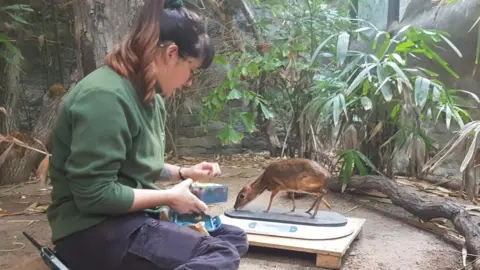
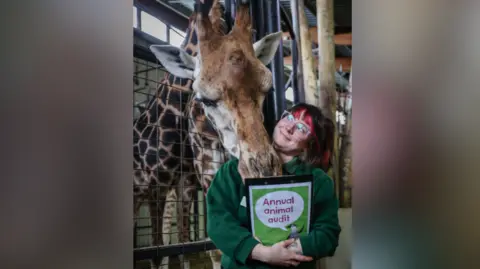
She is a hoofstock animal keeper at Marwell Zoo, near Winchester in Hampshire, and looks after "everything with hooves" - from giraffes to zebras - as well as white rhinos, tapir, red river hogs and Visayan warty pigs.
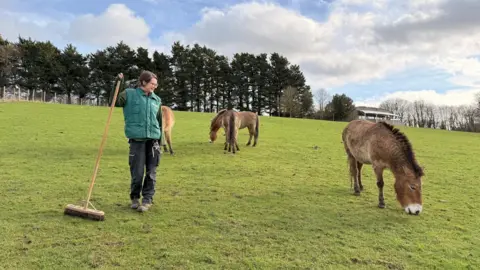
Wolff describes the Przewalski's horses as one of her favourites and talks about two of the females that recently left the zoo to return to the wild.
She says being part of species conservation is "a very special part of the job".
 Marwell Zoo
Wolff says she was "always very fond of animals" but "didn't necessarily know I was going to be a zookeeper".
She first considered being a vet but then discovered she could do courses that were "very specific towards exotic animals".
"I love pets and domestic animals but also you could do things with these exotic and sometimes endangered animals that really need help with conservation."
After a university degree in zoo management and an unpaid internship at Chester Zoo, she got a job at Marwell.
"I moved down in 2020 to do just a maternity cover job and I've never left," she says.
 Marwell Zoo
Her day-to-day tasks include cleaning, providing nutritional enrichment, record keeping, observing animal behaviour, faecal collection, monitoring fence lines and training.
"A rhino is so large, and so are giraffes, so we train them for things like X-rays where they just stand and we do an X-ray and they're awake and they just do it by choice, blood draws, vaccination."
She adds that many of their animals are IUCN Red List, such as the scimitar horned oryx, that were extinct in the wild but Marwell "had a big hand" in reintroducing them back in the wild.
"It's definitely a privilege to work with so many species and it's a bit of a pinch me moment sometimes that you're working with these animals that you know are very elusive or people rarely see them in the wild," she says.
Wolff is especially fond of okapi that she says need to be handled gently "but a lot of them are very hardy and it's just a pleasure to work with them".
'Chunky little things'
 Rhiannon Wolff
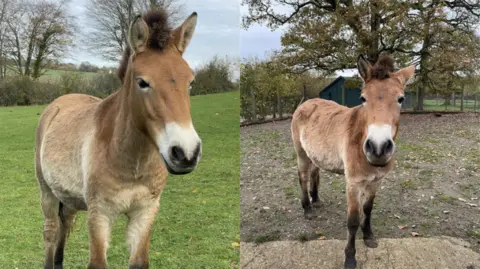
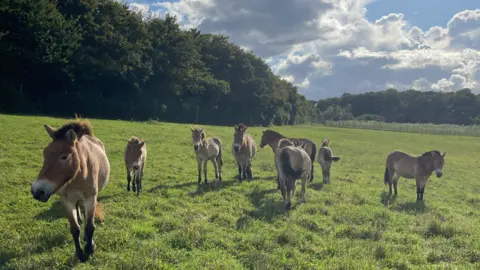
The keeper says the Przewalski's horses are "one of my favourites".
"They're very special, so they have some similarity to domestic horses but they're wild.
"They are these shorter, stockier, chunky little things that are very feisty, very hardy because they have to live in a really harsh environment, occasionally."
The zoo says the Przewalski's horses alive today "are descended from just 12 captive individuals after the population in the wild was declared extinct".
"They're really interesting to work with because of how they interact socially," Wolff says.
"You do have to be quite careful when you're with them. When they kick off at each other, it can be quite scary and I think if people saw it, they'd be quite shocked."
She says that on 22 January, two of the Marwell's female horses - Shara and Togs - left the zoo to return to the wild in their native Kazakhstan.
Rhiannon adds they had made it to Berlin, thus completing the first part of their journey.
It is part of Marwell's ongoing international efforts to save the species from extinction.
"It's bittersweet but it's very cool to be part of that as well because I worked with them from when they were born to when they left, so it's a very special part of the job."
 Marwell Zoo
She will continue to work with the remaining Przewalski's horses group, which consists of seven females.
"[It] is in the works for us to get another stallion in, so that hopefully, we will have more than seven after that.
"The whole team gets fond of the animals we have, so it is sad when they leave for other zoos or other things.
"But to be part of the conservation is a really exciting thing that we have to try and remind ourselves."
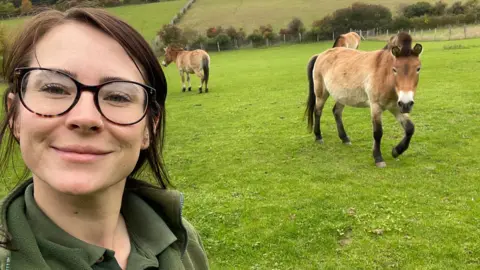
Wolff says it is "even more special" when the Przewalski's horses choose to interact.
"You're stood next to a wild animal pretty much that's wanting to see what you're doing. It's very cool."
 Marwell Zoo
You can follow BBC Hampshire & Isle of Wight on Facebook, X, or Instagram.
