What to do if a storm dumps a beach in your harbour

 Dorset Council
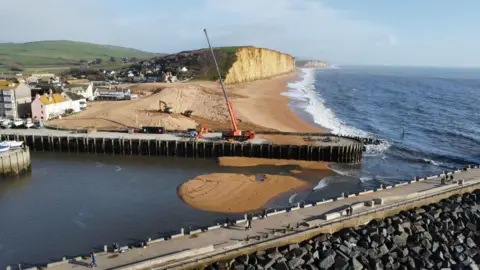
Work has been continuing to remove a huge sand bar that appeared in the entrance of a harbour.
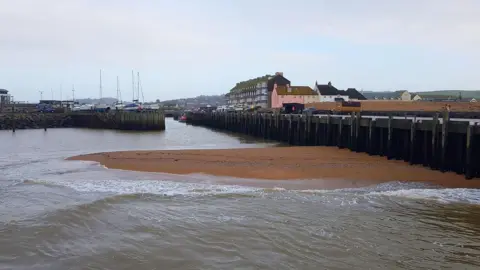
The beach appeared in Bridport outer harbour at West Bay, Dorset, in January following south-easterly storms that have also reshaped other parts of the coast.
Dorset Council said it was the largest amount of sediment seen there for more than two decades, estimated at 10,000 tonnes.
Work to clear it is expected to be complete by early March.
The sand bar, that built up on the eastern side of the entrance, was estimated to be about 3m (10ft) above low water on 29 January and it severely reduced the depth of the entire channel.
Bridport Harbour masters warned of a "high risk of grounding for vessels attempting entry or exit, except during favourable tidal conditions".
So how do you go about moving 10,000 tonnes of sand from a working harbour?
Crane and grab
 Bridport Harbour / Dorset Council
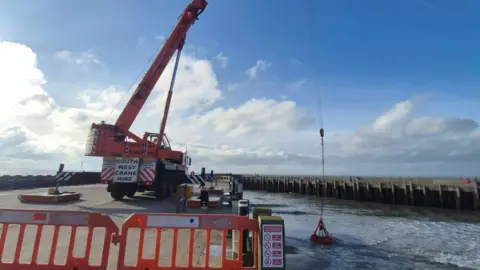
An 80-tonne crane, installed on the east pier, began dredging the sediment on 2 February.
It is fitted with a one-tonne grab which has a 40m (131ft) reach to scoop the material and deposit it on the East Beach side of the pier wall.
Dorset councillor for place services, Jon Andrews, said: "We are acting quickly by using equipment that allows us to start work immediately."
This, he said, would "maintain safe navigation while ensuring the harbour remains operational".
Water injection dredging
 Dorset Council
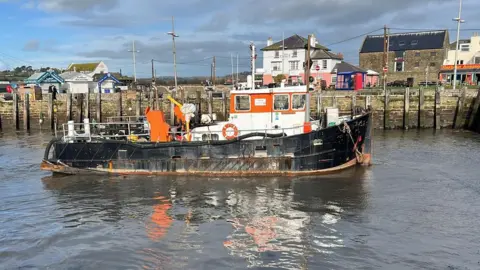
In the coming week, spring tides will allow work to step up, with water injection dredging trials taking place alongside the crane-and-grab method.
Spring tides are periods of exceptionally high and low tides that happen about twice a month.
Dorset Council began testing the Water Injection Dredging (WID) system at Lyme Regis and West Bay in November.
It uses low-pressure water jets to loosen sediment which is redistributed by the natural currents and avoids the need to excavate and suction of the seabed.
The council said previous trials had proven "highly effective", and the spring tide provided "excellent conditions for moving the loosened sediment".
Sluicing the harbour
 Bridport Harbour / Dorset Council
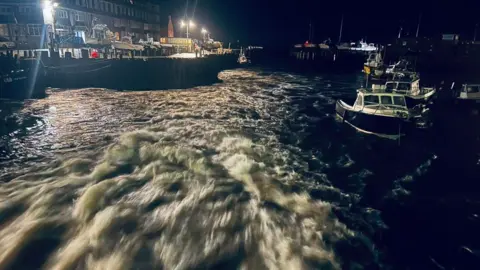
Bridport Harbour team has also been continuing its routine work of using the sluice gates to flush sediment from the harbour on evening low tide.
In a Facebook post explaining the sluicing process, it said: "For maximum effect, the gates are opened around an hour before low water, using the falling tide to help pull silt seaward.
"Sluicing is often carried out overnight, which means many people don't see it happening.
"It helps reduce silt build‑up, but it depends on the right tide and river conditions, so it can't replace dredging and can't be done every day."
Replenish the beach
 West Bay UK
Material from the dredging is being reused to replenish East Beach, which has also been depleted during the storms.
Beach levels at West Bay gradually drop throughout the year as a result of the wind and waves and the Environment Agency carries out annual replenishment because it forms a vital part of the town's sea defences.
The agency is partnering with Dorset Council to co-ordinate the work.
Works are also continuing in the inner harbour to stabilise the crumbling harbour walls.
