Gyratory not appropriately planned - report

 BBC
BBCGyratory works outside Shrewsbury railway station were carried out without robust political oversight or appropriate planning, a cross-party report concluded.
Shropshire Council's economy and environment overview and scrutiny committee launched the review after a so-called floating bus stop installed outside the station did not meet Department for Transport guidance.
The report makes 10 recommendations for changes that will be discussed by the council's Liberal Democrat leaders at a meeting later.
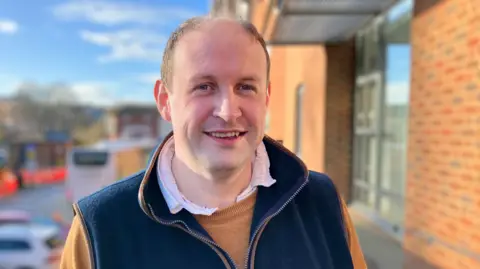
"The main thing from this is learning from it to make sure these sort of things don't happen again," said Conservative councillor Ed Potter, chair of the committee.
The report said the scheme was a large bid based upon a concept "without early enough change control, governance, evaluation and consultation", stressing that a public backlash that ensued after it was completed could have been avoided.
It added there had been a breakdown of communication between various groups involved, and stronger political oversight was needed on future projects.
The recommendations include an independent safety audit, which would look at whether there could be safe use of the floating bus stop, and consider whether bollards could be removed or modified to improve access for emergency vehicles.
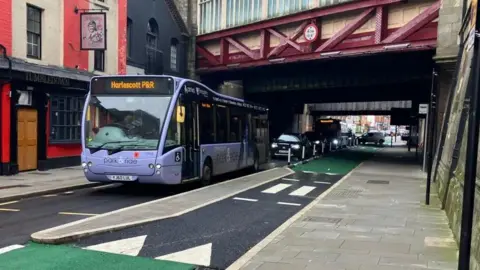
Floating bus stops - which include a cycle lane between the stop and the pavement - were due to be built across England, after more than 150 were installed in London.
The BBC measured Shrewsbury's buffer area between the road and cycle lane as 1.1m (3.6ft) wide.
However, government guidance suggests it should be between 1.5m and 2m, meaning it is nearly 40cm (15.7in) short of the minimum width.
The BBC heard fire engines had used the new cycle lane as a means of avoiding getting snarled up in traffic jams, which built up after the scheme was completed.
Council 'let down'
Disability campaigners and wheelchair users criticised the project, and Arriva Midlands took the decision to suspend services to that stop, after the miscalculation came to light.
Liberal Democrat-run Shropshire Council previously told the BBC it felt "let down" by the contractors that built the stop, as the designs had indicated it was the minimum size required.
The contractor, WSP, previously said the island ended up smaller than planned because unexpected underground utilities were identified, forcing a change in the design.
Potter said in future there needed to be full understanding of works before putting bids in for government money.
"We can't just chase the pound signs, we need to ensure what we're bidding for is going to work," he said.
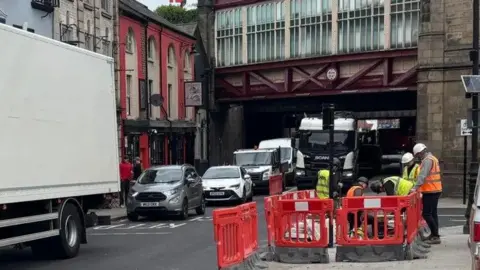
"Installation started in the summer of 2025, and I think there were missed opportunities, there was miscommunication, particularly going back to portfolio holders over the whole scheme," Potter added.
He added that there had been issues informing partners that a problem had arisen.
"If that had gone back, particularly to the wider steering group… and then consulting with people like Arriva… and the blue light services, perhaps another solution could've been found or looked at," he said.
Concerns were also brought up about heavy traffic that built up because of the two-lane road being reduced to a single lane with the traffic light scheduling.
The report recommended regular contact between blue light services and highways, to monitor traffic issues and signalling.
'Perilous financial situation'
Potter said it was not as simple as making significant changes or altering the gyratory back to its original form.
"The financial implications for Shropshire Council in its perilous financial situation would be significant, to make changes to an external government grant," he said.
"That being said, there are things that can happen – traffic light sequencing and maintaining that... does make an improvement, we've seen that - but there are still problems.
"I appreciate that the public would like to see much more physical changes… but being realistic about what is financially possible is something we just need to bear in mind."
Follow BBC Shropshire on BBC Sounds, Facebook, X and Instagram.
