Pond project boosts nature and flood resilience

 Shropshire Council
Restoration work at a National Trust estate is helping bring overgrown ponds "back to life" whilst boosting flood resilience.
Contractors working at the Attingham Park Estate have cleared dense vegetation, opened up shaded areas and excavated silt to deepen the ponds.
This means the ponds can now hold more water during heavy rain, reducing the amount that enters the River Severn at peak times.
Those behind the work said it demonstrated how nature-based solutions were "vital" for water management in the area.
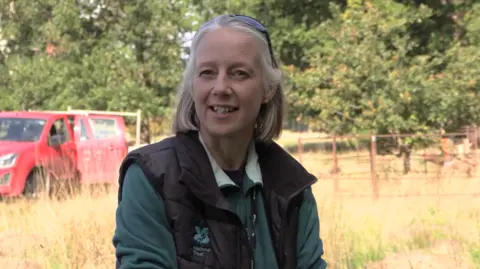
Jane Birch, who heads the Attingham Nature Recovery Project for the National Trust, said the improvements were already transforming the ponds into richer habitats.
"With more light, cleaner water and better structure, they'll support a wider range of wildlife," she said.
She added this would help nature thrive across the estate and provide a spectacle for visitors.
Piles of logs have been left around the ponds to provide refuge for amphibians and reptiles as well as valuable habitat for a variety of invertebrate species.
The work was being carried out as part of a project funded by the Severn Valley Water Management Scheme (SVWMS) and managed by Shropshire Council.
It is one of eight demonstrator projects which will test methods for reducing flood risk in the upper River Severn catchment area.
Those behind the scheme said creating wetlands, restoring "ghost ponds" and planting trees would slow the flow of water through the Attingham Estate, which had the potential to store an additional 22,000 cubic metres of water.
"We have the potential to make a significant contribution to managing peak flows across the catchment, demonstrating how nature‑based solutions can work at scale to build long‑term resilience," said project manager Pete Lambert.
Follow BBC Shropshire on BBC Sounds, Facebook, X and Instagram.
