Rare cottonweed returned to beachfront

 Havant Borough Council
An endangered plant species is being reintroduced to a beachfront common where it was first recorded more than 400 years ago.
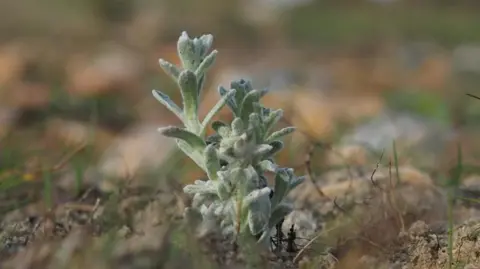
Cottonweed, which is part of the daisy family, was first noted by the botanist John Goodyer on Hayling Island, Hampshire, in 1621.
In recent years the plant has been in severe decline and is only found in Wexford, Ireland, having previously been widespread across the UK and Ireland.
Natural England is reintroducing the plant on Sinah Common, a site of special scientific interest on Hayling Island as part of its threatened species recovery actions programme.
The Rare British Plants Nursery - a specialist nursery which cultivates some of the rarest, most threatened native plants for habitat restoration schemes - grew hundreds of young cottonweed specimens from the Wexford plants.
The sturdy plants have now been planted along Sinah Common and are expected to thrive, setting seed and becoming a self-sustaining feature of the Hayling Island coastline.
Natural England is due to undertake annual monitoring to see how the plants progress.
Seventeenth century naturalist John Goodyer noted its location as "on the seashoare on the south parte of the Iland of Haylinge".
Havant Borough Council lead member for the environment Grainne Rason said: "Over 400 years ago, Hayling Island was home to Cottonweed and I now take great pride in the fact that it will be a focal point for its reintroduction into our impressive natural shoreline.
"Through partnership, hard work and dedication to a noble cause, it is plain to see we can have a positive impact on our environment when we put our minds to it."
You can follow BBC Hampshire & Isle of Wight on Facebook, X (Twitter), or Instagram.
