Coventry's light rail technology a 'game-changer'

 BBC
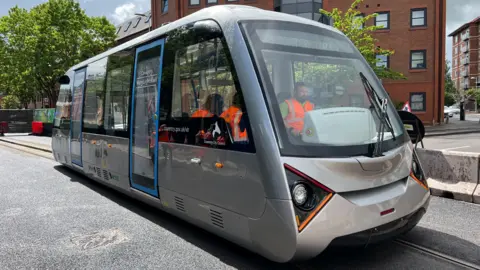
BBCThe technology used in the Very Light Rail (VLR) system in Coventry could be a game-changer for the city's coffers, according to the programme director.
Nicola Small told a council meeting there was interest from both home and abroad in the track the VLR cars ran on and the council owned those rights.
"We have also spoken to people in Australia and Ireland and are trying to work very closely with South Yorkshire, who have a renewals programme, which would give us an ideal opportunity to test the universal slab in Sheffield where they have the heaviest tram in the country."
The meeting also heard about the work on the next phase of the project, an 800m (2,624ft) section alongside live traffic.
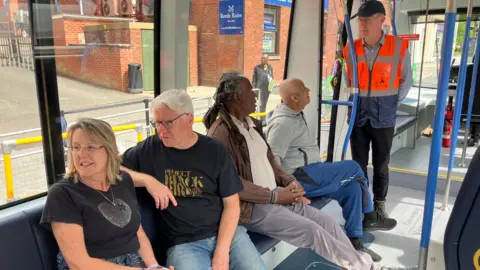
Small told the council's business, economy and enterprise scrutiny board that it was great to see things happening after seven or eight years of research and development behind closed doors.
She confirmed the authority was in talks with other councils about the technology, including with a group from Canada in the past week.
The meeting also heard from Colin Knight, the director of innovation at the council, who said an important factor to bear in mind was the universal slab, the section containing the track elements, was easier to install than other systems and was technology owned by the city council.
"I'm sure most of us can remember Broad Street in Birmingham which was closed for around four years. What we are talking about is measuring disruption in weeks, not years, and that is a critical point which makes it more affordable so that it can be adopted in many more towns and cities.
"There is so much opportunity with this and we need to make sure we capitalise on it."
This news was gathered by the Local Democracy Reporting Service, which covers councils and other public service organisations.
Follow BBC Coventry & Warwickshire on BBC Sounds, Facebook, X and Instagram.
