Most smart motorways 'not value for money' say reports

 In Pictures / Getty Images
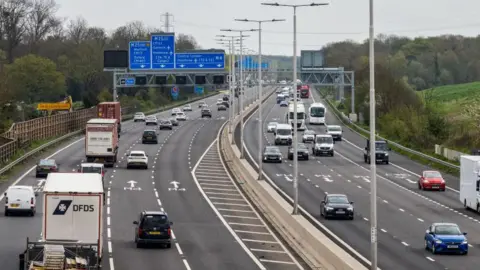
Many smart motorways are currently failing to offer the value for money expected when they were originally planned, according to newly released reports from National Highways.
Two of the schemes,involving sections of the M25 and the M6, were found to be offering "very poor" value.
Just three out of a total of sixteen projects across England were on track to deliver the financial benefits expected, although in most cases they were delivering safety benefits in line with original forecasts National Highways said.
The AA, representing motorists, said the schemes had turned out to be a "catastrophic waste of time, money and effort".
Smart motorways were introduced to reduce congestion by increasing motorway capacity, using technology to regulate traffic flow.
The simplest type are controlled motorways. These operate like conventional motorways but use overhead gantry signs and variable speed limits to regulate traffic flow.
Two other schemes, that allow drivers to use the hard shoulder as an additional lane, have proved more controversial.
Dynamic hard shoulder roads permit traffic on the hard shoulder at peak times, while all-lane-running schemes get rid of the hard shoulder altogether, replacing it permanently with a live lane.
When there is no hard shoulder drivers who get into trouble are meant to aim for refuge areas located at regular points, but broken-down cars can sometimes be left stranded in a live lane.
Edmund King, president of the AA said as a result smart motorways had a "mixed safety record".
While controlled motorways, using additional technology, were safer, he said, several of the others had seen "more people killed and seriously injured".
He said the current situation was "frightening" with drivers who had broken down having to rely on a quick response from other drivers to move out when signs said a lane had been closed.
The schemes had been a way of "widening motorways on the cheap", King said, but that they were a "failed experiment" which were "not really working on any level".
The National Highways' periodic reviews of England's smart motorways check the projects against their original objectives, including looking at the impact on safety, environmental benefits and their effects on congestion and journey times.
National Highways claims that in most cases safety and environmental criteria have been met. Many of the motorway sections would have been unable to cope with today's peak-time traffic had they not been converted, it said.
Traffic growth had been lower than was originally expected when the schemes were conceived so fewer drivers are benefiting from the changes, the organisation said.
As a result, value for money has generally been lower than anticipated in the majority of cases.
Among the worst performing projects is a section of all-lane-running motorway on the M25 to the north of London, which originally cost £180m, but failed to deliver the improvements in journey times that had been forecast.
Similarly, a £118m dynamic hard shoulder section of the M6 near Birmingham was meant to make journeys quicker for road users at peak periods. It did so in the morning rush hour, but not in the evening, when in fact they were slower, National Highways found.
Both schemes were deemed on course to deliver "very poor" value for money through their 60-year lifetimes.
In terms of safety, National Highways argued that the five-year evaluations that have so far taken place "demonstrate that smart motorways are delivering safety benefits in line with or above those originally forecast".
It said most schemes evaluated had lower collision rates than would have been expected on the conventional motorways they replaced.
However, the AA has criticised the methods used in the evaluations, including the "inconsistent nature of the figures", which it claimed made it difficult to draw conclusions from the data.
The AA also pointed to an apparent increase in fatalities on an all-lane-running section of the M3, as well as an increase in the average number of collisions in which people were killed and seriously injured on the M1, which it claimed brought the safety of smart motorways into question.
In a statement, the Department for Transport said that although it would not be rolling out any new smart motorways, they remained among our safest roads in terms of deaths and serious injuries, and were just as safe, or safer, than the roads they replaced.
National Highways has indicated that the value for money assessments should be treated with caution, as they were based on projections made more than a decade ago, and cover a relatively short period in the life of those projects.
"Our latest analysis continues to show that overall, smart motorways remain our safest roads. They are also providing much needed extra capacity for drivers, helping to reduce congestion and lower carbon emissions," it said.
In 2023 the government cancelled the building of new smart motorways after concerns were raised over their safety.
