What will 'HIF1' road scheme do for Oxfordshire?

 BBC
BBCIt is set to cost between £320m and £400m, take more than two years to build, and has been in the pipeline for more than a decade.
But you would be forgiven if you were not sure what the "HIF1" scheme is - and what it could mean for Oxfordshire.
The huge roads project in the "Science Vale" area around Didcot has been beset by delays, and those in charge admit there was a need for it years ago.
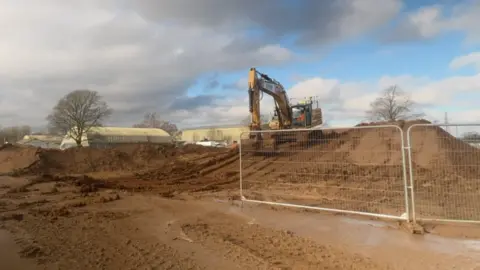
All the discussions have finally led to actual shovels in the ground, with work scheduled to be completed in autumn 2028.
HIF1, which stands for Housing Infrastructure Fund 1, consists of four main parts:
- Widening of the A4130 to create a dual carriageway east of the Milton Interchange
- A "science bridge" across the railway and through the former Didcot A Power Station site
- A new Thames crossing, linking the A4130 at Didcot and the A415 at Culham
- A bypass for Clifton Hampden
Discussions over the plans first came to the fore back in 2015, when Didcot was awarded Garden Town Status.
A bid was originally agreed in 2020 for £218m of government funding, linked to thousands of new homes.
But although Didcot has seen huge housing growth, many feel the wait for promised new infrastructure alongside it has taken too long.
HIF1 was delayed in 2023, when Oxfordshire County Council's planning committee rejected the plans.
The government overturned that decision in 2024, following a planning inquiry - but in the meantime costs rose, and traffic congestion in the area continued to build.
Judy Roberts was one of the councillors that voted against the plan back then, but says she is now convinced it is the right way forward.
"We've got all these extra bits in and we've made it part of a master plan for the whole area," she said.
"It kind of gives a second entrance to Oxford city, as well as being able to go the other way and make it really easy to get to Reading as well.
"So it helps with that connectivity, which is broken by the rail and the river, that makes it so difficult to get out of Didcot."
The scheme is designed to benefit the whole of "Science Vale", which is an area around Didcot, Harwell and Culham targeted for major economic growth.
Alongside the roads, the project includes 19km of new cycling and walkways and additional bus connections.
Roberts said: "It's such a big project - it covers from Wallingford, to Didcot, to Harwell.
"We are in the middle of a huge science innovation area - of Harwell, Culham and Milton Park in the middle.
"It will connect those three areas up."
In 2020, the cost was put at £234m, but now the final price tag is unclear.
"It'll be more than £320m but I don't think it should be as much as £400m," explained Roberts.
"There is a spread in the middle there and that will depend on the cost of materials and the cost of time.
"There is always an uncertainty in any of these projects."
Even though shovels are technically in the ground, there is a little longer to wait before work fully gets going on this project.
Archaeologists first need to survey the area, and have already found evidence of Roman activity on the site where the Clifton Hampden bypass will be built.
You can follow BBC Oxfordshire on Facebook, X (Twitter), or Instagram.
