Couple want awareness of disease after son's death

 Family handout
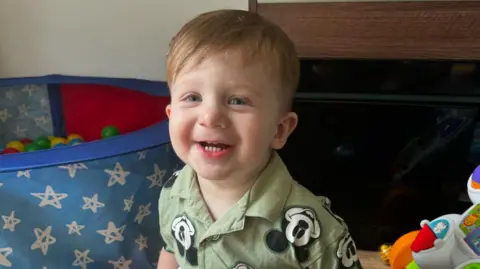
The family of a toddler who died after collapsing while playing at home have paid tribute to their "fearless" little boy.
Hudson, from Knowle in Bristol, was weeks away from celebrating his third birthday when he collapsed and died on 8 January.
His parents believe his death was due to a coronary artery rupture, as his heart vessels were damaged when he had Kawasaki disease at seven months old. They want to raise awareness of the disease, which affects eight in every 100,000 children.
"He was fearless and loved life," said Damian, Hudson's father. "He was just the life and soul of our family."
On the day he died, Hudson was playing at home when he approached his mum Natalie.
"I looked at him, and you could see that he was quite pale and he had blue around his mouth, then he just started to cry and I knew something was wrong," she said.
"He just kind of lay on the floor crying, so I quickly picked him up, and then he just went out of consciousness. He was just going."
Natalie and, later, an ambulance crew gave Hudson cardiopulmonary resuscitation (CPR) but his heart did not restart.
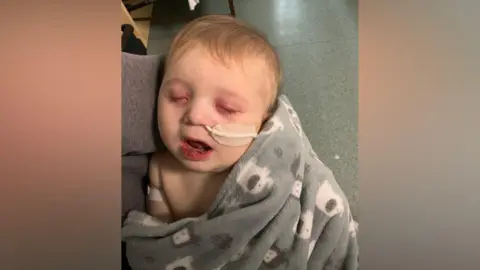
Hudson was first admitted to hospital as a baby when he developed a conjunctival infection - or pink eye - and a fever that over-the-counter medicine did not affect.
While in hospital, Hudson also developed a rash across his tummy, swollen glands and swelling on his tongue.
His condition steadily worsened and his parents said that doctors initially struggled to identify the cause.
"They thought it could be measles but ruled this out," said Damian.
"They said they thought it could be Kawasaki disease, which we had never heard of, but Hudson had only had a persistent fever for three days and not five [which is the number of days typical with the disease]."
 Family photo
Kawasaki disease inflames the blood vessels throughout the body. It especially affects the arteries around the heart and can cause clotting.
After being diagnosed with it, Hudson was given the correct medicines and his condition improved.
He remained in hospital for five weeks while medics ensured his blood was able to clot properly. Hudson eventually returned home and his parents were trained on how to give him twice-daily injections and monitor his blood's ability to clot.
They say he continued to live a happy life and was taken to hospital for regular scans and check-ups.
 Family photo
Damian and Natalie said they had never heard of Kawasaki before Hudson got it and would never have guessed that he was so seriously unwell.
"A lot of our families tended to forget about the situation we were living with," said Natalie.
"We were told he couldn't do any physical sports as he grew older and we had to be careful then, but Hudson was the complete opposite.
"He would climb the chairs, he would climb the top of the sofa and he was always chucking himself everywhere — he completely lived a normal life."
'Lack of awareness'
Charity Kawasaki Disease UK works to raise awareness of the classic symptoms of the disease
Trustee Ian Lyon said the peeling of the skin on hands and feet was a "really, really clear indicator of a heart problem".
"[The charity] is trying to initiate a campaign for every child that reaches reception to have an ultrasound of their heart," he said.
"That would show if there were residual aneurysms, because a lot of parents don't know that their child has had Kawasaki disease.
"If your child has a really, really bad bout of flu, it may be something considerably worse.
"Most children or babies - 99.9% - recover effectively from the original symptoms, but they won't know that what is left behind is something that is actually life-threatening," he added.
Damian said "Kawasaki needs to be at the front of the mind" for parents.
"It's a rare case but even if you only know a little about it then push for it, because we don't know if the drug was given quicker to Hudson, [if] it could have helped in the long-term.
"We want to stress that it's not just flu-like symptoms, a bit of Calpol won't work, so you have to act fast and look for the key elements that are important to Kawasaki," he added.
Kawasaki disease symptoms
According to the NHS, the most common symptoms of the disease are:
- a rash
- swollen glands in the neck
- dry, red cracked lips
- a swollen, bumpy, red tongue — or 'strawberry tongue'
- red inside the mouth and at the back of the throat
- swollen and red hands and feet
- red eyes
Follow BBC Bristol on Facebook, X and Instagram. Send your story ideas to us on email or via WhatsApp on 0800 313 4630.
