Iconic Le Mans winning car 'was a Slough product'

 SLOUGH MUSEUM
"I remember as a child seeing these cars driving around Slough and hearing their growl... you knew they were coming and you couldn't ignore them."
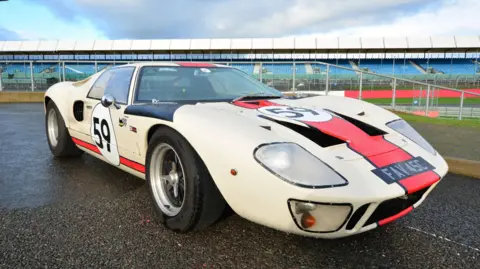
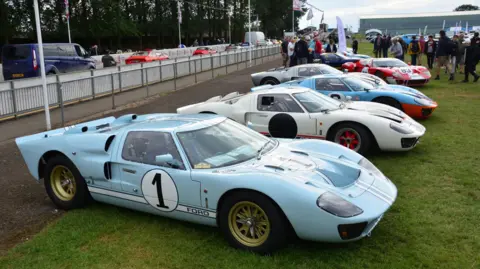
It is 60 years since the Ford GT40 finished in all top three places at the Le Mans 24 Hours, with the team going on to win the trophy three more times in a row.
Ford's triumph went on to inspire the critically-acclaimed film Le Mans '66, but it may be a surprise to some that one of the most famous racing cars ever made was built at a trading estate in Slough.
"If you ask the Americans, they'll say that the GT40 is an American car, designed and built in America - well, it wasn't," says Slough historian Jaye Isherwood.
"It was built in the UK, it was built in Slough, and it was a Slough product."
Ford's participation in endurance event Le Mans was a "grudge match" for Henry Ford II, the culmination of a perceived slight after Enzo Ferrari pulled out of a deal to sell his company to the American car manufacturer.
"[Ferrari] were dominating the Le Mans 24-hour races at the time and Ford decided that they were going to create a car that would beat Ferrari," Isherwood explains.
This mission led Ford to the UK, where it set its sights on a small car firm called Lola, which was making a racing car using a Ford V8 engine and was already taking part in Le Mans.
"Lola at the time were based on the Slough Trading Estate and they agreed with Ford that they would make an adaptation of the Lola car and call it the GT40," Isherwood says.
"They produced a racing car within a year, which is a very short space of time, so I don't think Ferrari knew what was coming.
"One of the things that Ford liked about the Lola design was it had a unique gearbox that drove the rear wheels... at very high speeds and was lasting.
"So much so that the Lola cars used to drive from Slough over to Le Mans to go into the race... that showed just how good their endurance was."
The GT40, so-named because of its height of just 40in (1.02m) did not start winning races straight way.
However, further developments by American designer Carroll Shelby and British driver Ken Miles - played by Matt Damon and Christian Bale in the film - set the car on the road to destiny at Le Mans.
Isherwood says: "[Shelby] tweaked the design of the GT40 and by that time there were three separate units of production, with the GT40 one based at Slough, one in France, and one in the USA.
"Together they pulled the design into being more streamlined, tweaked the suspension, changed the engine, and slowly these cars were starting to show that they could do something, and then it all happened in 1966."
The body shell of a GT40 was later donated to Slough Museum, and Isherwood points out that the town has a long history of car manufacturing going back to 1918, "so Slough's got a lot to be proud of".
But Ford's iconic race-winner remains one of its greatest legacies, a vehicle Isherwood calls the "most amazing endurance racing car".
"Even today, if you saw an image of it, you'd still think it's futuristic."
 SLOUGH MUSEUM
Ford GT40 - the statistics
Year: 1964-1969
Engine: 4.2, 4.7, 4.9 and 7.0-litres (the 7.0-litre 427cu version produced 485bhp, 475lb ft of torque)
Transmission: Ford T-44 four-speed manual
Weight: 1207kg (Mark II)
Top speed: 215mph
Stand-out moment: 1-2-3 finish at Le Mans in 1966
Source: Top Gear
