Why is Slough full of data centres?

 BBC
BBCSlough is commonly regarded as Europe's largest collection of data centres.
With about 40 already and more on the way, experts say the town is the second largest data hub in the world, beaten only by Virginia in the US.
But why are data centres so important - and why is Slough such a hot spot?
James Tyler, UK managing director for Equinix, which runs six sites in the town, has been explaining why he believes it is one of the most "strategically important" areas on the planet.
What is a data centre?
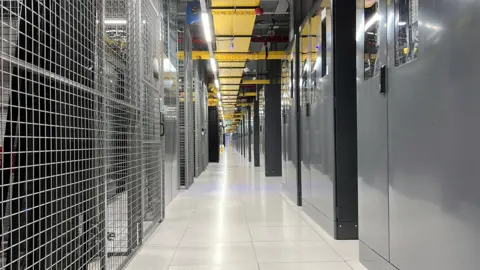
A data centre is essentially a large warehouse filled with computer servers that store and process digital information.
These facilities are run by specialist companies and major organisations like technology firms and network providers, which rent space or operate their own equipment on site.
Tyler says Equinix's Slough sites host hundreds of customers, with large numbers of different networks connected in the same buildings.
What do we use data centres for?
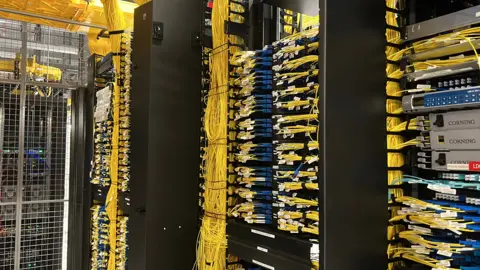
Data centres are the physical infrastructure that underpin our digital world.
Every time you make a bank transaction, stream a film, buy something online or send an email, that information is stored, moved or processed through data centres.
Tyler says: "Imagine everything you do online. When you're on your phone looking at photos, when you're listening to Spotify, watching a movie or doing your banking.
"If we're using the internet and we're using electronic information, that actually has to sit somewhere and be processed somewhere on a machine. It doesn't sit in the ether.
"Even though we talk about the cloud and the internet, they're actually very physical things. And so we need the machines, the computing equipment, to host and process all that information, and typically those machines sit in data centres."
He adds that data centres also act as major connection points for the networks that carry that information around the UK and the rest of the world.
What if we didn't have data centres?
Without data centres, Tyler says, we wouldn't be able to use a huge amount of the technology the modern world has made available to us.
"I think your life would feel fundamentally very different," he says.
"Think mid-1990s. You maybe had a mobile phone but you couldn't do very many things with that and broadband speeds were slow.
"Everything has expanded to give us the experience we have now. Your life would not feel like 2026, when it's intrinsic to how we live."
Why Slough?
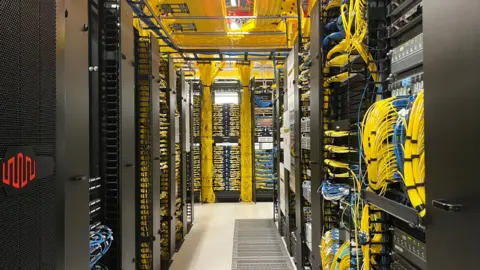
There are about 40 data centres in Slough. In addition to Equinix, companies with centres based in the town include VIRTUS, Kao Data, CyrusOne, Iron Mountain, Virgin Media and NTT Data.
It may seem like an odd choice for the second biggest data hub on earth, but its location and history make it a prime location.
Tyler says: "Slough was, for the past 100-plus years, an industrial area, with lots of factories producing things.
"As those industries faded out there was a lot of power here, and data centres need a lot of power.
"But also what we need is lots of fibre networks to connect all these data centres, and a lot of fibre routes in the UK run through and past Slough."
As a result of its optimal position in the country, Tyler says Slough has grown into a global hub over the last two decades .
Data centres in Slough support approximately 14,000 jobs.
Slough Borough Council, which says it has delivered more centres than any other local authority in the country, has been contacted for comment.
What are the concerns about data centres?
Data centres require huge amounts of electricity to keep thousands of computer servers running around the clock.
They also need powerful cooling systems that require large quantities of water to prevent equipment from overheating, which can put pressure on local infrastructure.
As more data centres are built, some experts have raised concerns about the environmental impact of rising energy demand, and whether the costs of supporting that growth could have knock-on effects for consumers.
Dr Sasha Luccioni, AI and climate lead at machine learning firm Hugging Face, says that in the US "average citizens in places like Ohio are seeing their monthly bills go up by $20 (£15) because of data centres".
She says the UK had an "aggressive" timeline for new data centres and argues that companies should foot the bill for the extra energy rather than consumers.
According to the National Energy System Operator, NESO, the projected growth of data centres in Great Britain could "add up to 71 TWh of electricity demand" in the next 25 years, which it says redoubles the need for clean power - such as offshore wind.
You can follow BBC Berkshire on Facebook, X (Twitter), or Instagram.
