Town that became a national testbed for road safety

 Getty Images
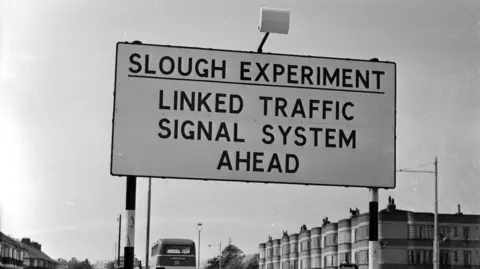
Motorists navigating the busy Crown Corner junction in Slough may be unaware that more than 70 years ago the intersection was at the heart of one of the UK's boldest road safety experiments.
From 1955 to 1957, the Berkshire town was transformed into a living laboratory for ideas that would shape traffic management across the UK.
Linked traffic lights, zebra crossings and even a signal that turned red if someone had died on the roads that week were tested in an effort to save lives.
The prevention of road deaths is a subject close to local historian Jaye Isherwood's heart.
Radio Berkshire's Lorin Bozkurt went to Slough to find out more.
"There was a need to prevent deaths on the roads of Slough, and that relates closely to me, because my own grandmother was run down by a soft drinks lorry that was reversing in Manor Park," said Isherwood.
"It put a mark on our whole family that Slough wasn't the best place and you had to be careful of where you went."
Before the end of World War Two, owning a car was considered a luxury.
By the late 1950s and 1960s, the introduction of affordable cars and increased prosperity led to a boom in mass car ownership.
Around the same time, the population of Slough was growing rapidly.
"At the time, Slough Trading Estate was employing 53,000 people and a huge proportion of them were on bicycle.
"You can imagine around 10,000 bikes cycling from the trading estate to the houses around Slough - it was just causing incredible demands on the infrastructure - and it created a lot of accidents."
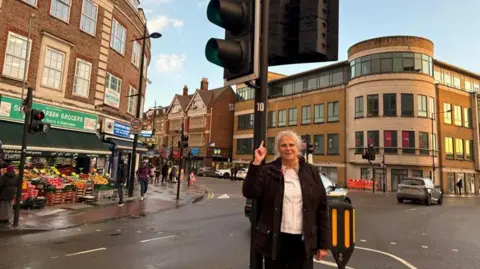
A set of traffic lights stands today at a spot on Crown Corner - during the experiment there stood instead a 25ft pole topped two light beacons, one red and one green.
Isherwood said: "If it was green, it meant there had been no deaths on the roads around Slough in that week. If it had turned red, it meant that someone had been killed on or around the roads of Slough.
"I remember it vividly, walking past it and just hoping that I could see a green light and knowing that Slough was safe that week."
The Slough Experiment consisted of education, enforcement and engineering.
Posters went up, talks were held in schools, cycling and motorbike proficiency classes were introduced along with extra police officers drafted in to enforce the new rules.
Road junctions were re-engineered and the Road Research Laboratory, set up in the Langley area of the town in 1946, was tasked with creating a pedestrian crossing with road markings that were visible in all conditions.
According to a report published in 1957 at the end of the experiment, there had been a reduction of about 10% in fatal accidents and injuries in Slough as a result, said Isherwood.
"The biggest change, in my mind, was in the mindset of the Slough residents," she said.
"We can see elements of the experiment in all towns and cities now, right round the world - the zebra crossing, the linked traffic lights, the 'give way' sign."
As part of the experiment, safety testing for motor vehicles was also introduced, points out the historian, adding: "Of course, we now know that as the MOT test.
"It was a real holistic approach to road safety."
You can follow BBC Berkshire on Facebook, X (Twitter), or Instagram.