Wartime tunnels hidden beneath housing estate

 Graham Rimmell
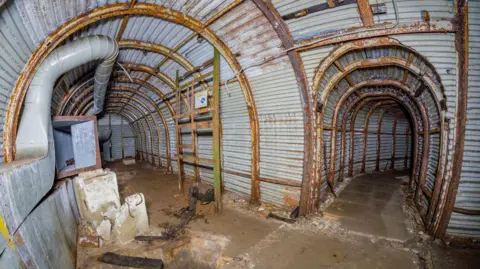
A network of wartime tunnels hidden beneath an East Sussex housing estate once formed one of the Royal Navy's most secret command centres.
The underground complex, known as HMS Forward, which was built into the chalk hillside at South Heighton, near Newhaven, during World War Two, played a vital role in coastal defence and naval intelligence along the English Channel, historian Ian Everest told Secret Sussex.
The site began life as a large holiday home built in 1938, but it was never used for its intended purpose after war broke out the following year.
It was initially taken over by the First Aid Nursing Yeomanry before being requisitioned by the Royal Navy after the fall of Dunkirk in 1940.
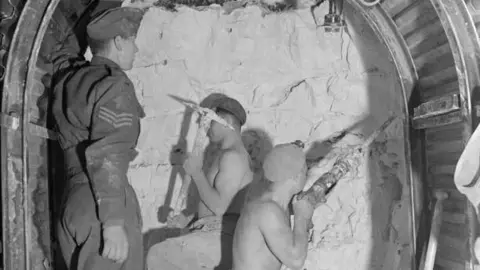
Because of its exposed position on the hilltop, the Navy decided to move operations underground, commissioning the Royal Engineers to excavate a secure command centre beneath the site.
Everest said the network had about 500 yards (457m) of tunnelling, describing it as "quite immense".
The BBC's WW2 People's War archive contains an account of the tunnels by Geoffrey Ellis, Secretary of Friends of HMS Forward.
In it, Ellis revealed how the tunnels remained undetected during World War Two and stayed secret into the 1990s.
Everest said about 6,000 tonnes of chalk were removed to create the underground galleries, which housed plotting rooms, teleprinters, switchboards and communications equipment.
Many members of the Women's Royal Naval Service, known as Wrens, worked below ground, staffing the operations around the clock.
The site acted as a nerve centre for shipping and radar information across the English Channel and was crucial to the wider war effort.
"I would say it was absolutely vital," Everest said.
 Imperial War Museum
The tunnels were sealed after the war and HMS Forward was decommissioned in August 1945.
Because the site had been created under wartime emergency powers, the tunnels were never formally recorded on land documents.
As a result, when housing was later built above the area, many residents were unaware their homes sat over a large underground complex.
Today, the tunnels remain completely inaccessible due to safety concerns.
Everest said HMS Forward had played a significant, but largely unrecognised, role.
He said all the tunnels and galleries had direct communications with all shipping going up and down the Channel, adding: "To a certain extent that it's an untold story."
Follow BBC Sussex on Facebook, on X, and on Instagram. Send your story ideas to southeasttoday@bbc.co.uk or WhatsApp us on 08081 002250.
