'I'm still fighting demons from horror orphanage'

 BBC
BBCWars leave deep scars in the memories of all who have lived through them, but the place that was meant to keep Alan Kelly safe from the bombs became his worst nightmare. Aged 90, he returns to the Lake District orphanage where he spent four years as a child evacuee during World War Two.
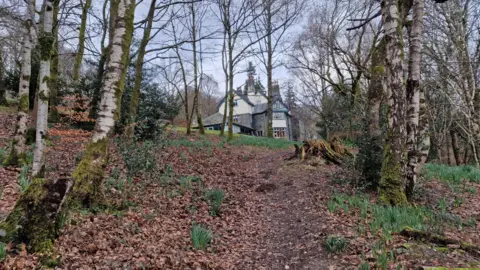
Alan Kelly was taken to Cumbria from Liverpool aged six in 1941 and spent four years at Hawes End, an orphanage on the shores of Derwentwater near Keswick.
"What happened here, people would have been put in prison for it, for the way children were treated," he says.
The memories of what happened still haunt him, led to a rift with his mother and he has spent much of his life trying to forgive her for sending him there.
"My mother didn't know what to do," he says. "My older sister could look after my younger brother, but at that stage could not look after both of us at the same time."
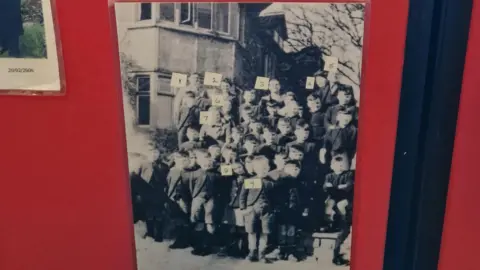
He recalls an institution run by a cruel headmaster Mr Tingle, where letters and gifts from family members were never delivered and where physical punishments were used to discipline children.
"He was a monster," says Kelly. "He took delight in punishing people.
"Our punishments ranged from a slipper to the cane on the backside, to be sent to your dormitory for three days on nothing but bread and water and that was something he seemed, in my opinion, to delight in doing."
Children were awarded points for good behaviour and the prize was a trip to the cinema in Keswick on a Saturday morning.
Kelly only got to go twice and was forced to walk the journey of three and a half miles (5.6km) without a coat.
"If you got wet, you sat through the film for an hour, an hour and a half, soaking wet, dripping and then had to walk back again," he says.
But asking for help was simply not an option, which compounded his sense of isolation.
"What was drummed into us all the time was that you should never talk to a stranger or somebody you don't know - that person could well be a spy."
One of the most traumatising memories was when Mr Tingle mentioned the death of Kelly's father, which had been kept from him for years.
Kelly says: "I was called into his study, his words to me were: 'Kelly, your mother's coming to collect you tomorrow but I don't know why you're going home.
"'Your father's dead, your mother won't know who you are, neither will your sister, nor your younger brother' - that was the first indication I had got of my father being dead."
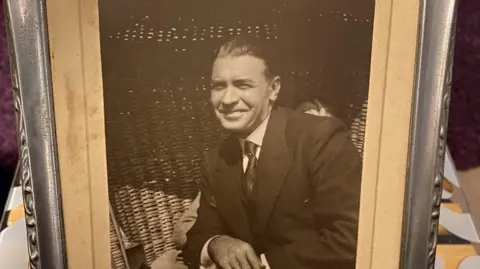
He later discovered his father was on the SS Oropesa and lost his life when the ship was torpedoed in 1941.
Initially, even his mother had not known of his death, which took months to be confirmed to her by officials.
Kelly says: "A lady that was in front of my mother in a shop a few paces was in tears, crying that she'd just heard that she'd lost her son when the ship was sunk.
"Somebody asked her what the name of the ship was - SS Oropesa."
The resentment he felt over his mother not telling him about his father's death meant Kelly was unable to cry at her funeral when she died in 1970.
 Family handout
Hawes End is now an outdoor centre, a place where children come to enjoy themselves.
It has a display about its history and when he first came back to visit some years ago, Kelly told a member of staff he had not been able to forgive his mother.
He says: "Her response to me at that time was, 'do you not think that your mother thought she was doing the best for you at that time?'
"And that had never occurred to me, I was so overcome whenever anyone mentioned my father's death."
He says eventually he came to accept that had been her intention and wrote a letter to her although she had already died, to "rid myself of the demons".
"When I finished the letter, I felt some relief because I got a lot off my chest," he says.
"Ever since then, I regretted I was never able to make amends to my mother."
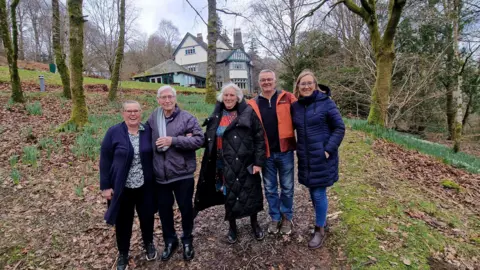
Although this was his second visit to Hawes End in about 25 years, the pain of returning has not lessened, Kelly says.
"I felt I had lost some of my childhood and I would never ever get it back unless I visited those places and tried to get the unhappiness out of my system - it never worked fully, it never will, but at least I tried."
And while the pain will never fully leave him, as he comes across a tree stump, his mind is flooded with the memories of the few happy moments spent here.
The large tree hid the view of the children from the headmaster's office, allowing them brief carefree moments having mud fights and running to the lake's shore.
"I've often thought over the years about the times I spent here, remembering the bad parts, but remembering the beauty.
"The feeling of what I can only describe as love for the area and the beauty of it that has never left my mind at all."
If you have been affected by any of the issues raised in this report, you can seek support through BBC Action Line.
