Storms unearth more World War Two beach defences

 BBC / Luke Walton
Recent storms have revealed more World War Two coastal defences.
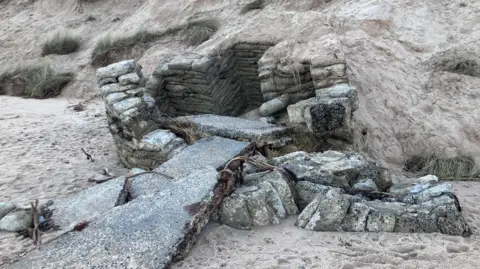
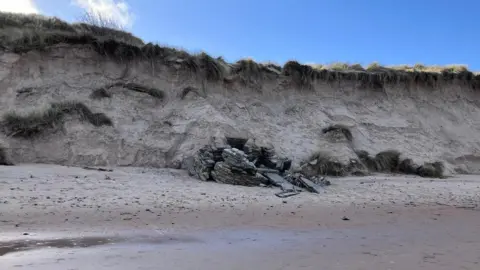
A collapsed beehive-type pillbox was uncovered over the past couple of weeks under shifting sand dunes at Low Newton-by-the Sea in Northumberland.
It would have formed part of a network of coastal defences during the war, providing a sheltered firing position for troops when the east coast of Britain became the "front line" after the evacuation of Dunkirk, the National Trust said.
Archaeologist at the conservation charity Chris Scott said it was not unusual: "We've had a lot of bad weather over the last months, and indeed the winter time is the most common time when features like this become exposed".
The pillbox was made of stacked sandbags filled with concrete, which stuck together as they dried, and topped with a solid concrete top, he said.
Scott said the section of coast was "really dynamic".
"It's changing all the time," he said. "Things can be exposed that we haven't been expecting and they can be just as easily be covered up again by the weather."
 BBC / Luke Walton
Scott said most of the coastal defences in the area were made in 1940, in the aftermath of the evacuation of Dunkirk.
"At that point, the beach in Northumberland, or the whole east coast of England, was the front line," he said.
"The concern was that any time we could face an invasion."
Scott said there were more intact pillboxes elsewhere on the coast that the public could get close to and touch, but he advised people to take care around the collapsed structure.
He said climate change meant natural coastal erosion processes might have been sped up, by more intense or more frequent storms.
"It's a real challenge for us," Scott said of the National Trust, which maintains the land.
There was "lots and lots of archaeology from all different periods" under the dunes, which had not yet been recorded, he said.
The trust was working to record the pillbox and "share what we can learn with people, because, ultimately, archaeology is part of everyone's story", Scott added.
