Bird flu fears after dozens of swans found dead

 Getty Images
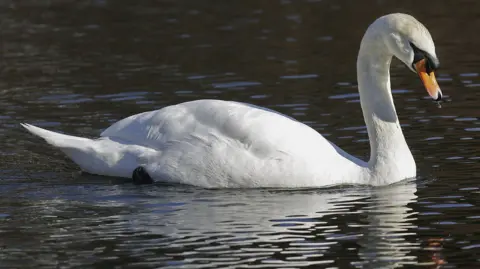
More than 30 swans have been found dead in London's Docklands, with concerns the deaths may be linked to an outbreak of avian flu.
The birds have been recovered from West India and Millwall docks, near Canary Wharf, over the past week. The Canal and River Trust says it is currently "carrying out tests to determine cause of death".
The Animal and Plant Health Agency (APHA) has warned members of the public "not to touch or pick up any dead or visibly sick birds" and to "wash their hands thoroughly with soap and water" if they interact with wild birds.
The Swan Sanctuary charity has been helping to remove the bodies, leaving volunteers feeling "powerless" after the scale of the losses.
'Very lethal and infectious'
Canal & River Trust ecologist Ben Macmillan said: "A specialist contractor has now collected 30 dead birds, all swans, from our waterways in and around West India and Millwall Dock."
He urged the public not to touch dead birds and to report them to the Department for Environment, Food and Rural Affairs (Defra) on 03000 200 301.
Although the virus mainly affects birds, according to the NHS humans can get bird flu through close contact with birds that are infected. It can be fatal but it's very rare in the UK.
Andy Miller, a volunteer at the Swan Sanctuary, said: "There was a previous wave of bird flu a couple of years ago. We don't know to what extent that affected Docklands here but it certainly wasn't as intense.
"The current strain is very lethal and infectious and it seems to be particularly affecting the young Cygnus that were born earlier on this spring."
 TOLGA AKMEN/EPA/Shutterstock
While suspected cases have been reported further up the River Thames, Miller said the concentration and speed of deaths in the Docklands area seemed to be more intense over "a fairly short period".
Identifying infected birds can be difficult. Miller said lethargy is the main symptom, but birds affected by the current strain often develop a "twitch or tremor" or begin to "start going around in circles".
He also cautioned that feeding birds by hand could increase the risk of transmission.
What is bird flu?
According to the RSPB, avian flu is a virus that affects both poultry and wild birds. There are multiple strains and most cause little or no illness in wild birds.
The current outbreak involves a strain of Highly Pathogenic Avian Influenza, which can cause severe disease and high death rates.
It has significantly affected wild bird populations across the UK since summer 2021.
The strain was first detected in intensive poultry farming in Asia in 1996 before spreading to wild birds.
In humans, symptoms of bird flu usually start about four to six days after being in contact with an infected bird.
The NHS lists the symptoms as having a temperature (hot, cold or shivery), cough, sore throat, wheezing, sneezing, runny or blocked nose, shortness of breath and sore eyes.
It advises people who have been in contact with an infected bird, or someone with bird flu to call 111.
The swan deaths have taken an emotional toll on rescuers. Miller said: "It really is pretty awful to be honest with you.
"There's lots of stress, but there's no real prospect of being able to do anything. That's the worst thing. The worst thing is feeling powerless."
He said the charity is pushing for the bodies to be collected for further research into the disease.
An APHA spokesperson said it is investigating the death as part of the agency's dead wild bird surveillance scheme.
The main causes of transmission to poultry and captive birds include contact with wild birds as well as faeces from infected birds and contaminated footwear, clothing, vehicles or equipment.
Members of the public are encouraged to report dead wild birds via Defra's online system or helpline, which helps APHA track the spread of the virus.
Listen to the best of BBC Radio London on Sounds and follow BBC London on Facebook, X and Instagram. Send your story ideas to hello.bbclondon@bbc.co.uk
