Six key takeaways from the hospitals inquiry

 BBC
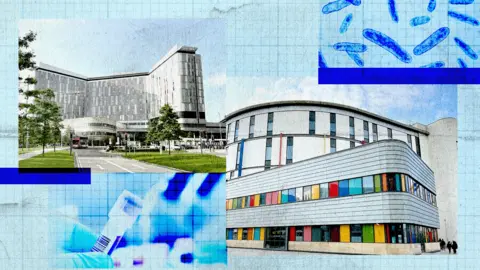
BBCThe Scottish Hospitals Inquiry is drawing to a close, with the key participants making final submissions before a report is published, probably later this year.
The public inquiry was ordered in 2019 after a number of deaths and high levels of infection at Glasgow's flagship Queen Elizabeth University Hospital (QEUH) campus prompted concerns about patient safety.
In particular, attention focused on the Royal Hospital for Children where immune-compromised young people were being treated for blood disorders and cancer.
Among the patients who died was 10-year-old Milly Main, who acquired an infection while in remission for leukaemia, and 84 children were infected.
The inquiry, which is looking at the design, build, commissioning and maintenance of the hospital and their impact on patient safety, has heard from 186 witnesses.
We now have a clearer, but still disputed, picture of what went wrong.
1. The water system 'probably' caused infections
During the earlier hearings, NHS Greater Glasgow and Clyde (NHSGGC), which is responsible for the hospital, took the position that infection rates were not abnormally high, and therefore it could not be concluded there was a problem with the buildings.
But in a dramatic U-turn, in its final submission it said it now accepted this was not the case.
It now says it is "more likely than not" that some infections at the children's hospital were caused by problems with the water system.
In August 2024, it had presented its own commissioned report - known as the HAD report after the initials of its authors - which found there was no excess infection risk, completely at odds with other expert testimony.
This late submission was initially rejected by the inquiry but NHSGGC went to the Court of Session to get this overturned.
However, it now says oral evidence from the hearings have corrected "earlier errors" and provided more information.
As a result, it now accepts that the rate of infections was unusually high between 2016 and 2018 when changes were made to the water system.
The high infection rates then started to fall.
2. The hospital was opened before it was ready
The health board accepts that many aspects of the design, build and commissioning of the hospital campus were flawed and says there is legal action against the main building contractor Multiplex to try to recover £90m.
"NHSGGC did not receive the building it asked or paid for," it says.
Multiplex has previously said in evidence that infection problems arose because of design choices by the health board or poor maintenance.
NHSGGC accepts there was poor supervision of contractors and a lack of in-house expertise, including at board level, for a project of such complexity.
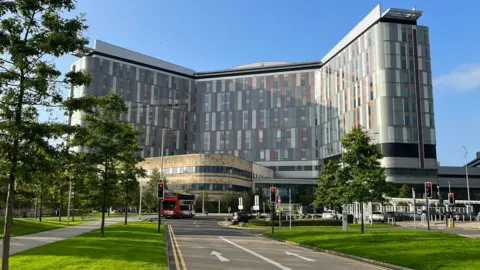
When the campus opened to patients in 2015 it says there were still 200 contractors on site and the hospital's facilities staff were under extreme pressure to manage a situation "not of their making".
It accepted there were too few people employed to rise to the challenge, and a request for extra staff was turned down.
And during the first three years after opening, the buildings were not adequately maintained, it says.
NHSGGC says there was pressure to deliver the project on-time and on-budget, and it is now clear the building opened too early, before it was ready.
It gave as an example that there were no hepa filters - which remove airborne particles - fitted inside the filter casings on Ward 2A, which treated children with cancer and blood disorders.
This was immediately rectified but should not have happened, it said.
3. Disagreements over whether hospital is now safe
The health board says that both hospitals on the QEUH campus are now safe.
They have a bespoke water testing and treatment regime as well as air monitoring that is more rigorous than any other hospital in the UK, it says.
While it admits it previously failed to provide clinicians and other staff with the best possible working environment, it says it has taken adequate remedial action.
"There can be no doubt that the QEUH/RHC is safe," it said in its final submission.
While the health board now accepts there were issues with the water system, it says the impact of ventilation failings on patient safety remains subject to debate.
It claims evidence presented to the inquiry supports its view that proximity to the Shieldhall sewage works may have led to unpleasant smells but did not harm patients.
While it accepts that the ventilation system still does not comply with a national engineering and safety standard, it says that does not necessarily mean it is unsafe.
It argues there are other ways of managing the infection risk, such as frequent air testing, cleaning and other infection management measures.
Lawyers for the inquiry disagree, claiming that while the ventilation might be safe for most patients, there are some areas where it could potentially be "unsafe for some patients in certain circumstances".
They have previously said that bringing rooms up to the national standard may be "practically impossible" without replacing entire air handling units.
They also question why the health board has only admitted problems with the water system until 2018 rather than until late 2020 when infection levels returned to normal.
4. Was there a cover-up?
NHSGGC insists there was no attempt of a cover-up, just "failures of communication".
It argues that it is "inherently unlikely" that healthcare professionals, who have dedicated their lives to patient care, would behave in such a way.
While it accepts there were "shortcomings" in its communications with patients and their families, it denies this was a deliberate attempt to conceal things.
It says it did not want to cause needless anxiety so only told them things it was certain were true - but it accepts this led to a breakdown of trust.
However, the KCs for the inquiry - whose role is to act in the public interest and uncover the truth - do not accept the health board's assertion that professionals are unlikely to engage in a cover-up.
They say there are plenty of historical examples where this has happened.
In their final submission, they say it cannot be ruled out that some deliberate suppression of evidence may have occurred.
5. Whistleblowers were treated badly
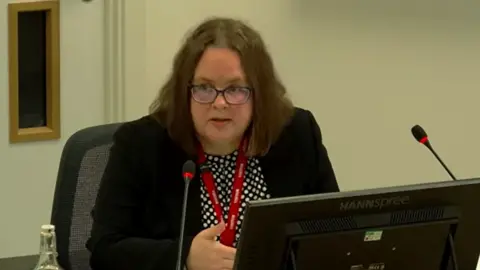
During the hearings, lawyers for the health board downplayed concerns raised by microbiologist Teresa Inkster and other "whistleblowers".
NHSGGC now accepts this was "unfair".
Inkster repeatedly raised the alarm about water supply and ventilation with managers before the scandal became public - and was told not to speak at infection control meetings.
Another microbiologist said colleagues in effect told her to "pipe down".
 Scottish Hospitals Inquiry
The health board says the treatment of whistleblowers fell "far below the standard expected" and this had a significant impact on their wellbeing.
The new chief executive of NHSGGC Prof Jann Gardner - who took over from Jane Grant early last year - has already apologised to them for the fact that they did not feel "listened to".
The health board repeats this apology in its written submission.
In its defence, it says Scottish NHS whistleblowing procedures were not well-developed at the time with national standards not introduced until 2021.
NHSGGC says it has taken steps to improve things so that staff feel "supported and empowered" to raise concerns.
6. What else is in the final submissions?
The inquiry's legal team say the hospital's built environment - particularly the water and ventilation systems - did make a material contribution to bloodstream infections among young patients between 2016 and late 2020
They are very critical of the health board's internal culture and the failure to properly investigate staff concerns.
Microbiologists were raising concerns from 2015 onwards about various risks but the warnings were not acted upon, they say.
Three of those microbiologists also made a submission, detailing how they repeatedly warned about water-borne bacteria and issues with Bone Marrow Transplant ventilation systems for both adults and children.
They say there were major structural risks but their warnings were met with a culture of defensive management.

The Scottish government says it broadly agrees with criticism of the internal culture.
Ministers say they had plans to conduct a Scotland-wide review of health board governance but this was interrupted by Covid.
They have also promised funding to implement recommendations, such as improving the role of estates teams in the development of projects.
Two affected families - the Cuddihy and MacKay families - whose evidence was important to the inquiry, submitted statements about the human impact.
Molly Cuddihy died last year at the age of 23, seven years after she acquired an infection while undergoing treatment as a teenager.
Her father John has told BBC Scotland News that NHS bosses ignored warnings for years, and he is saddened she is not alive to hear the health board's admission about the water system.
