Families challenge Swinney over hospital apology claim
Families whose loved ones died or were harmed by infections at Scotland's biggest hospital have disputed John Swinney's claim that he has apologised to them.
In a BBC interview the first minister, when asked if he apologised to the relatives during an online call on Thursday, replied: "Of course I did, yes".
The comment surprised families of patients at the Queen Elizabeth University Hospital (QEUH) campus who have issued a statement saying no formal apology was given.
In a clarification Swinney said he may not have "communicated effectively" during an emotional meeting but wished to be "crystal clear" that he was "sorry for the issues they have experienced at the QEUH".
The BBC has established that Swinney did use the word "apology" in his opening remarks at the meeting, but it referred to "the fact that on a number of questions we have not met your expectations or delivered the solutions that you would have wished to have seen".
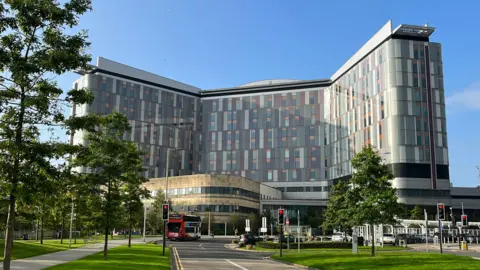
The QEUH campus, which includes the Royal Hospital for Children, became Scotland's largest health facility when it opened in 2015.
But within a few years it emerged that a number of cancer patients had died and many others became more unwell after contracting infections during treatment. Many concerns have focused on the water and ventilation systems.
In an interview for Sunday with Laura Kuenssberg, Swinney denied that SNP ministers failed to respond quickly enough to "red flags".
He pointed out that the government announced the Scottish Hospitals Inquiry in 2019 which is looking into the design, construction, commissioning and maintenance of the buildings and their impact on patients.

On Thursday, Swinney along with Health Secretary Neil Gray and senior NHS officials held a private 90-minute online meeting with families who continue to have concerns about the safety of the hospital.
Asked what he told them, Swinney said he expressed his "regret for the experiences of families and in some cases for the loss of children".
But Swinney added: "I said to the families that fundamentally I believe the hospital is a safe hospital on the basis of all of the data that I have available to me.
"But we have a public inquiry that is looking at the original construction and development of the hospital and the issues that have emerged as a consequence.
"It's important that I leave that inquiry, the adequate space, to come to its conclusions."
Pressed on whether he apologised to the families, he said: "Of course I did, yes".
The interview, when it was broadcast on Sunday, prompted a backlash from relatives who said they had heard no such apology at the meeting.
In a statement they said: "Despite the gravity of the discussions, at no point during the session was a formal apology offered by either the first minister or the cabinet secretary.
"The meeting was intended to provide a platform for those affected to seek transparency and acknowledgment of the hardships endured."
While welcoming the meeting as a positive opportunity, they said "the absence of an apology has been noted as a significant oversight in the pursuit of meaningful reconciliation and justice".
They continued: "This morning the first minister said to Laura Kuenssberg that he offered the families an apology during this meeting. We can confirm that this simply never happened."
In response, Swinney issued a statement saying he had expressed his "sincere sorrow and regret" during a "long, and at times emotional, call with families".
He continued: "It was primarily an opportunity for them to tell me their experiences and for me to listen but I also tried to communicate to them how sorry I was about their experiences.
"I have obviously not communicated that effectively so I want to be crystal clear today. I am deeply sorry for the issues they have experienced at the QEUH and all that families have gone through.
"Their pain, trauma and suffering is unimaginable and I have said the conversation on Thursday was the start of a wider discussion to help families get the answers they deserve, beyond the work of the Scottish Hospitals Inquiry."
Swinney was asked repeatedly during the BBC interview whether the hospital had received a full set of safety validations for every ward and unit, a question that opposition parties have also been asking.
He did not appear to give a clear answer, but said: "What I'm saying to you is that essentially that work has been undertaken on an ongoing basis to make sure the hospital is safe.
"And in the course of the public inquiry there were specific examples of water analysis and ventilation system analysis that gave greater levels of confidence about the safety of the hospital."
Recently details have emerged of a new infection alert at an adult bone marrow transplant ward where some rooms have been sealed off due to water ingress and concern about mould.
Swinney told the Scottish Parliament last week that the "red" alert status reflected heightened public concern rather than an "increased clinical risk to patients".
He told Laura Kuenssberg that when new problems arose, his government, through NHS Greater Glasgow and Clyde, was addressing those issues.
In its closing submission to the public inquiry in January, the health board for the first time admitted that problems with the water system probably caused infections of some patients being treated at the children's hospital.
During the hearings it emerged that aspects of both the installed water and ventilation systems had not met national technical standards.
The health board says it has put mitigations, including bespoke cleaning regimes and other infection control measures, in place to reduce risks.
Representatives of affected families have been offered dedicated seats on a new Safety and Public Confidence Oversight Group set up by the government with the aim of restoring public trust.
The public inquiry, under Lord Brodie, has concluded taking evidence and is considering its findings.
