'I was healthy - why did I have a heart attack?'

 Bristish Heart Foundation
A "fit and healthy" man who survived a heart attack is helping to break down the "misleading" myths surrounding cardiovascular disease.
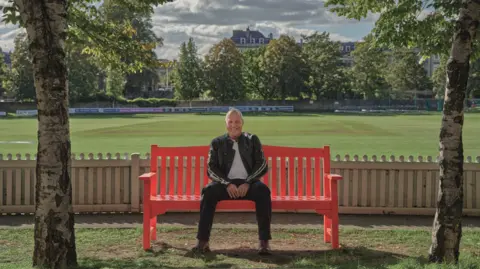
Lee Paxton, 63, who has had a red bench dedicated to him by the British Heart Foundation (BHF), said his initial reaction to the attack was to wonder what he had "done wrong to deserve it".
"I've been quite a fit and healthy man all my life, always eaten a good diet and never smoked. I thought all that good work that I've done put me in good stead," said Paxton, who lives in Amesbury, Wiltshire.
New research by the BHF shows half of the people living with the disease felt judged or embarrassed, with a third saying others assumed it was self-inflicted.
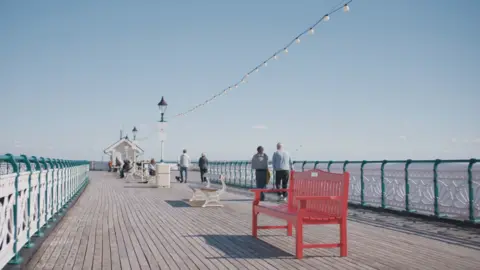
The charity marked its 65th anniversary by unveiling 65 benches across the UK - including in Wiltshire - each dedicated to a heart disease survivor to encourage conversations about the disease.
There are 840,000 people living with cardiovascular disease in the South West of England, according to the BHF.
Paxton is one of those who survived an attack, caused by the disease, whilst at work in October 2024.
"The first sign was that I got incredibly hot and I started sweating profusely; I thought, there's something not right here," he said.
He tried to get the attention of a colleague, who asked if he was alright.
"I said, 'no I'm not', and with that I had a pain in my chest and just literally it was like a bomb went off. It radiated out across my two shoulders.
"It was so severe, it pretty much incapacitated me instantly," he said.
The project manager had to wait more than an hour for an ambulance, during which time he was conscious but had "completely lost" the use of his body.
"My next vivid memory was being in the cardiac suite [at Salisbury District Hospital] and the stent being inserted and expanded," he remembers.
"Then just 20 minutes later, I was fully aware, fully conscious, sat up and chatting to staff."
 Lee Paxton
Paxton said he felt grateful to have survived, but realised that not only were there physical effects due to damage to the heart, but also psychological effects.
"When I look back now and think about the possible consequences, and the impact that would have had on the people that care about me, then that is quite frightening," he said.
"There was an embarrassment because I think there's this preconception, which is misleading, that a heart attack victim is somebody that's overweight, has smoked all their life, has a bad diet and doesn't exercise.
"When I understood exactly the type of heart attack I survived - which the Americans very nicely phrase as a 'widow-maker' because it's got a 90% mortality rate - I actually then changed my attitude," he told BBC Radio Wiltshire.
 Bristish Heart Foundation
Senior cardiac nurse at BHF June Davison said stereotypes around heart disease patients can be misleading, causing mental health problems and difficulties in personal relationships.
"We know that older people get heart disease but there are many cases where a child is born with a heart problem or somebody has a genetic predisposition, so it isn't always the things you are in control of," she added.
She said the idea of the red benches was to "flip the memorial bench concept to celebrate lives lived, not lost".
"We want to show that actually talking about it and changing misconceptions can be really helpful for survivors to cope with the everyday kind of emotional challenges," she added.
Paxton said he felt it was sometimes difficult for family and friends to really comprehend what happened to him, as he still looks the same.
"I don't want it to define me, but it does.
"It's definitely changed my outlook on life; my eyes are now open to the beauty of where I live.
"I hope people might sit on my bench and be curious to look into the individual stories of survivors, and find out about the work of the British Heart Foundation," he added.
Follow BBC Wiltshire on Facebook, X and Instagram. Send your story ideas to us on email or via WhatsApp on 0800 313 4630.
