Woman tackling CPR taboo calls for female manikins

 Chloe Lipton
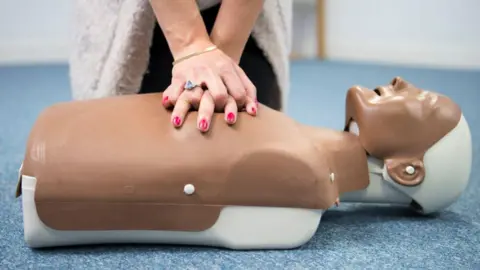
A campaigner says she is calling for female manikins to be mandatory in CPR and defibrillator training because she does not want women to become statistics.
Chloe Lipton, 29, from Hertsmere, Hertfordshire, said studies into the survival rates of women compared to men after a heart attack had "really hit home".
Research part-funded by the British Heart Foundation suggested more than 8,200 women in England and Wales could have survived if they were given the same quality of treatment as men.
Lipton said: "I've got a mother, I've got a sister, I've got friends who are women. [I'm] thinking, 'God, if something happened to one of them', the idea that somebody would hesitate is horrifying."
Lipton, an engineer who aims to make Science, Technology, Engineering and Maths (STEM) more accessible, has started a petition, which already has more than 8,600 signatures.
It calls for the government to work with organisations to update training standards so accredited CPR and first aid courses practice on both male and female manikins.
CPR stands for cardiopulmonary resuscitation, a life-saving technique that involves giving chest compressions.
She said: "This is about saving women's lives and it's such a simple, easy change for such a huge reward.
"I've done first aid on so many occasions... but I never really clocked I'd never practiced on a female manikin."
 Getty Images
Research published in the European Heart Journal in 2019 found only 68% of women were likely to receive CPR from a bystander compared to 73% of men.
It said a contributory factor was people not recognising a woman who had collapsed had been having a cardiac arrest.
Lipton said: "Looking at the reasons that women don't receive CPR as often as men, [there] is this misconception that heart attacks are a male thing.
"If you ask me to picture someone having a heart attack, I don't know about you, but I'd instantly picture a man.
"Practicing on a female manikin ingrains in you this idea that you would be just as likely to do CPR on a man or woman."
She said there were still "huge misconceptions" and concerns regarding consent and "phantom fear" fuelled by misinformation.
When using a defibrillator, the advice is to remove a person's bra.
Lipton said she believed undressing someone in public had been another "mental barrier" [to giving women first aid] where people had been "too hesitant or ginger".
'Increase confidence'
In 2025, she wrote to the Conservative MP for Hertsmere, Oliver Dowden, who took her concerns to the Department of Health and Social Care (DHSC).
In a letter DHSC said: "NHS England runs training sessions on first aid, CPR and the use of defibrillators both in the community and in schools (as part of the Restart a Heart programme).
"This training should help increase confidence in performing CPR on women."
DHSC said 35,800 adults and children had been trained in CPR and defibrillation in the last 13 years including 2,100 of these in 2025 alone.
But Lipton said she felt she had been "dismissed", and felt the message of representation had been missed.
She said: "It felt like it wasn't really being taken seriously by them, which for me is a kind of reflection of the bigger view around a lot of gender discrepancies in healthcare.
"It's really motivated me to push this issue harder... it's going to have to come from us, from women, from society."
 Jamie Niblock/BBC
In 2025, the East Anglian Air Ambulance (EAAA) introduced six female manikins for training.
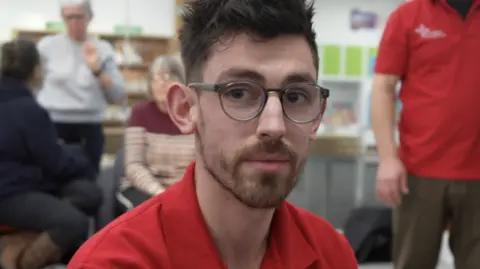
Josh Lawrence, EAAA's community CPR training manager, said: "The purpose of the manikins is to raise awareness of this disparity, and to remove the fear that someone may have of performing chest compressions and removing a bra in order to apply a defibrillator correctly when someone has breasts.
He said EAAA welcomed "opportunities for open and honest conversations" so that "more lives can be saved — regardless of gender".
Follow Beds, Herts and Bucks news on BBC Sounds, Facebook, Instagram and X.
