'Burnout brought me to my knees - walking saved my life'

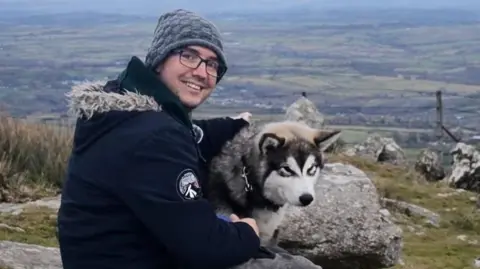 Dean Cooper
After stress, addiction and a near‑fatal collapse, a father-of-two has managed to rebuild his life by walking Cornwall's country lanes. Now thousands follow his "street therapy" journey online for inspiration on burnout recovery and mental health support.
Dean Cooper was working in IT, commuting from his home in the south-west of England to Scotland - a 500‑mile (805km) round trip that was taking its toll.
The pressure of the job had led him to drink. He was keeping going, but felt his life was eroding.
Crisis came during one of his journeys with his wife and two children.
He told his wife they had to stop so he could lie on the road, convinced he was dying.
"It was a moment of burnout when my body just collapsed on itself," he said. "Everything was sweat, palpitations and panic."
On their way to hospital, with a crushing weight on his chest, Cooper could feel his children's hands in his.
"My son was nine at the time and my daughter was five," he said. "They put their hands into mine and looked down on me and said: 'Don't go anywhere'.
"I had to promise to them I wouldn't die."
Later in A&E, he kept replaying that promise.
"The weight of the hands of my children was more than the weight on my chest. That was my change moment," he said.
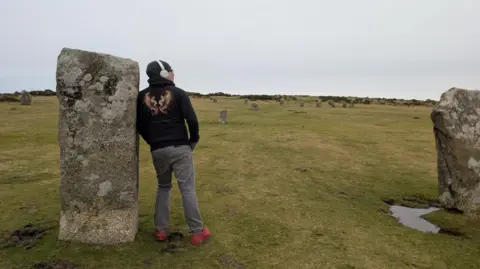 Dean Cooper
Cooper, 46, who lives in Lewannick, Cornwall, now shares his story of being "brought to his knees" by burnout and his path to recovery.
Diagnoses of burnout hit an all-time high in 2024, with more than a third of adults reporting feeling fatigue most or all of the time.
Looking back to the day in A&E, he said he had been extremely close to a full heart attack: "Not inches, feet or miles away - more like millimetres.
"It was the result of the life I was living: constant stress, pressure, burnout, drinking heavily, pushing too hard for too long and not listening to the signs."
Since then, he has been diagnosed with vascular heart disease, manages high blood pressure, carries angina spray and takes daily heart medication.
Now a successful IT director and entrepreneur, Cooper said the crisis was fuelled by long‑held pressures.
"Living up to labels played a big part. I remember being told at school that I would end up sweeping floors in a factory and that I just shouldn't bother with education," he said.
That stayed with him.
"It's that one pebble of doubt that the rest of your life is teetering on," he said.
"I built a life on a problem, and I couldn't fix it. I kept building but my foundations weren't stable."
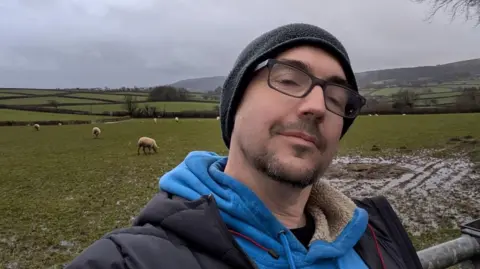 Dean Cooper
After the heart attack scare, he knew things had to change.
"I literally just started walking," he said.
"At first it was in the house as I couldn't go much further given the stress my heart had been through.
"I lost four stone [25kg] walking up and down the corridors before I felt brave enough to go outside.
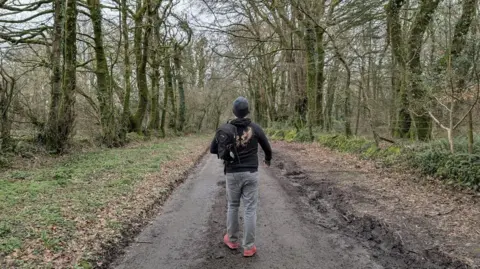
"The country lanes of Cornwall became my recovery playground."
How walking can help
Walking for mental health - especially walking in nature - is one of the recognised treatments for stress.
Just 30 minutes of walking every day can boost a person's mood and improve their health, according to the National Institute of Mental Health.
Cooper walked around Lewannick, then the moors, and then along the South West coastline. Every pause became part of the healing.
"One of my favourite places is up on the Cheesewring on the moors," he said.
"Sitting on the rocks, looking out across the vastness, seeing the roads below and knowing that somewhere out there are thousands of people - each with their own story, their own struggle, their own journey."
He said nature brought clarity: "Einstein said clarity comes from nature and it did.
"I took to social media to share my thoughts. I felt free... I found my zen."
So now Cooper walks and talks, recording his reflections and sharing them online as a self‑styled street therapist, using the name Icarus - symbolising ambition, and the danger of ignoring warnings.
He said everyone had their own personal sun they had flown too close to.
As he opened up, so did others.
"I've heard from people who have lost their homes, from men who have historically been silent," he said.
One follower said: "He is a living example of what life can look like on the other side when you refuse to give up."
Another wrote: "My children still have a dad because of you."
 Dean Cooper
Cooper said he hoped street therapy could be recognised as a life coaching method.
"I've written about the gaps I see in how we sometimes over-clinicalise people and miss the human part," he said.
He said he wanted to collaborate with mental health groups such as Man Down and initiatives like Parkrun.
"At the end of the day... I'm nobody, but I can tell you what I would do," he said.
"We've all had pain but it's important to remember we all have sunrises too.
"Have I recovered? I'm just different, now. And I know you have to end a chapter to begin another."
What is burnout?
Burnout is recognised by the World Health Organization as an "occupational phenomenon".
It is seen to resulting from chronic workplace stress that has not been successfully managed.
Dr Rachel Sumner, a psychobiologist at the University of Bristol, said burnout was "a response to prolonged, unmanaged occupational stress".
"While a lot of us feel stressed from work, burnout involves a very specific set of symptoms," she said.
"It tends to start with feelings of emotional exhaustion, making people feel physically and mentally drained.
"Over time, this is accompanied by feelings of inadequacy - where people feel that they can neither be, nor do enough to achieve what they want to, and an increase in cynicism towards work and life - where someone might start withdrawing from their work or even other people."
She said burnout could be "very destructive" and took a "huge toll on mental health, mood, and behaviour".
"It can create a negative cycle that can be hard to break," she said.
"Some people might self-medicate with alcohol or drugs to help manage their burnout, but this often makes things far worse - adding other stressors, worries, and feelings of exhaustion to their load.
"We've known about burnout for a long time, but - importantly - it's something that's being talked about more these days."
Follow BBC Cornwall on X, Facebook and Instagram. Send your story ideas to spotlight@bbc.co.uk.
