Why do the Northern Lights keep appearing?

 Sumutd1985/Weather Watchers
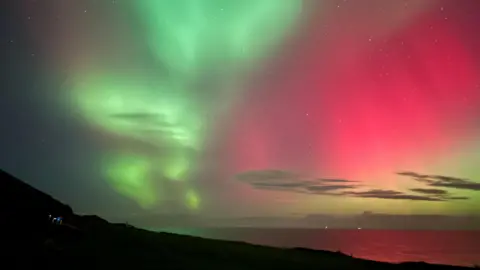
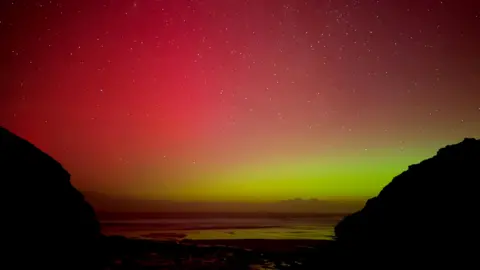
The Northern Lights have lit up skies across Devon, Cornwall and the Channel Islands twice in a week.
Experts explain why it's happening, how solar maximum affects auroras - and whether we could see more.
What's behind the aurora surge?
The lights were caused by Coronal Mass Ejections from the sun, said Elaine Mahy, from the Astronomy Section of La Societe Guernesiaise - a Guernsey group dedicated to the study and conservation of the natural world as well as historic buildings.
"[Coronal Mass Ejections are] charged particles which are kind of exploded out from the surface of the Sun and you get more of those near solar maximum.
"So when the sunspot cycle has lots of sunspots you get more solar flares and coronal mass ejections and it's the latter which causes the aurora as those particles interact with our atmosphere and magnetic field."
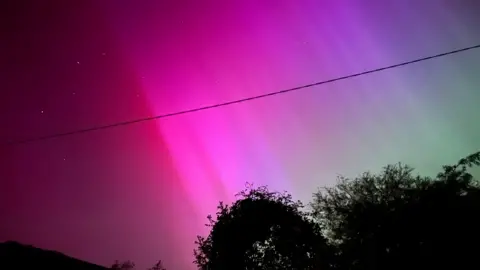
The reason we have seen more recently is due to the Sun being at the "maximum" of its 11-year solar cycle.
A solar cycle is the sun's transition from one solar maximum to the next and is measured through the number of visible sunspots on the surface of the sun, the Met Office said.
Mahy added: "If it's a stronger cycle it tends to be a shorter cycle.
"If it's a weaker one a slightly longer one.
"Although they can try and predict, it's not always very easy to predict so they're never sure when you're in the maximum or you're past the maximum.
"We're still in a very strong part of it now."
Can we predict the Northern Lights?
BBC South West senior broadcast meteorologist David Braine said the years 2025 and 2026 are "believed to be the peak for 'solar cycle 25'".
He said: "National Oceanic and Atmospheric Administration's Space Weather Prediction Centre and NASA, based on the published solar cycle 25 predictions, concluded that solar cycle 25 will be very similar to solar cycle 24."
He added: "They anticipate that the solar cycle maximum is happening now and that the solar minima in about five years' time could be long and deep.
"The next maximum solar activity could be as far away as 2037 -11 years from now."
 Shedders/Weather Watchers
The Met Office said forecasting space weather involved "combining scientific observations, modelling techniques and expert analysis".
The forecaster said it used data from solar monitoring satellites, ground-based observatories and international partners to "build a detailed picture of solar and geophysical conditions".
How far south can the aurora be seen?
Braine explained why the dazzling lights can be seen as far south as the Channel Islands.
"The reason we are seeing them so far south and with so much intensity is that as the sun reaches its maximum activity it produces the most powerful and frequent geomagnetic storms, and if they are directed towards earth they create the Northern Lights," he said.
"Whilst many of these magnetic storms are not visible with the naked eye, they can be picked up with modern phone cameras and photographic equipment."
Where to see the Northern Lights in the South West?
 Jo Shreeve/Weather Watchers
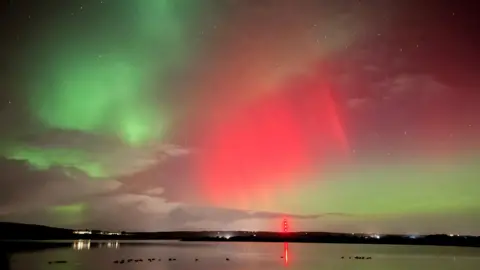
Braine said the South West's dark sky status sites mean there are a number of places the lights can be seen.
"To see them without a camera then its best to be as far away from light pollution as possible and to head for our dark sky status sites," he said.
Dark sky status is given to an area when there is not a lot of light pollution from major cities and people can see clearly into the stars above.
Here are some of the places in Devon and Cornwall which have dark sky status:
- West Penwith International Dark Sky Park
- Exmoor National Park (International Dark Sky Reserve)
- Bodmin Moor International Dark Sky Landscape (top areas include Colliford Lake, Siblyback Lake, and the Hurlers Car Park in Minions)
- Dartmoor National Park
How to maximise chances of seeing the Northern Lights
- Check alerts from the Met Office Space Weather service
- Head to a dark area away from city lights
- Look north
- Use a long‑exposure phone camera - even weak auroras can show up
Follow BBC Guernsey on X and Facebook. Follow BBC Jersey on X and Facebook. Send your story ideas to [email protected].
