Deluge of rain fills reservoirs after dry summer

 Getty Images
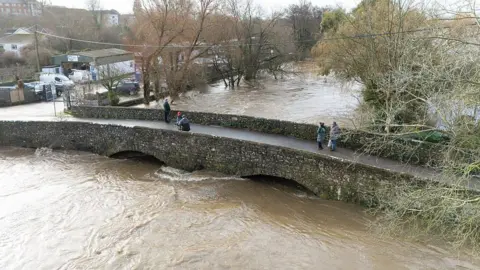
Relentless January rainfall and three named storms have topped up key reservoirs in Devon and Cornwall. The deluge has left South West Water "confident" about supplies heading into summer - but there are still concerns the network remains vulnerable.
South West Water (SWW) said as of Thursday total water levels across its network hit 91.4% full.
Devon and Cornwall's three strategic reservoirs - Roadford, Wimbleball and Colliford - have respectively reached 94.9%, 94% and 78% capacity.
Paul Merchant, SWW's senior water resources manager, said the rate of recovery was "unusually high" compared to a normal year.
"Many of our reservoirs were relatively depleted after a dry summer," he said.
"What we'd always hope for is a nice bit of rain to recover and we've certainly received that."
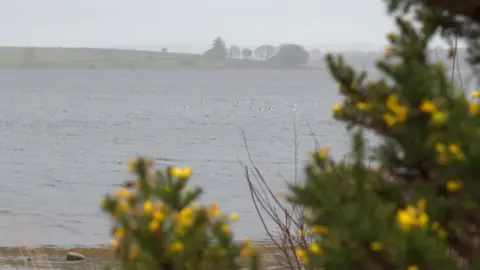
The region experienced a major drought in 2022, bringing the first hosepipe ban in Cornwall in 26 years and raising concerns about the resilience of water supplies.
Another dry summer in 2025 meant there was "a bit of a deficit" to make up this winter, said Merchant.
But he said the amount of water dumped into reservoirs made him "confident we are in a very good position" heading into summer.
Exceptionally wet January
Three named storms in January brought double the normal monthly rainfall to many places and resulted in Cornwall's wettest January since 1836.
According to the Met Office 230mm has fallen at Mountbatten in Plymouth - more than double the monthly average of 110mm.
About 202mm has fallen at Exeter Airport, where January rainfall is normally 85mm.
Bodmin in Cornwall has so far received 290mm of rainfall this year - nearly double the January average of 155mm, the weather office said.
Water levels at Roadford, Wimbleball and Colliford were at 84%, 74.3% and 65.4% respectively since the start of the year, according to SWW.
 Getty Images
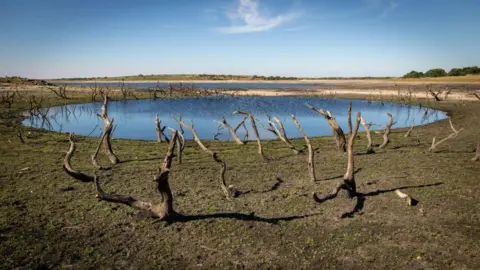
"There's certainly been a sudden jump over the most recent weeks," said water campaigner Jim Hunt, who monitors water levels.
He noted Colliford - the largest of SWW's reservoirs in Cornwall - "still has a long way to go to get to 100%" and "no-one can be sure" of the level of rainfall for the rest of the year.
Ofwat, the water regulator for England and Wales, found SWW was "undoubtedly underprepared" for the 2022 drought but had since taken "urgent action" to ensure resilience.
Alastair Chisholm, the director of policy at the Chartered Institution of Water and Environmental Management, said: "The risk is still there.
"We've seen some pretty tight situations come mid-summer because of a very, very dry spring and early summer," he said.
"It's fair to say given the changes around climate change and the extremes associated with that we can't work on the basis the events we've seen in 2022 and 2025 are abnormal.
"Even though you're getting circumstances of reservoirs filling quite well, we can't rely on it being enough."
Drought resilience plans
Hunt urged SWW to take more action to prevent such a scenario occurring again.
He said it sounded like the firm was "kicking the can down the road, crossing their fingers that we don't have a dry spring and summer".
"They have dodged a bullet the past two summers," he said.
One of the strategies explored by the firm was to build a desalination plant in Par in the St Austell Bay area of Cornwall but it has since been delayed amid objections raised over concerns for marine life.
Merchant said desalination was "still on the cards... but what the period since 2022 has enabled us to do is actually take a step back and consider how we actually get that across the line".
"It remains an option, but there are also other options on the table," he said.
Merchant said other approaches such as pump schemes - where water is pumped from rivers to top up reservoirs - were under way and detailed in its water resources management plan.
"As well as that inflow, if we can reduce the amount we have to take from reservoirs, that means there is more available in the summer," he said.
On the likelihood of a hosepipe ban in summer, the water boss said: "I am very confident we are in a very good position.
"I'm not hand on heart going to rule it out entirely, because let's see what the climate delivers to us next summer."
Follow BBC Cornwall on X, Facebook and Instagram. Send your story ideas to spotlight@bbc.co.uk.
