Nuclear site's princely burial reveals more secrets

 OCA
OCA"If anyone says they don't get excited about finding a sword, they're definitely lying," archaeologist Len Middleton says.
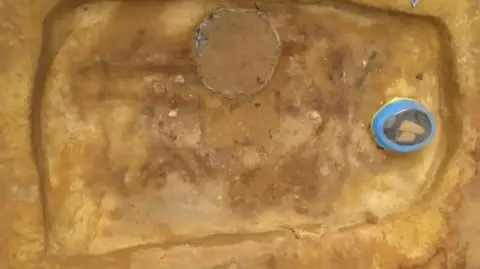
He has been on the team that has discovered a "princely" grave of a horse buried alongside two people, which was revealed on Monday.
The excavation is one of many that have been carried out by Oxford Cotswold Archaeology (OCA) ahead of the building of the Sizewell C nuclear power plant, near Leiston in Suffolk.
It was featured on BBC Two's Digging for Britain on Wednesday - but much more has been revealed about the Anglo-Saxon cemetery since filming, as the BBC has been finding out.
'Fancy grave goods'
 OCA
OCAMiddleton, who is a project officer directing excavations for OCA, says the archaeologists had no idea what was in the grave during filming last year.
"We were expecting just one person and it turns out we had two - one lying on their back and the other lying on their side, right next to each other," he says.
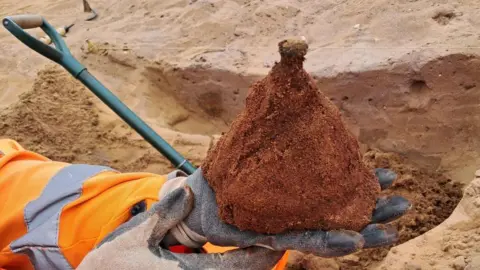
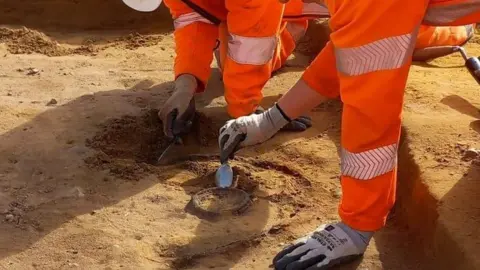
"The one on their back had a sword laid down on its right hand side and on top of the sword was a 40 to 50cm (15 to 19in) copper bowl or dish - and within that, a 15 to 20cm (6 to 8in) silver vessel was placed.
"The other individual had a spear next to it and both individuals had shields as well."
The "fancy grave goods" confirmed what they had already suspected thanks to the horse - it was a high status burial.
 Oxford Cotswold Archaeology
These finds were extracted from the earth in a soil block and X-rayed at Rossdales - a Newmarket-based vet practice.
This revealed the sword's pommel appeared to have survived along with a hand grip, which would have been moulded to its owner's hand.
"Everyone lost their minds when that came up, especially when everyone saw it on the X-ray as well," says Middleton.
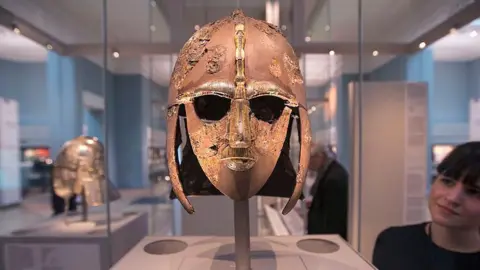
He adds it is "pretty rare, but not unheard of" to discover one person buried with a horse, such as the Sutton Hoo prince or the warrior discovered at RAF Lakenheath.
"[But] in East Anglia, we've yet to hear of two individuals with their horses," he says, explaining why the find has excited the experts.
Who were these 'princely' people?
 Oli Scarff/Getty Images
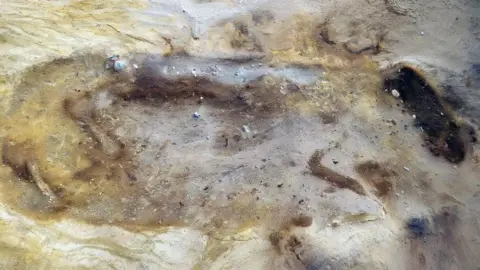
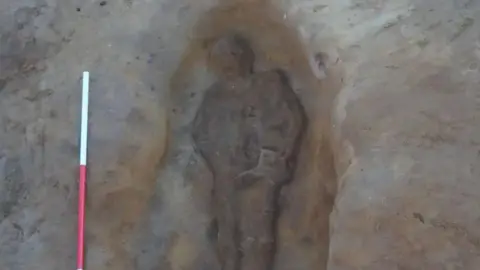
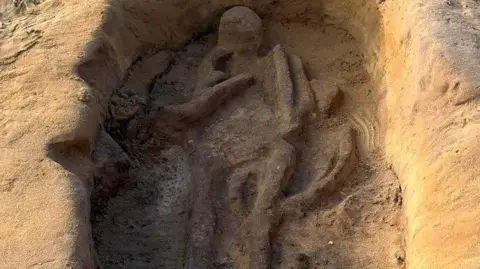
All that was left of their remains were sand skeletons - shadows of painstakingly revealed body shapes.
"This is the nightmare of being a bone specialist on a site that has barely any human bone," admits Ann Schmidt, acting supervisor and OCA burials lead.
"If we had bone preservation we would be able to determine if we had a man or a woman, but all we have is the sand stains.
"While weaponry usually indicates a traditional male grave, female graves with weaponry are not unheard of, even for that time period."
 OCA
OCAThe grave goods and horse burial appear in the same elite tradition as other 6th to 7th Century burials in East Anglia, such as Sutton Hoo and Snape in east Suffolk and Prittlewell in Southend-on-Sea, Essex.
DNA samples were taken from the soil and Schmidt hopes that yet to be developed techniques might eventually be able to determine more about the people in the "princely burial" - and the others buried in the same cemetery.
How do you excavate shadows in the sand?
 OCA
OCANeither Schmidt nor Middleton had previously excavated sand skeletons because digs on this type of sand geology are relatively rare.
"It's almost like beach sand - and these seem to be the only conditions to preserve bodies in this way in this part of Suffolk," says Middleton.
Schmidt says very small trowels were used to very, very carefully reveal the imprints; brushes would obscure the lines.
 Oxford Cotswold Archaeology
"The body stains themselves are just slightly harder than the surrounding back-fill and so you can just tease it out," she explains.
"They feel slightly different when you excavate them compared to the surrounding soil as well, which helps, and they hold a little bit better than the surroundings."
Both experts agree there was something haunting about unearthing the outlines of long-dead people.
Middleton says: "These sand bodies don't just preserve the [shape of] bone, they've got a bit of [the shape of] flesh preserved as well - they look like the outline of a person."
"It's a very strange feeling, especially when we have the graves of younger individuals," adds Schmidt.
'Extremely rare Anglo-Saxon find'
 OCA/Chris Fern
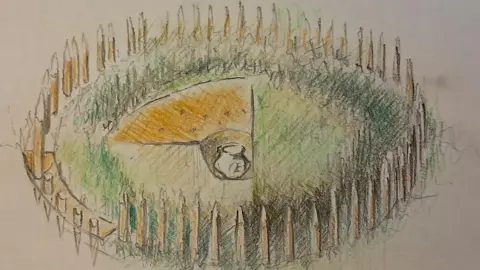
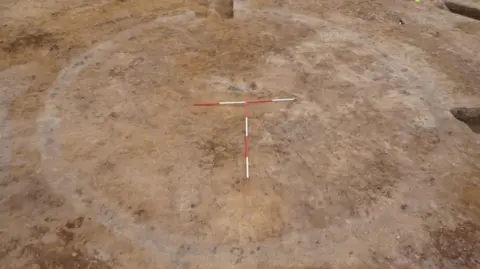
Middleton says there was one further find that astonished the archaeologists - a "completely new" low-lying burial mound surrounded by a circle of posts.
"We initially thought it was a mound; we had an un-urned cremation, we had personal items such as bone playing pieces, bits of a bone comb, bits of copper," he says.
"But rather than a traditional burial mound with a circular ditch around it, this burial mound would have been entirely encircled with upright posts, all quite close together."
 OCA
OCAAs far as they are aware, there is just one other similar burial in Kent and possibly another in France.
"It's completely new for Anglo-Saxon East Anglia and extremely rare in the record for the Anglo-Saxon world at the time," the archaeologist says.
A previously unknown cemetery
 OCA
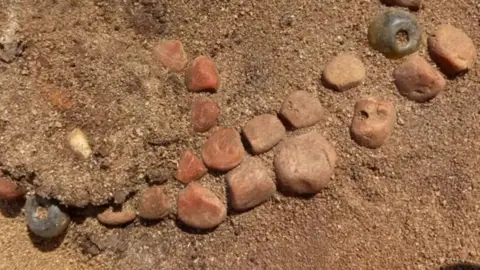
OCAThe princely burial was one of 12 barrow mounds that would have stood out in the landscape.
They were surrounded by about 40 other burials and they all dated to the 6th and 7th Centuries.
Some of the bodies were buried and others cremated and all had grave goods.
But the poorer the person, such as those found with just a knife, belt buckle or bead, the more likely they were to be interred further away from the high-status people in the barrows.
 OCA
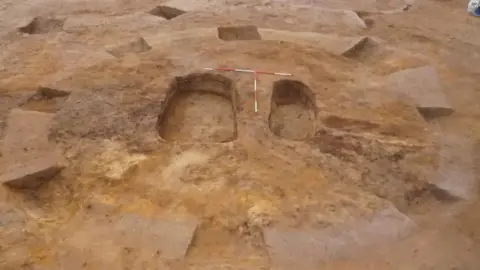
OCA"At this point in the 6th or 7th Century, there's no full conversion [to Christianity] yet, so there's a bit of a hodgepodge of burial practices and anything goes," says Middleton.
"The burials are laid in lots of different positions, some on their sides, some on their backs, some with their knees bent - and some are cremated."
He adds it was an amazing site to have worked on - and expects more stories to be shared after the results of the post-excavation analysis are revealed in years to come.
Follow Suffolk news on BBC Sounds, Facebook, Instagram and X.
