The mammoth discovery made by chance by a couple walking their dog

 Shropshire Museums
Nearly 40 years ago, a couple walking their dogs made a discovery which turned out to be one of the most significant finds ever in archaeology in western Europe.
In September 1986, Eve Roberts and her husband, from Bayston Hill, Shropshire, were exercising their pets in nearby Condover.
As they passed a sand and gravel quarry, something caught their eye - what looked to be a very large bone, sticking out of the mud.
The find led to the uncovering of more than 400 bones of an adult mammoth and several young mammoths - and proved the creatures existed in western Europe for several thousand years longer than scientists had thought.
"There was a lot of excitement, there was a lot of interest," Stephanie Bellows, from the Shropshire Hills Discovery Centre, said.
"Before then we thought that mammoths had become extinct in the UK and in western Europe 18,000 years ago."
 Shropshire Museums
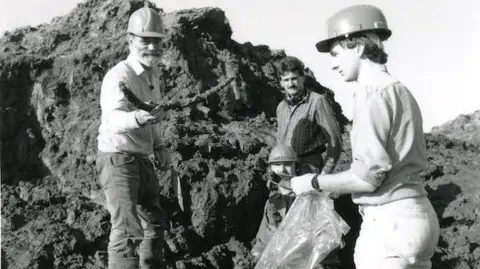
The bones came to light after workers at the quarry, dredging up clay and peat, found what they thought was a telegraph pole, along with a few more bone-like items.
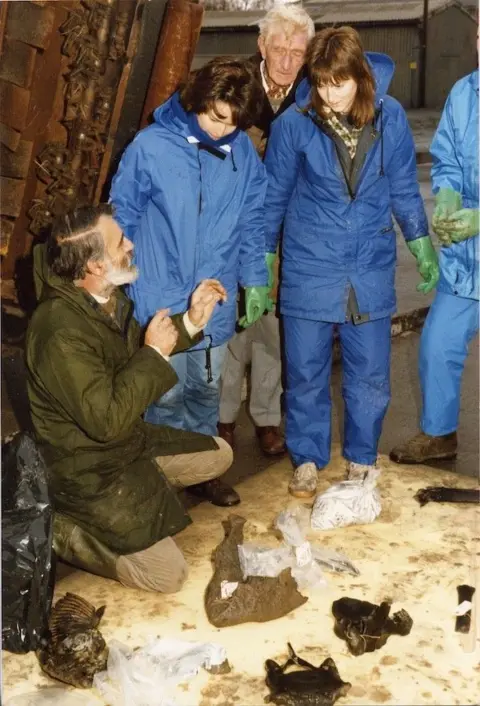
The Roberts called the local museum service and Professor Russell Coope, from the University of Birmingham, was then called in.
Although he later admitted his hopes were not high as he was often called to look at prehistoric "monsters", only for them most of the time to turn out to be shire horses.
At first, when he got to the garage where the bones were stored, he only saw deer bones but then, right at the back, he caught sight of an enormous leg bone.
His first thought, as he admitted in a 1987 lecture, was that it must have been a circus elephant but it did not take long for Coope to become convinced that was had been found was the remains of a mammoth.
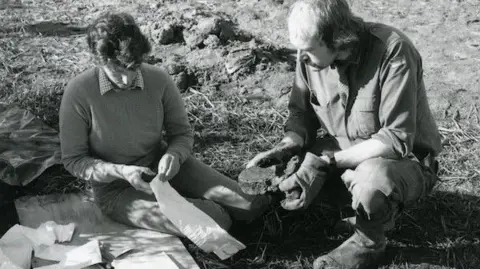
A flurry of activity followed - a team was sent to investigate and, as more bones were uncovered, even the BBC children's show Blue Peter went along to have a look.
 Shropshire Museums
The remains were went to Ludlow Museum to be cleaned and work on them also happened in Cardiff, where there was more space, before it was then decided that the bones would come back to Shropshire.
Bellows said the discovery was hugely significant especially when they were radiocarbon dated and found to be 14,000 years old.
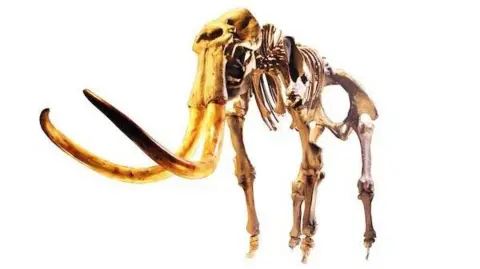
"That is the most complete mammoth skeleton that has been found in Britain or elsewhere in north-western Europe," she said.
"Finding out that they had come back at the end of the last Ice Age was very important, because it was something that nobody knew about this area.
"The fact that mammoths walked this area is just amazing."
 Shropshire Museums
Analysing the bones revealed that the adult was between 30-32 years old when it died while of the younger mammoths, Bellow said two or three of them were between three and six years old.
"There's one rib from a sub adult, [which is] something that is more than eight but less than 15 years old," she added.
Archaeologists also found the adult's shoulder blade was broken but that was not what caused the mammoth's death.
"Other bones would break if it had happened from a fall," Bellows said.
Instead, experts believe it was an injury from when the mammoths fought each other as Bellows said one would bring its tusks down on another's shoulder blades, with the goal of breaking them.
So, how did it die? Archaeologists think it got stuck in a kettle hole.
"That's a place where a large piece of ice doesn't melt as quickly as other parts from the glaciers and gets covered and then, of course, the ice does melt, the dirt on top collapses onto that and then other things fill that kettle hole," Bellows said.
"Here, it filled with clay and sticky mud and probably grass grew on top of it and the mammoth came walking across it and became trapped in that clay and sticky mud."
Double celebration
Interestingly, she said, the younger mammoths did not die at the same time as the adult male.
"Just like with the elephants alive today, young mammoths do not go round with a male, it's a matriarchal society, so it's at different times that different mammoths became trapped in that mud," she told the BBC.
The Discovery Centre has a replica skeleton of the adult male, which is still a popular part of its exhibits.
Most of the other bones are at the Ludlow Library and Museum Collection Centre, with some on display in Shrewsbury's Museum.
On 20 June, to mark the 40th anniversary of the discovery, the Discovery Centre will host a celebration which will also mark its own 25th anniversary.
Correction 26 January: An earlier version of this story incorrectly said the bones dated back 12,800 years. We have changed this to say they date back 14,000 years.
Follow BBC Shropshire on BBC Sounds, Facebook, X and Instagram.
