Secrets of an 'opulent' Georgian house

 BBC
BBCMaister House has stood on Hull's High Street since Georgian times. Today, the Grade I listed building, which is owned by the National Trust, is entering a new era as a music school. But its history has been shaped by trade, tragedy, loss and survival.
Built in the 1740s, it originally belonged to the Maisters - a powerful merchant family who used it as a grand home and workplace.
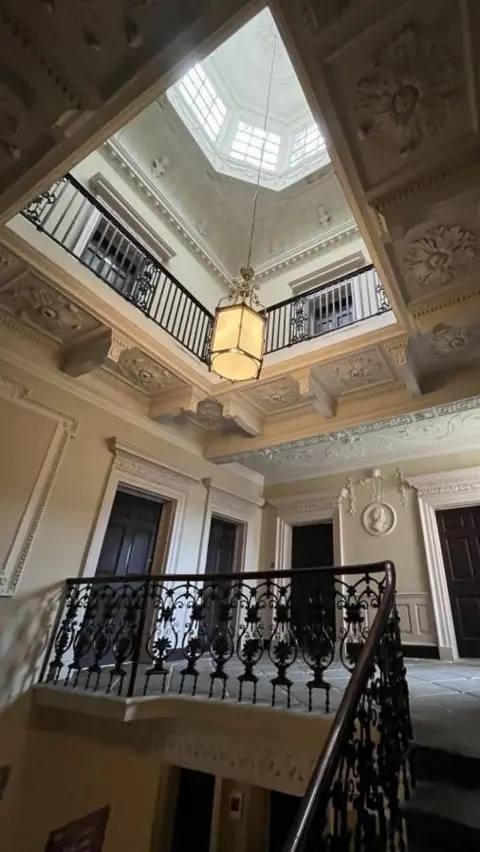
Its most celebrated feature, a stately stone staircase, is said to have been built after a fatal fire.
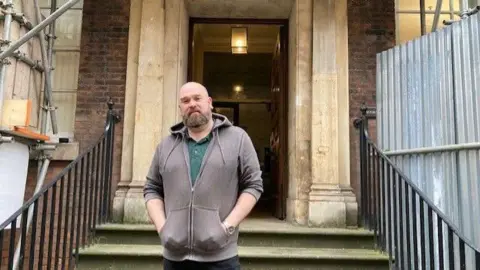
Danny Thompson, the creative director of Eclectic Music, which is based at the property, has been telling the story to the BBC's Hidden East Yorkshire podcast.
"The house originally had a wooden staircase and, unfortunately, the house set on fire and the staircase burnt down," he explains.
"There was a child trapped inside and the mum ran back in with a maid to save the child.
"But, unfortunately, the staircase collapsed, killing the wife, one of the maids and one of the children."
 Susan Amaku, Woodhall Planning and Conservation
The stairs were rebuilt in stone so they would never burn down again.
Danny points out where he thinks the fire may have started and adds: "You can see the char in the floor, beneath the new floor."
When the property was built in the 1740s, Hull was a hotbed of trade and industry, and the Maisters were known around Britain and Europe for trading in iron, he says.
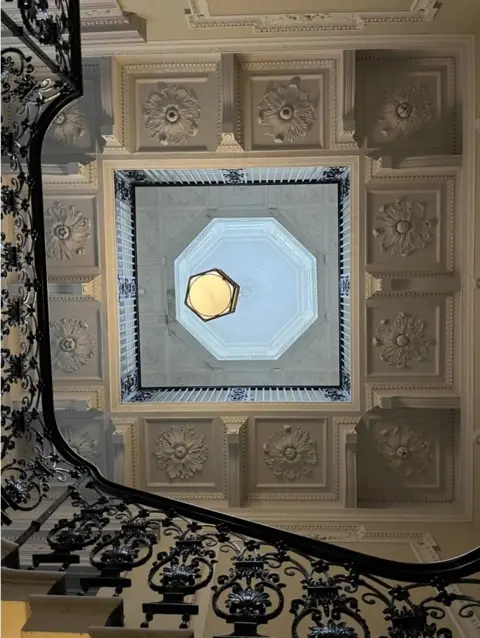
The house is renowned for its opulent interior, which Historic England describes as "of importance both locally and nationally".
"It has these great big steps that run up to the front and a big Palladian doorway and quite a sober-looking front," Danny adds. "But when you go inside, it's a real treat, as a lot of Georgian houses were."
Along with the ornate staircase and intricate wrought-iron balustrade, which leads up to an octagonal lantern, other notable features include a stucco ceiling and decorative panels.
"There's lots of detailed, handmade fruit work, grapes... it's absolutely beautiful," Danny says.
Scaffolding covers parts of the house at present, as it is undergoing renovation, with the eventual aim of returning more of the interiors to their original Georgian state.
"Unfortunately, we're also scaffolded inside, so you don't get the full look right up to the top window - the lantern on the top."
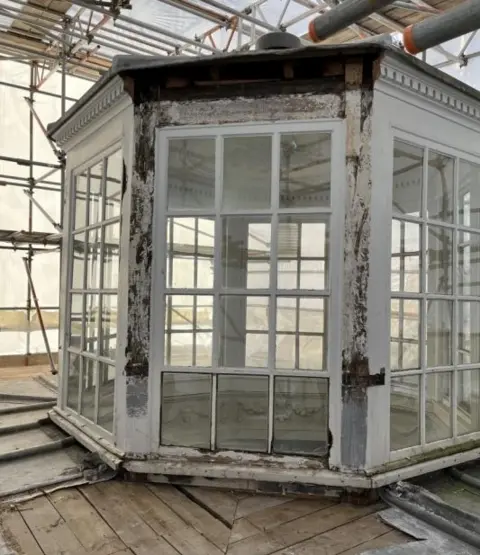
During the Blitz, a bomb fell just across the road, leaving a large gap in High Street and taking the roof and lantern with it.
"Over time, the lantern had been replaced bit by bit, so there wasn't much original material in there," Danny explains.
 Susan Amaku, Woodhall Planning and Conservation
The whole thing will now be replaced with a structure matching the shape and look.
"They're going to get a huge crane down the street and lift us a new lantern on to the top of the building and replace our roofs."
The project received almost £111,000 in Levelling Up money in November last year.
Today, Maister House is a centre for lifelong learning.
Teaching happens in some of the smaller rooms that would once have been the Maisters' offices.
"When the Maisters lived here, their offices were downstairs and they lived on the first and second floors," Danny explains.
"People would come down the river – the merchants with their iron – and they'd see this magnificent house and come into the entranceway and into these offices.
"All of the heads of the company traded from these spaces and impressed people in these rooms."
 Susan Amaku, Woodhall Planning and Conservation
At the back of the building is now a musical instrument repair shop, where Danny and a colleague repair trumpets, saxophones and all manner of other instruments.
"I've had everything from contrabassoons, to bass clarinets, bass recorders, piccolos, you name it.
"We've had people come to us with disabilities, where we've remade parts of their instruments so they can play again."
As a tenanted property, Maister House is closed to the public for most of the year, but the National Trust opens it on selected days during the Heritage Open Days festival.
Danny says: "It's a really proud feeling to know that we've been part of this building and its history.
"Now, it's really starting to get recognised as the gem that it is."
Listen to highlights fromHull and East Yorkshire on BBC Sounds, watch the latest episode of Look Northor tell us about a story you think we should be coveringhere.
Download the BBC News app from the App Storefor iPhone and iPad orGoogle Play for Android devices
