'Having to leave my home after 20 years is a tragedy'

 Martin Giles/BBC
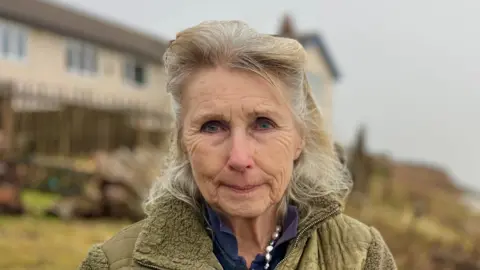
Hilary Lightfoot is packing away 20 years' worth of memories as she prepares to leave her clifftop home, despite having nowhere else to go.
A quarter of her garden in Thorpeness, Suffolk, has already fallen away, and she has been warned the entire building may soon have to be knocked down.
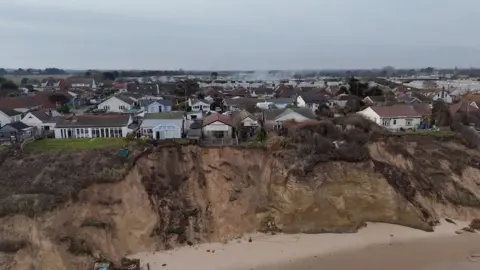
The coastline here is rapidly disappearing due to erosion, with four homes having been demolished this winter alone.
Further north, Hemsby in Norfolk has been suffering the same issues, and both counties could see hundreds of homes lost in the coming decades.
 Martin Giles/BBC
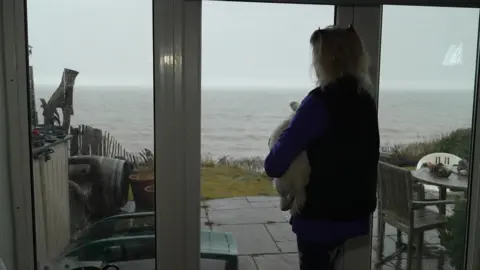
"This is my home and I'm in a real state about it," says Hilary.
"I just don't know where I'm going to be. I can't sleep at night. It's a tragedy for me."
Hilary first started coming to Thorpeness as a child on holiday with her family, eventually buying her ground-floor flat in Tinkers End two decades ago.
It "means everything" to her.
"All my childhood, then my children and now my grandchildren love Thorpeness," she says.
"They do the regatta; they go on the Meare; they build sandcastles; they play tennis at the country club.
"It's one of those magical places. It's a very special village."
Thorpeness was initially transformed from a hamlet into a holiday resort by playwright and barrister Glencairn Stuart Ogilvie in the early 20th Century.
He built new homes and created the Meare boating lake, inspired by JM Barrie's Peter Pan stories.
 Qays Najm/BBC
Erosion has plagued Thorpeness for decades, but its effects have been felt far more keenly in recent years.
In 2022, The Red House on North End Avenue was torn down after East Suffolk Council deemed its position on the coastline too dangerous.
Then, in October, 88-year-old Jean Flick lost her home of 25 years on the same street.
Since then, three more homes have gone and the council has warned nine other properties are at risk.
In Hemsby, the situation is even worse, with 36 homes lost since 2013, 12 of them since mid-December, according to Great Yarmouth Borough Council.
Local authority figures suggest 1,800 homes could be lost in the next 80 years in East Suffolk and North Norfolk.
 Martin Giles/BBC
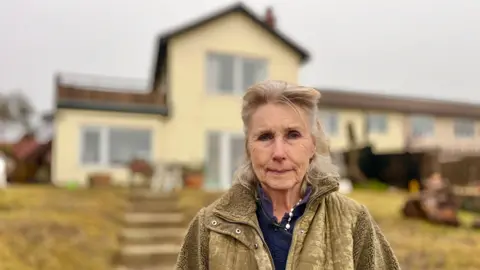
In recent days, 7m (23ft) of beach has been lost near Hilary's home.
"I'm starting to pack up things in my house," she says.
"I've got a vintage shop in Aldeburgh and I'm hoping to use that as storage... I've ordered boxes and got friends to help.
"I have nowhere to go; nowhere to live as a home.
"I could stay somewhere temporarily, but I haven't got anywhere to live and it's very difficult to buy something because I haven't got the money now I've lost this property."
She says the situation is a "living nightmare". While her flat is insured, it only covers flooding and not marine erosion.
Although the government offers funding of £6,000 per property for demolition, there is no money to help people buy new homes.
"I don't think people realise what an important place it is to save, Thorpeness," Hilary adds.
"There is no other village like it in Great Britain."
 University of East Anglia
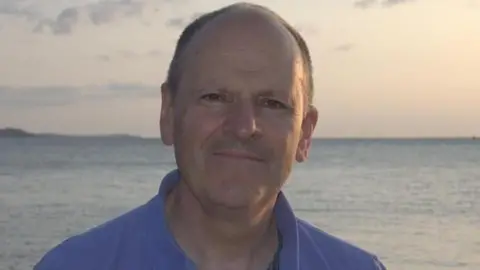
East Anglia has some of the fastest eroding coastlines in north-western Europe.
It is partly due to soft geology, according to Prof Robert Nicholls, an expert in climate adaptation at the Tyndall Centre for Climate Change Research at the University of East Anglia, Norwich.
"Several things come together: the geology is very soft, so it's easily eroded and then... the sea takes it away quite quickly," he explains.
If that material stayed on the beach, it might help protect the coastline, he says.
While the effects are being felt significantly at the moment, the erosion has been going on for thousands of years, he says.
"When the Romans invaded Britain 2,000 years ago, the Norfolk coast from Happisburgh to around Sheringham was probably 1-2km out to sea, to give you a feel for the changes that have happened."
In some places, as climate change causes sea levels to rise, coastal erosion worsens.
However, Nicholls says there is no evidence to suggest climate change is worsening the issue in East Anglia; rather it is an "added complexity", causing unpredictable weather patterns.
 Martin Giles/BBC
Councils are responsible for managing coastal erosion, while the Environment Agency manages flood risk.
East Suffolk Council has come under pressure from residents, who ask what it is doing to help.
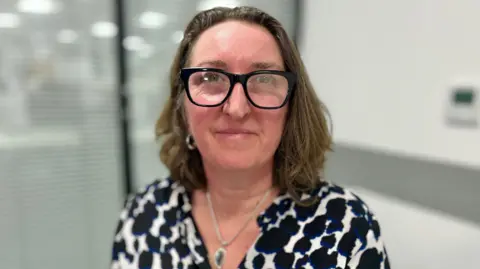
But the situation is complex, and safety is the priority, says Karen Thomas, the council's head of coastal management.
While the council must follow rules and regulations, she says, future government funding discussions must consider the cultural and economic value of at-risk areas.
"It's more than defences now; it's about places," she explains.
"What do we want our coast to look like for the future? What jobs is it going to offer people?
"Where is the environment going to go? Where are the people going to go?
"Arguably, that's a multi-government discussion."
 Martin Giles/BBC
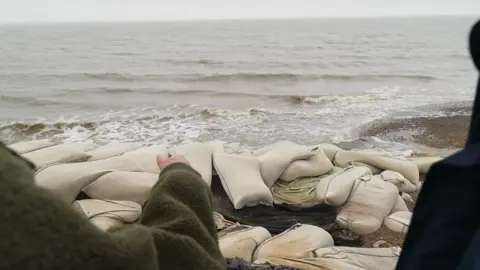
East Suffolk has 48 miles (77km) of coastline and last year the council spent £750,000 maintaining sea defences and just over £3m on capital projects.
Thorpeness residents have attempted to pay for their own defences but have had their applications rejected.
Thomas says coastal projects are expensive, which plays a huge part in decision-making.
She says the council also has to consider keeping a "naturally functioning coast", needing some places to erode to provide beaches and natural defences.
"That's the challenge that we've got," she says.
Hilary, however, feels "totally helpless" and at the end of her tether.
"It's a completely tragic thing that didn't need to happen," she says.
A Department for Environment, Food and Rural Affairs spokesperson says: "We're supporting coastal communities through our commitment to invest at least £10.5bn in flooding and coastal erosion by 2036, benefiting nearly 900,000 properties."
Follow Suffolk news on BBC Sounds, Facebook, Instagram and X.
