Bristol Airport tram - what do the experts say?

 Weca
WecaRecent news that trams are back on the agenda in Bristol's transport planning may be met with a sense of déjà vu, as various similar schemes have come and gone over recent decades.
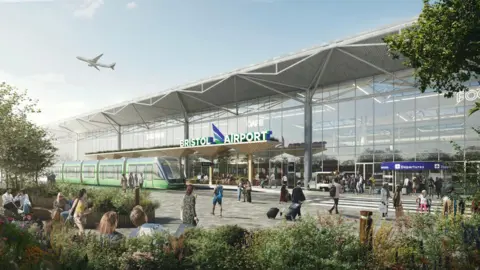
West of England Combined Authority mayor Helen Godwin, who is pushing for a potential light rail link to Bristol Airport, said "we are so far behind on [mass transit] as a region".
But travel expert Simon Calder told the BBC "It's extremely welcome, but many years and hundreds of millions of pounds away, so good luck everybody."
Chair of the Light Rail Transit Association, Dave Andrews, said nothing less than a tram will suffice. He said: "Only a tram will regenerate a city. Buses - no matter what - won't do that."
Bristol Airport sits 11km (seven miles) to the south west of Bristol city centre.
It is on high ground, at an elevation of 190m (662ft), and is the largest airport in the UK without a direct mass transit link.
Instead, drivers and buses rely on the mainly single carriageway A38 for access. Bristol Airport has several large car parks and a new transport centre for buses.
Andrews said there was an obvious financial incentive to build a tram.
"For each pound spent on a tram project, you get three to six pounds back over the lifetime of the scheme.
"The capacity of a tram is five or six times that of a bus so you wouldn't need to have that much parking at the airport," he added.
 Weca
WecaHis support for the project was echoed by Tony Lloyd from the Bristol Rail Campaign, who told the BBC "We have to get cars off the road."
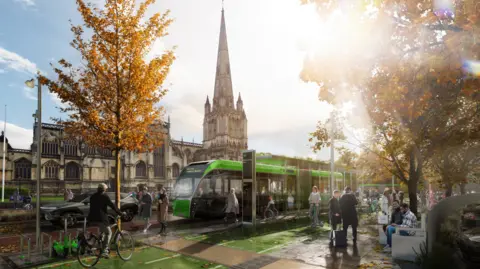
Lloyd suggested new tram developments, like Coventry's Very Light Railway, which is in construction, could remove the need for expensive overhead wires and lots of roadworks.
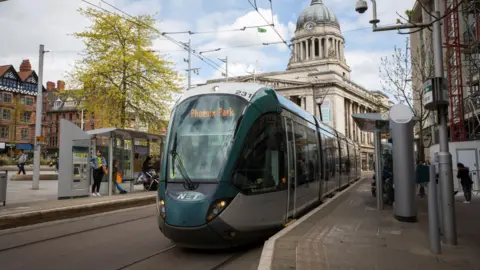
He also suggested tram-trains, currently in use in Sheffield, might be an alternative.
"On the Severn Beach Line, it could run to Temple Meads, then take off from there and go around the city loop," he said.
 Getty Images
Godwin said any future projects would rely on different council leaders to be in agreement - something which "is not a given."
In the 1990s, plans for a new Bristol tram system fell apart after disagreements over where the line would run to.
"I understand the cynicism, it's bound to be that way because we've had so many false starts on this before," Godwin said.
"We could have done it 20 or 30 years ago and the costs would have been so much lower than they would be now.
"So that's another reason why we need to keep the pace up - because the costs are only going to go in one direction," she added.
Follow BBC Bristol on Facebook, X and Instagram. Send your story ideas to us on email or via WhatsApp on 0800 313 4630.
