A shot in the arm: The vaccine photo that swept the world
 Getty Images
In December 2020, Covid vaccines were finally ready to be administered. One British photographer found himself with an historic assignment.
As the year 2020 drew to a close, a vast pharmaceutical project to develop a vaccine to the coronavirus was ready to be rolled out.
The first effective vaccine, developed by the drug companies Pfizer and BioNTech, was found to prevent more than 90% of people from getting Covid-19, according to preliminary testing on more than 40,000 people across the world. After months of lockdowns and the vivid, heartbreaking images of the disease's toll around the world, a light appeared to be at the end of the tunnel.
In December, the first doses of the disease were ready to be administered to the public at large. On 7 December, photographer Jacob King, who works for the UK's Press Association in the Midlands region of England, was contacted by his picture desk and told to prepare for a job early next morning in the nearby city of Coventry.
The UK's health authorities had decided that it would be a hospital in the Midlands, and not in London, that would administer the first dose – University Hospital.
"My picture editor at the time rang and said, 'You're going to be at Coventry hospital tomorrow, but you're going to have to be there for about 5am,' so that's how that happened," King says.
 Jacob King via Getty Images
"I only knew the day before, which is how this industry works a lot of the time. 'Go get some rest and go to Coventry nice and early tomorrow, because there's going to be a picture worth doing.'"
King said he arrived a little earlier – it's what press photographers are taught to do – and found it was just him and a camera team from UK broadcaster Sky News, an oddly small press pack for a story that would be beamed around the world. The Coventry dose was to be given about 10 or 15 minutes before other doses around the country, King says.
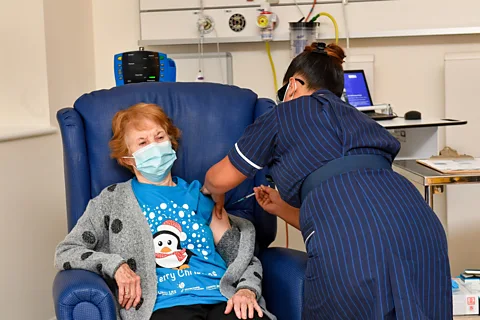
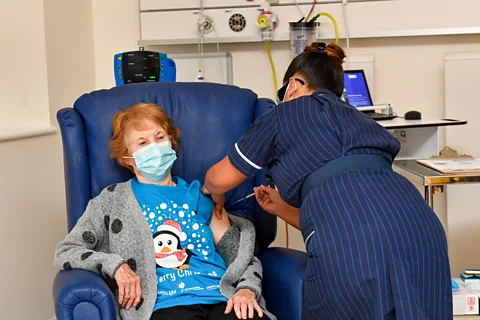
The first patient was wheeled in for her intimate press audience. Margaret Keenan, then 91, had lived in Coventry for 60 years after moving from her native Northern Ireland, and had worked in a jeweller's shop until she was 85 years old. Giving her the dose was Matron May Parsons. Keenan was wearing a festive shirt with a penguin on it; sales of the T-shirt tripled after being seen across the globe.
"I was probably about 5m (16.5ft) from Margaret," King says. "And, you know, you sort of have the feeling that it's going to be quite a big picture. It was the start of the latest chapter in the pandemic, I suppose, people hoping for a sense of normality. And this was the first stage of that, the first person to get the vaccine.
"I felt somewhat pressured, but not as much as you'd think, I just went for it. It wasn't necessarily a blur, but I was just sort of focused. You're concerned about if the nurse is going to block the view, because she's got to do her job and administer it properly, and you want to make sure you get the shot, but not annoy anybody in the process, because it's quite a delicate subject."
King says that even a minute or two before the vaccine was administered, he was still working out which lens and flash he would need to use. "I wanted to make sure I got this one right," he says.
The dose took mere seconds. "It was just a hospital room in Coventry. But for that moment, it was at the centre of coverage of the pandemic for the whole world, really.
"She was a lovely lady, and she was sort of wheeled back onto her ward afterwards, and it was certainly the most optimistic a job had been for many months.
"I went home afterwards, not really thinking too much of it, apart from hoping that everything was sharp and well exposed. And within a few hours, I got a sense of just how international these pictures were going to be."
The photo opportunity was also a shape of things to come for King's career over the next year, too. "For the 12 months after that, we photographed lots of people getting jabbed. And it really does just last seconds."
More like this:
• Covid 2020: The hugging room where Covid couldn't spread
• Covid 2020: Where cruise ships went to die
• Covid 2020: A lone figure in an eerie London lockdown
King had joined the Press Association not long before the start of the Covid-19 pandemic, intending to cover both news and sport, but during the pandemic "the sport events vanished, and the news became totally different to the usual calendar and features and customs that we do as press photographers in the UK".
Looking back at the image five years later, King says it felt like a turning point at the time – though the events of 2021 would show the Covid-19 emergency was far from over. "I think that's why the picture was picked up. People were just hoping for a resolution and something that would bring an end to 'life as we didn't know it'.
"I suppose it was just so odd for people to live in that way and not see family and friends, and I think that day, it felt like it might have been the beginning of the end."
--
If you liked this story, sign up for The Essential List newsletter – a handpicked selection of features, videos and can't-miss news, delivered to your inbox twice a week.
For more science, technology, environment and health stories from the BBC, follow us on Facebook and Instagram.
