The week that Covid-hit Britain returned to the pub
 Peter Summers/ Getty Images
In July 2020, Britons enjoyed a brief respite from the isolation of Covid measures as pubs and bars opened again for business.
It became known as "Super Saturday".
Britain's pubs had been shuttered for more than four months during the first wave of the coronavirus pandemic, since Boris Johnson, then UK prime minister, held a TV address which announced strict new lockdown rules that included shutting down a number on non-essential venues – the country's pubs included.
On 24 June, 2020, the UK's governments announced that pubs, restaurants and hairdressers would be allowed to re-open from 4 July, but that people would still have to follow social distancing rules, as well as other safety measures such as more frequent hand cleaning.
The UK's pubs had largely remained open during two World Wars (even if opening hours had been curtailed during World War One during the working day and only repealed in the late 1980s.) The pub tradition had survived the Blitz and rationing, but now Britons had a new challenge: confronting the first few months of this crisis without the sanctuary of a pint at the bar.
 Peter Summers/ Getty Images
The government's relaxation of some lockdown rules meant the UK's nightlife hotspots would see at least a semblance of normal activity return. Peter Summers, a photographer for the press picture agency Getty Images, who had spent the last few months covering Covid-related news events for the agency around London, knew that Soho was the place to be when the pubs reopened.
Soho, once the centre of London's sex industry, has become a historical epicentre of the English capital nightlife, thronged with bars, clubs, theatres and restaurants. As far as news agencies were concerned, this was the place where photographers would most likely capture iconic images. On 4 July, Summers found himself traipsing around Soho and training his camera on the unfolding festivities.
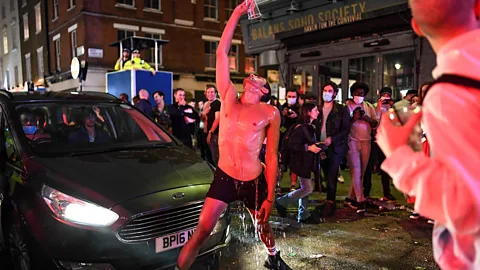
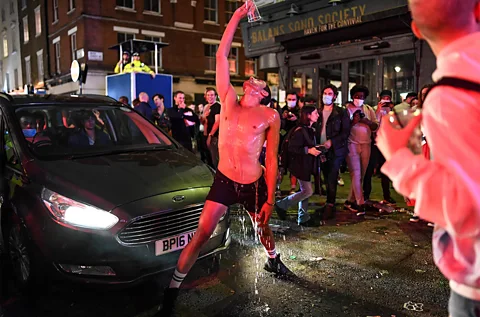
To prevent people going into venues, Soho's narrow streets had been closed to traffic, and tables and chairs had been placed in the streets; a common sight in places like France and Italy, but relatively rare in the UK. At about 22:00 or 23;00, Summers says, the streets reopened to traffic, which is when he snapped the pic of the shirtless man covering himself in water, lit by the coloured glow from nearby bars. "I think that was, like one of the first cars, like maybe the second or third car down the street," he says. "Old matey boy just had time to shine in front of others."
"Looking back on it, I kind of shot myself in the foot that night because I got that photo," he says. "Then I think they thought, 'Oh, it's gonna be like that every night.' And it wasn't… that night was just crazy.
"It was a really good atmosphere," he says. "I think it was Brits doing what Brits do, you know, drinking in excess… I think people were just happy to be back out and return to some sort of normal life, I guess."
Summers had spent the first few months of the pandemic working five days a week covering Covid-related news for Getty Images. "For a month or so, it was busy, and then it really died down, and there wasn't really much at all happening because, like, the initial sort of excitement of Covid and all the new things like empty streets and whatnot, had kind of been shot a lot. There was only so many times, I guess, we could go Chessington World of Adventures [a British theme park], and do people queueing get a Covid test."
Some of the assignments Summers found himself on were like "nothing I ever envisaged doing for an international press agency or even for like a local newspaper", such as photographing people making sandwiches in their kitchens for elderly neighbours. "It was a bizarre, sort of uncertain time, but I think as well, like I say, it was just documenting everything that was going on. All these community efforts, everything else, which then all culminated in a man pouring a drink over himself."
More like this:
Looking at the image five years on, Summers finds detail that perhaps wasn't as obvious to him then. "In the photo, there's two or three women in the background. They're on the pavement, they've got masks on. But largely people are just walking around as if nothing's happened. It was just more a general sense of excitement."
Summers says the party atmosphere continued as he spent other weekends covering the al fresco bars, but the mood got a little edgier as it wore on. He says some of the bar owners became "twitchy" at photographers around, fearing that they would pick up on lapses on Covid safety. One reveller ended up being escorted away by police after demanding not to be photographed and becoming aggressive.
The summer of abandon was accompanied by a government-funded Eat Out to Help Out scheme in August 2020 designed to help Britian's beleaguered hospitality industry with subsidised meals for diners. While it is thought to have boosted the industry's coffers by some £840m ($1,108m), it is widely regarded as one of the factors which led to another nationwide lockdown barely a month later.
--
If you liked this story, sign up for The Essential List newsletter – a handpicked selection of features, videos and can't-miss news, delivered to your inbox twice a week.
