'Unsigned and neglected': These artworks are by women – but men got the credit

 Kunsthistorisches Museum, Vienna
The magnificent unsigned painting The Triumph of Bacchus remained unseen, ignored and misattributed for centuries, but now its creator Michaelina Wautier is being celebrated with a major exhibition at the Royal Academy in London. Here is her masterwork – and four other groundbreaking artworks by women who are finally reclaiming their place in art history.
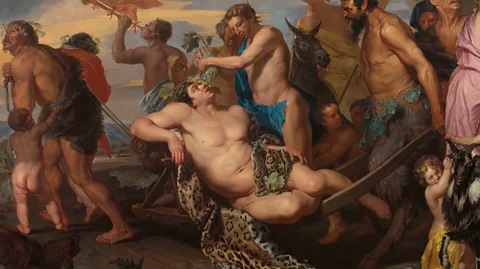
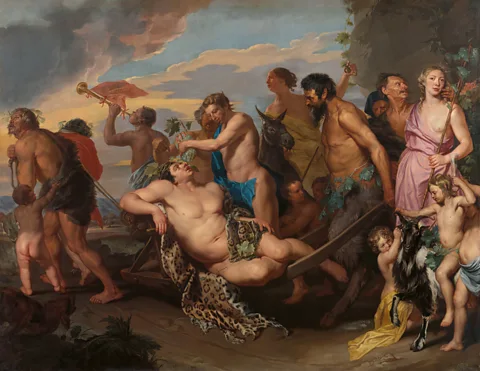
In 1993, while researching in the depot of the Kunsthistorisches Museum in Vienna, art historian Katlijne Van der Stighelen stumbled upon an epic painting titled The Triumph of Bacchus (1655-59). She was taken aback. How could this magnificent unsigned tableau have languished for so long in museum storage? The answer was that it had been painted by a woman: Michaelina Wautier.
Since women were normally excluded from life-drawing classes, it was assumed that the painting was the work of Wautier's brother Charles."When it comes to works by female artists, questions of attribution always arise," Van der Stighelen tells the BBC. Works by women are often unsigned, neglected, and less likely to be cleaned, explains the Belgian art historian, and so there is "little chance of uncovering 'hidden' signatures". Women's art has long been overlooked, and currently, women make up just 1% of the collection at London's National Gallery.
Around 150 years later, the exhibition Michaelina Wautier, opening at London's Royal Academy tomorrow, is a reminder of how unjust that is. It's the Flemish artist's first UK exhibition and the broadest survey ever of her work. It's part of a wider phenomenon that sees women artists occupying more gallery space and reclaiming their place in art history. The first step is acknowledging the work is theirs. Here are five masterpieces misattributed to men.
 Kunsthistorisches Museum, Vienna
1. The Triumph of Bacchus (1655-59) by Michaelina Wautier
The Triumph of Bacchus, once owned by Archduke Leopold Wilhelm of Austria, is a painting so enormous and ambitious that in the early 1900s, Gustav Glück, curator of Flemish painting at the Kunsthistorisches Museum, declared that it could never be the work of a woman. As if anticipating such dismissals, Wautier inserted herself on the right of the painting, staring straight at us: defiant, warrior-like and bare-breasted.
While the artist's brother was mistakenly given credit for this work, other paintings, some re-attributed to her as recently as 2020, were credited to Flemish masters such as Anthony van Dyck, whose work Van der Stighelen had been seeking when she made her surprise discovery.
Wautier has since been described as "the greatest artistic rediscovery of the century". For Van der Stighelen, "she is an exceptional, multifaceted artist", whose artistic range (including portraits, historical scenes, still life and genre pieces) was rivalled only by Flemish master Peter Paul Rubens. The Triumph of Bacchus, states the exhibition catalogue, "is now appreciated as one of the highlights of the paintings collection of the Kunsthistorisches Museum".
 National Gallery, London
2. Self Portrait as St Catherine of Alexandria (c1615-17) by Artemisia Gentileschi
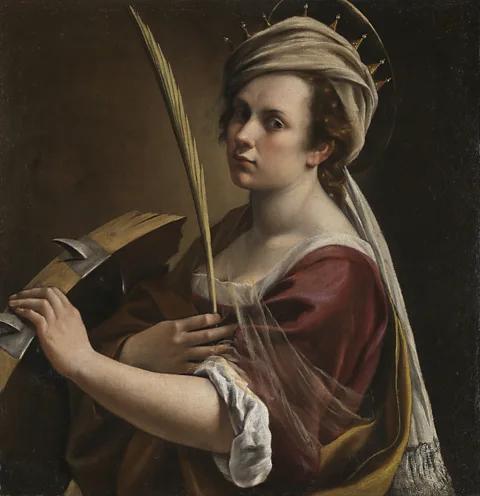
Artemisia Gentileschi, whose story inspired Elizabeth Fremantle's 2023 novel Disobedient, was still a teenager when she began painting the formidable women in her emotionally charged history paintings. Her work was in huge demand during her lifetime but slipped into obscurity when the appetite for Baroque faded in the 1700s. It was then assumed to be by her father, Orazio, or his close friend Caravaggio, famous for his dramatic use of light and shadow.
The painting Self Portrait as St Catherine of Alexandria was not formally credited to Artemisia until 2017. It depicts the artist as the Fourth-Century martyr St Catherine alongside the spiked wheel she was tortured with, echoing Artemisia's experience as a rape survivor who was tortured as she faced her attacker in court. "Gentileschi's paintings amplified the roles of heroic female subjects," writes Katy Hessel in The Story of Art Without Men (2022), and made "women seeking to avenge themselves" a recurrent theme.
Artemisia's list of known works is constantly growing. In 2020, the cleaning of David and Goliath revealed her signature on David's sword, while in 2023, Artemisia's Susanna and the Elders was rediscovered in the Royal Collection. "A woman's name raises doubts until her work is seen," she wrote to the collector Don Antonio Ruffo in 1649, adding later: "I will show Your Illustrious Lordship what a woman can do."
 Alamy
Alamy3. The Carousing Couple (1630) by Judith Leyster
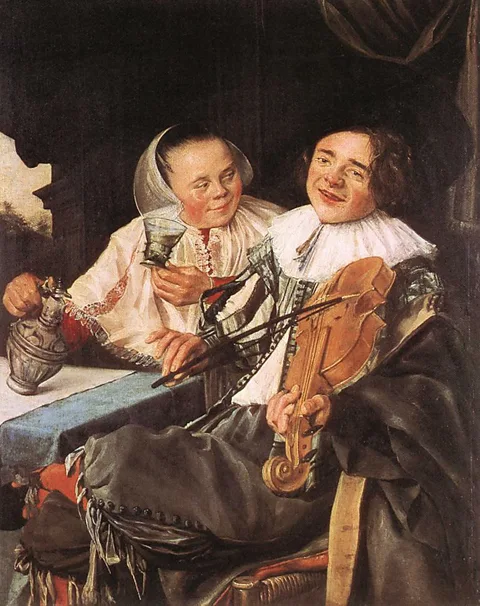
Dutch painter Judith Leyster was highly esteemed during her lifetime, but after her death her reputation was eclipsed by the men in her entourage, and her work was often misattributed to her husband Jan Miense Molenaer, or Frans Hals, who was believed to be her tutor.
The jolly genre painting The Carousing Couple, with its music-making and free-flowing drink, appeared to bear all the hallmarks of a Frans Hals until, in 1892, an art dealer noticed that beneath Hals's signature lay the entwined initials "JL" followed by a star (a play on her name which derives from the Dutch word for "lodestar"). Though Leyster's work rivalled Hals's in quality, she had been painted out of art history as a famous male master could fetch more at auction.
Leyster's career, like that of many women in art history, was far briefer than her male counterparts, cut short by the demands of raising five children and facilitating the work of her husband. It's likely she collaborated with him on some of his paintings, but the signature was always his.
 Alamy
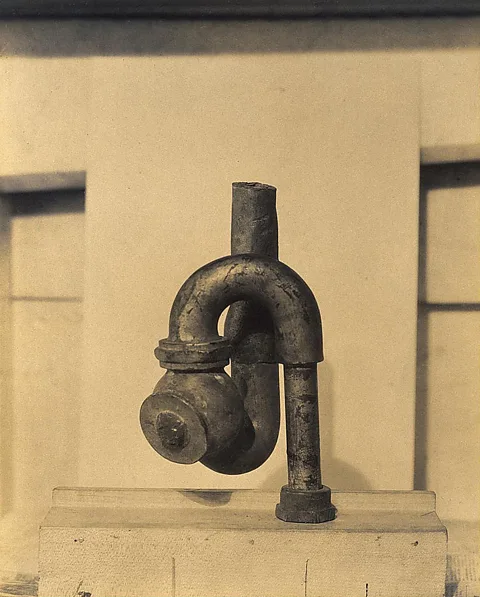
Alamy4. 'God' (1917) by Baroness Elsa von Freytag-Loringhoven and Morton Schamberg
In the 19th and 20th centuries, women artists were still commonly dismissed as amateurs. In her pivotal 1971 essay, Why have there been no great women artists?, American art historian Linda Nochlin argues that the canon of art has long been defined by a "white Western male viewpoint" that enjoys "uncritical acceptance".
Even the avant-garde Dada movement of the early 1900s (which challenged bourgeois conventions of what makes art) failed to break the mould. It was described by Paul B Franklin in Women in Dada (1999) as an "exclusive Boys' Club" that saw women as "artistic muses rather than active participants". One of Dada's overlooked pioneers was the flamboyant German painter, sculptor, poet and performance artist Baroness Elsa von Freytag-Loringhoven who shaved her head and painted it red and dressed in androgynous outfits made of salvage.
Her artwork "God", a phallic-looking cast-iron plumbing trap turned on its head and attached to a mitre box, was celebrated as one of the earliest "readymades" (everyday "found objects" reimagined as art). It was attributed to the US artist Morton Schamberg until the early 2000s, when the Baroness's name was officially added to the credits – a century too late to lift her from poverty.
Some scholars have argued that Marcel Duchamp's upturned urinal, titled Fountain and signed "R Mutt", was also her work. Irene Gammel in Baroness Elsa (2002) cites the 1917 letter Duchamp sent to his sister Suzanne, in which he writes: "One of my female friends under a masculine pseudonym Richard Mutt sent in a porcelain urinal as a sculpture." Gammel asserts: "While final evidence of the baroness's involvement may be missing, there is a great deal of circumstantial evidence that points to her artistic fingerprint."
 Margaret Keane
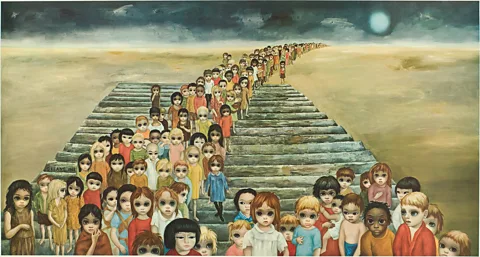
5. Tomorrow Forever (1963) by Margaret Keane
The 2014 biopic Big Eyes, directed by Tim Burton and starring Amy Adams and Christoph Waltz, tells the story of the US artist Margaret Keane, whose kitsch wide-eyed "waifs" sold prodigiously as paintings, prints and postcards in the early 1960s. But they were believed to be the work of a man. Helen Gørrill's analysis of 5,000 paintings, referenced in her book Why Women Can't Paint (2020), revealed that "when work by men is signed it goes up in value", while for women the reverse is true.
More like this:
While Margaret was shy, her slick-talking husband Walter was an excellent salesman. He coerced her into letting him front her art business and take full credit for her paintings, which she signed simply as "KEANE". After Margaret divorced Walter, his insistence that he'd made the paintings led to an extraordinary showdown in court where both parties were set before an easel and asked to paint in front of the judge. Walter pleaded a sore shoulder and left his canvas blank, while Margaret's instantly recognisable big-eyed child, known as, Exhibit 224, was completed in less than an hour.
Michaelina Wautier is at the Royal Academy, London from 27 March until 21 June 2026. It is organised in collaboration with the Kunsthistorisches Museum, Vienna.
--
If you liked this story, sign up for The Essential List newsletter – a handpicked selection of features, videos and can't-miss news, delivered to your inbox twice a week.
