Is New York's cannabis business really flying high?

 Alamy
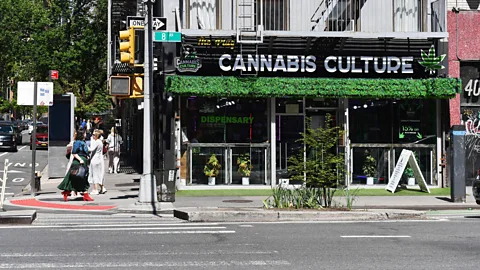
AlamyFive years after it was legalised in the state, cannabis is seemingly everywhere in New York. But, business owners say that many legitimate outlets are struggling – largely because of a thriving grey market, and the complicated legal status of the US cannabis industry.
If you've recently visited New York, you've probably noticed something.
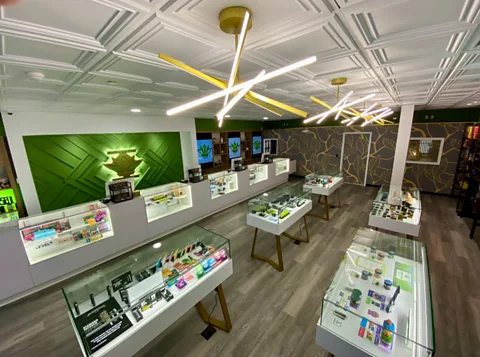
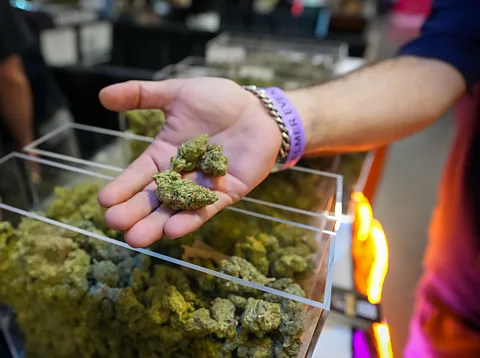
Advertisements outside bodegas display pictures of bright green flowers, higher-end dispensaries that resemble coffee bars or electronics shops welcome customers from all over the world, and then of course there's the smell – so seemingly omnipresent that even US Open tennis players have complained.
Weed is everywhere. From the outside it looks like a free-for-all, one that is drawing scepticism even from voices broadly supportive of the aims of the legalisation – including reducing harm and boosting tax revenue.
 Getty Images
Social media is rife with complaints (typical comments include "New York could not have screwed up legal weed any worse!") and for years the local press has been chronicling the rise of the "weed bodega" – typically a corner store selling products of dubious provenance. Across the country, weed consumption has increased – though studies indicate that the rate of young people using has gradually declined since the turn of the century.
Things may have come to a head recently when the New York Times, once a legal weed supporter, published an editorial headlined: "Marijuana Is Everywhere. That's a Problem."
The newspaper now argues that "marijuana is causing more harm than predicted" and calls for tighter regulation.
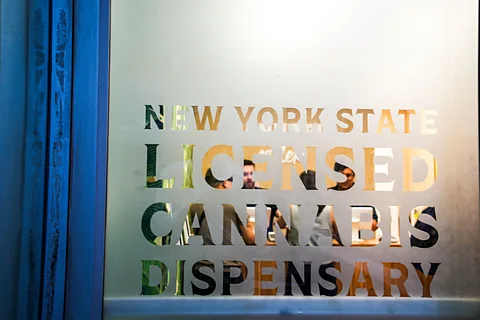
But this new green rush is not as straightforward as it seems. Business owners say that public perceptions have been sullied by illegal operators, and that many above-board businesses are struggling – largely because of the incredibly complicated legal status of the US cannabis industry.
"At first glance, New York's cannabis industry appears to be booming," says Jayson Tantalo, a cannabis businessman and vice president of operations for the New York Cannabis Retail Association. "But that perception was initially driven by an oversaturation of illicit operators.
"These shops often presented themselves as legitimate, creating a misleading sense of scale and economic success," he says.
 Jayson Tantalo
New York state legalised recreational use of cannabis five years ago this month. But legal wrangling and slow issuing of licenses hampered initial growth, while sales in other states such as California were racing ahead.
The bottleneck was so restrictive that some growers in New York complained that their crops were going to waste because of the lack of retail sales outlets. Meanwhile hundreds of those shady outlets sprang up, particularly in New York City.
Those wild days may be coming to an end. State authorities are starting to crack down on illegal operators, and police have been given power to immediately shut shops without a licence. And more legal businesses are being set up to address pent-up demand.
"It was really out of control," says Vlad Bautista, co-founder of Happy Munkey, a cannabis retailer in the Inwood neighbourhood of Manhattan.
"It made a little dent," he says of recent enforcement efforts. "But there’s still a long way to go."
CRB Monitor, a firm that researches the cannabis industry, counts more than 2,000 active cannabis business licenses across the state – including retailers, wholesalers, growers and other types of cannabis companies – with another nearly 5,000 applications in the pipeline.
The effects can be seen far from Manhattan with weed shops popping up all across a state that is roughly the size of England.
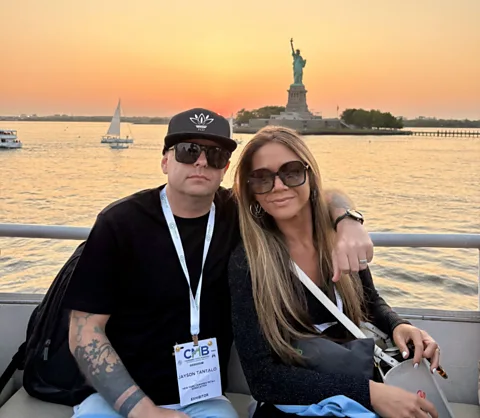
Jayson Tantalo owns one of them. He was involved in the weed business long before it was legal. "What started as survival evolved into deep expertise in the industry," he says. He and his wife Britni set up their Flower City Dispensary retail business in Victor, a suburban community in western New York state with a population of about 16,000.
Tantalo says that while the industry is "highly visible and normalised" across the state, only a small percentage of legal operators have captured large shares of the market.
"Growth exists, but it's constrained, uneven, and still stabilising," he says.
 Jayson Tantalo
New York's growing pains are just one example of the extraordinarily complicated legal status of cannabis that has caused confusion across the country - for businesses, customers and the public.
The patchwork legal regime around the industry is a product of cannabis's long strange trip from respectability to contraband and back again. George Washington, the first US president, famously grew hemp crops at his estate.
But waves of restrictions followed, culminating in a 1970 law that deemed marijuana a Schedule I drug – the most restrictive category.
Despite the US government's war on drugs, there has always been a significant movement calling for looser regulations on cannabis. That movement gradually became more mainstream in the early years of this century.
Support for legalising cannabis first cracked 50% of Americans in 2013, according to polling firm Gallup, and that figure has since risen to more than two-thirds today.
But instead of blanket legalisation, reforms came in piecemeal fashion, on the state and sometimes even the local level, creating a fragmented state-by-state market.
To top it off, weed remains illegal under federal law – thousands of people still get arrested each year for marijuana possession and related crimes.
This legal patchwork results in some bizarre consequences. A road-tripper heading west from New York would pass through Pennsylvania, where recreational use of marijuana is illegal, and then into Ohio, where it was legalised by a 2023 referendum. If they continued along Interstate 80 they would eventually get to Indiana (where weed is illegal), Illinois (legal), and Iowa (illegal) – and so on.
That's confusing in itself. But another legal loophole has opened the door for all sorts of grey-market and online businesses, effectively making cannabis accessible to nearly everyone in the country.
The 2018 Farm Bill legalised hemp with a relatively low level of tetrahydrocannabinol or THC – the chemical that gets cannabis users high.
Hemp contains CBD – a chemical that doesn’t produce the high of THC but has some health benefits. A glut of CBD ensued. And in a lab, CBD can be converted into psychoactive THC.
"Entrepreneurs could say, 'this is just hemp', even if what they were producing was a highly intoxicating form of THC," says Chris Lindsay, vice president of policy and state advocacy for the American Trade Association for Cannabis and Hemp (ATACH), which represents licenced businesses.
Those products are sold online or in those weed bodegas – even in states that have not legalised marijuana.
Robin Goldstein, an economist at the University of California-Davis and co-author of the book Can Legal Weed Win?: The Blunt Realities of Cannabis Economics, estimates that just behind California, the second-biggest weed market is in Texas, despite the Lone Star state's blanket ban on recreational cannabis use.
 Getty Images
Business owners like Jason Ambrosino, have become used to dealing with spiralling legal complexities.
Ambrosino is founder and chief executive of Veterans Holdings, a weed business based in Gloversville, New York, about three hours north of New York City. An army vet who was seriously injured in Iraq, he got into the cannabis industry after discovering that medical marijuana was effective in alleviating his pain. These days, he says his legal headaches include rules that make it impossible to branch out into neighbouring states or to obtain traditional sources of financing.
"There’s a million different ways to get institutional funding, but you can’t get any of those for cannabis because of federal law," he says.
Despite the headwinds, Ambrosino has managed to grow his business and now employs around 80 people, and is hopeful that the increased licences for legal shops in New York will mean more sales opportunities down the line.
Vlad Bautista, the Happy Munkey co-founder, roughly estimates that he spends 40% of his time complying with various regulations, and, in particular, he questions some of the rules around advertising and tax law.
"If you own a cannabis business, you have much stricter advertising regulations than companies selling alcohol, cigarettes or gambling," he says. "You're stuck in the stone age, handing out flyers on the street."
A buzz ran through the industry in December of last year, when President Trump signed an executive order which directed officials to accelerate efforts to reclassify marijuana to a less stringent category.
That might eventually give cannabis businesses some added profits – due to another federal law, weed companies aren't able to deduct all of their normal business expenses from their taxes. But businesspeople and experts aren't holding their breath for a practical impact any time soon.
"It's smoke and mirrors," says Naomi Granger, founder and chief executive of the National Association of Cannabis Accounting and Tax Professionals, who says some headlines heralding a new dawn for the cannabis industry have been somewhat misleading.
Some industry insiders say uncertainty is part and parcel of a nascent industry.
Steve Kemmerling, founder and chief executive of CRB Monitor, notes that states that were earlier to legal weed – California and Colorado in the western US were among the first – experienced hiccups on the way to relative stability.
"In any new market you're going to have wild volatility and price swings, mergers and acquisitions, along with competitive businesses and people cutting corners," he says.
And in a buzzy industry perhaps it's not surprising to encounter businesspeople who seem hard wired for sunny-day thinking.
"I'm an optimist," says Vlad Bautista. "We live in a divided and polarised world where nobody agrees on everything, and when you look at public opinion, there's a majority of people who agree on legal cannabis."
"We've made a ton of progress," he says, "but there's still a long way to go."
Please visit BBC Action Line for support with drug addiction.
--
For global insights and expert analysis for the boardroom and beyond, sign up to the World of Business newsletter, while The Essential List delivers a handpicked selection of features and insights.
For more on business and beyond, follow us on LinkedIn.
