Project Hail Mary review: Ryan Gosling's space epic is 'a mind-stretching sci-fi' ★★★★☆

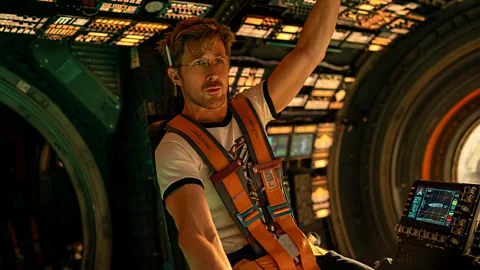 Amazon MGM Studios
This new blockbuster starring Gosling as a solo astronaut trying to save humanity is over two-and-a-half hours long – yet manages to be "zippily entertaining" throughout.
From Star Wars to Dune, from Avatar to Independence Day, most science-fiction blockbusters come down to the question of how skilful the heroes are with guns and swords. But there are a few sci-fi films that value brains over brawn. One of the best recent examples is Ridley Scott's The Martian (2015), which was based on a novel by Andy Weir and scripted by Drew Goddard. Now Goddard has adapted another of Weir's novels, Project Hail Mary, and, again, it features a lone scientist thinking his way through a problem in the depths of space.
The difference between the two films is that this one is directed by Phil Lord and Christopher Miller, who opt for the "Everything is Awesome" perkiness that characterised their defining hit, The Lego Movie. With a leading man, Ryan Gosling, who can't resist showing off his goofball charm and all-round Kenergy, Project Hail Mary is surprisingly shiny and fun for a story about the potential extinction of the human race.
Gosling plays Ryland Grace, who is first seen waking up on a vast spaceship that's streaking towards a distant star – the only two other crewmembers have died en route. Several years in an induced coma have fogged his memory, but he gradually recalls that he is a biologist who was recruited (by the dry-witted Sandra Hüller) for the titular Project Hail Mary.
Alien microbes known as "Astrophages" are gobbling up the sun's radiation, which means that the Earth will soon be too cold to support life. It's Grace's job to find out why one particular star is unaffected by the Astrophages, and to send the secret back home, even if his ship doesn't have enough fuel to get back home itself.
Luckily, he's not quite alone. It turns out that another spacecraft is on the same mission from a different planet, and it, too, has just one living occupant, a crab-like alien made of lumps of stone (a puppet, with some digital tweaking). The jovial Rocky, as Grace calls him, builds a corridor between the two ships, and Grace learns to talk to it via his computer, which can translate its R2D2-ish burbles into English (the main puppeteer, James Ortiz, provides its chirpy voice). Interplanetary chat is a lot easier here than it was for Amy Adams in Arrival.
More like this:
• Maggie Gyllenhaal's The Bride is 'exhilarating'
• 10 of the best films to watch in March
• The most shocking win in Oscars history
Indeed, Grace skips past every obstacle without much difficulty, and therefore without much drama, at least until the film's nerve-jangling final stretch. Essentially, Project Hail Mary is an upbeat buddy comedy. Grace has no family and no romantic attachments, so there isn't the sense of painful personal sacrifice that gave Christopher Nolan's Interstellar its heart-wrenching power. Nor does this laidback, well-groomed joker seem angst-ridden by his high-stakes suicide mission, or awestruck by his close encounter with an extra-terrestrial. It's the end of the world as we know it, and he feels fine.
PROJECT HAIL MARY
Director: Phil Lord and Christopher Miller
Cast: Ryan Gosling, Sandra Hüller, Lionel Boyce, Ken Leung
Run time: 2hr 36m
Release date: 6 March
Still, maybe Lord and Miller knew what they were doing when they went for such a bright and breezy tone. They've crafted a sci-fi epic which is more than two-and-a-half hours long, and which is a one-man show for much of that time. They have filled it not with action, but with mind-stretching concepts, painstaking laboratory research and knotty technical puzzles. To do all that and keep things zippily entertaining throughout is an extraordinary achievement.
Besides, as jaunty as it is, Project Hail Mary is radical in its own way. The fate of humanity, it suggests, might not rest on fighting, but on knowledge, intelligence, communication and collaboration. No wonder the film is already being tipped for next year's best picture Oscar.
★★★★☆
--
If you liked this story, sign up for The Essential List newsletter – a handpicked selection of features, videos and can't-miss news, delivered to your inbox twice a week.
For more Culture stories from the BBC, follow us on Facebookand Instagram.
