The turbulent history of the union jack

 Alamy
AlamyFor centuries the ultimate emblem of Britishness has meant different things to different people, and now it is back in the news. What does its history tell us?
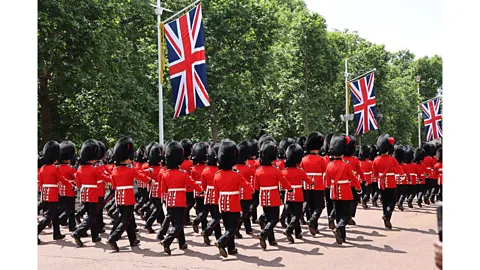
Although centuries old, the Union flag – commonly known as the union jack – which represents the unification of England, Scotland and Ireland, is rarely out of the UK news at present. Previously the flag was mostly found displayed on the flagpoles of official buildings but is now being hung from windows of people's homes, and dangled from motorway bridges and in other public spaces.
Its meaning and symbolism are under the spotlight in debates often producing more heat than light. Is the increasingly widespread public display of the union jack – and the St George flag – patriotism or provocation? The argument rumbles on – but what is clear is that the Union flag stands for very different things to different people in different contexts. For some it is simply a symbol of the UK, while for others it is an emblem of Empire, or has unsettling connotations of appropriation by the extreme right.
 Getty Images
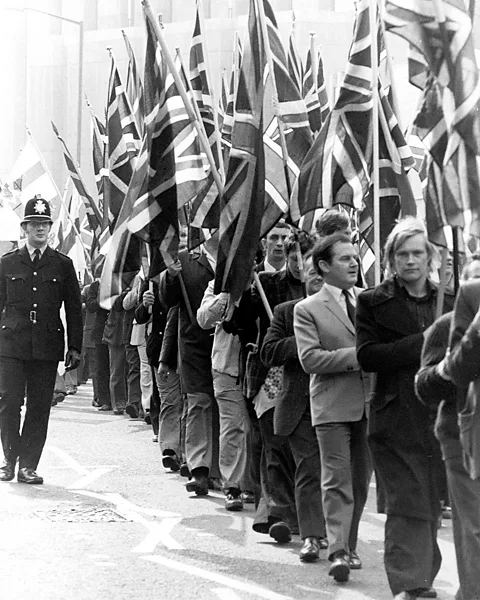
Professor Nick Groom is a cultural historian whose book The Union Jack: The Story of the British Flag traces the flag's history. He tells the BBC: "In the 1970s, you had [far-right nationalist party] the National Front attempting to appropriate the union jack but you also had Tim Brooke-Taylor of comedy group the Goodies wearing his union jack waistcoats. You had the Queen's silver jubilee, and you also had punks cutting up the flag and turning it into a fashion item.
"There are periodic outbreaks of flag-waving and displays of the flag, some of them endorsed by government, such as happened in 2007 when Gordon Brown became prime minister, and in his first statement to the Commons recommended that government buildings should fly the union jack every day in order to encourage a sense of British identity."
"I think it is incumbent on everyone not to let political extremists set the agenda," says Professor Groom. "If they try to set the agenda, you take it back. This is a flag of inclusivity and diversity. The union jack is almost like a history or map of these isles. Every element has had to compromise to fit in with the others and it has a very long and varied history."
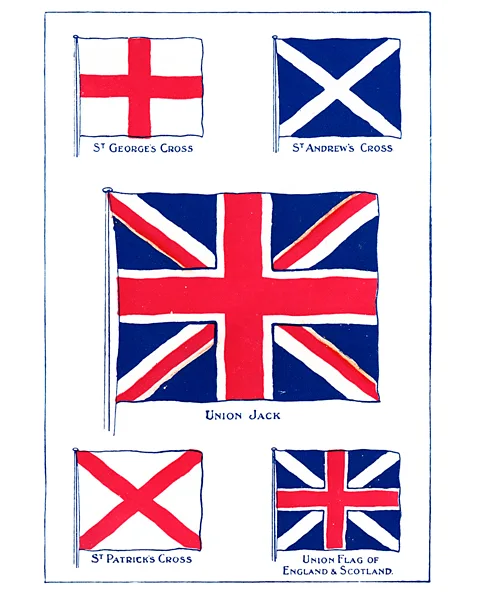
There are three components to the flag. The red cross of St George on a white background is the symbol of England. The diagonal cross of St Andrew on a field of blue is the emblem of Scotland. The red diagonal Irish cross of St Patrick on a white field is the third element.
Union of the Crowns
When James VI of Scotland acceded to the throne of England in 1603 as James I, it created a Union of the Crowns, uniting two kingdoms under one monarch but leaving them constitutionally separate. British naval vessels were required to fly both the red cross of St George and the blue saltire of St Andrew. However, two flags flying from the same mast signified that a military engagement had taken place, with the victor's flag flying above that of the vanquished (according to some, the practice of flying a flag at half-mast means the invisible flag of death is flying above it). English ships flew the cross of St George uppermost, Scottish ships the cross of St Andrew.
 Alamy
AlamyThis was hardly in the spirit of union that the king wished to encourage, so he had the Earl of Nottingham consider how the two flags might be combined. The earl – who was also Lord High Admiral – favoured a design with the cross of St George alongside the cross of St Andrew. However, according to the protocols of heraldry, whichever flag was nearest the flagpole was superior, so this design did not solve anything.
In 1606, an ingenious compromise was adopted. The cross of St George would be imposed over the cross of St Andrew but the "canton" – the upper portion of the flag nearest the flagpole and, according to heraldry, the most important sector – would be dominated by the colours of St Andrew. Neither insignia had the upper hand. The new "Union Flag" was to be flown by all merchant and royal vessels. There were still unhappy Scots and English who felt their identity was threatened, and there were design modifications, but essentially this became the basis of the Union flag.
When the Act of Union with Ireland was passed in 1801, the red cross of St Patrick was added to the flag, running it within the St Andrew’s cross. As historian Graham Stewart explains in his book Britannia: 100 Documents that Shaped a Nation: "In order not to obliterate the Scottish saltire, the Irish saltire was made less thick and was also 'counter-charged' – reversed in each half so that it is lower on the half nearer the flagpole (thereby ceding hierarchical priority to Scotland) but higher on the half more distant from the pole."
More like this:
Stewart continues: "This was another means of smoothing national sensibilities by ensuring that the precedence given to the Irish saltire – because it lay over the Scottish saltire – was balanced by the Scottish saltire having precedence in the more prestigious half of the design." The flag was first flown on 1 January 1801, when the United Kingdom of Great Britain and Ireland came into being. Since the Anglo-Irish Treaty of 1921, the red has represented Northern Ireland.
 Alamy
AlamyWhy no Wales, the other nation that makes up Britain (England, Scotland and Wales) and the United Kingdom (England, Scotland, Wales and Northern Ireland)? Because in 1283 Edward I conquered the rebellious Welsh. To underline his supremacy, Edward made his son the Prince of Wales. As a principality, rather than a kingdom, Wales is regarded as being represented by the cross of St George.
It was declared in Parliament in 1908 that "the union jack should be regarded as the national flag". Along with the United States' stars and stripes, the union jack is arguably the most recognised flag in the world. "I think in terms of longevity, influence and representation in different spheres, the union jack is absolutely iconic," Nick Groom says. He points out that the flag is easily recognisable from just a small portion of it, or when rendered in different colours or in black and white.
A symbol of Empire
Although originally a royal flag, the Union flag gradually became the symbol of Britain and then the UK. And as Britain grew as a colonial power and its empire spread, the union jack, which at one time flew over roughly a quarter of the world's population and landmass, became synonymous with subjugation and exploitation for those peoples of imperial territories who wanted independence. For many, the flag still carries connotations of colonialism as well as unsettling associations with Britian's role in the transatlantic slave trade.
 Alamy
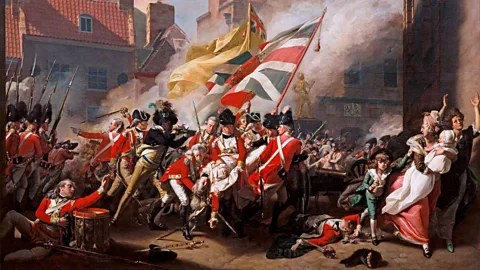
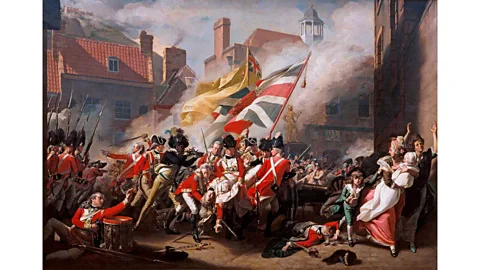
AlamyOver the centuries the flag has been a recurring motif in art, and many of the earlier examples are military and maritime depictions, such as John Singleton Copley's The Death of Major Peirson (1782-84). Celebrating a British victory against a French invasion of Jersey at a time when the British Empire was facing challenges, the painting served a propagandist purpose, boosting confidence in the British Empire after the loss of its American colonies, and glorifying British imperial power.
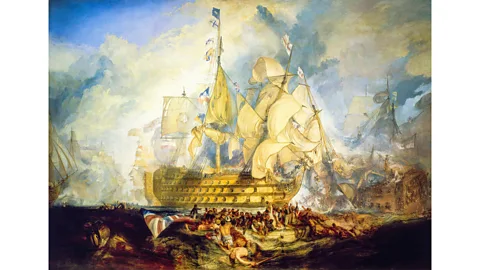
In Turner's painting The Battle of Trafalgar (1805), the eye is drawn to the only partly visible but unmistakable Union flag in the left foreground. Likewise, this painting has been seen as a powerful nationalistic statement, celebrating Britain's naval supremacy and its role as a global power following the battle. But it has also been interpreted as anti-war and anti-empire, with the art critic Jonathan Jones zoning in on its "troubling" portrayal of human suffering at its centre, with "a huge union jack floating, like a shroud, over the grisly waters".
In more recent years, the union jack has taken on a different meaning for some of the UK's citizens.Author and critic Arifa Akbar tells the BBC: "I was born in London but as someone of Pakistani heritage, my first and formative childhood memories of the union jack are closely associated with the National Front [NF], and the very real fear of abuse or attack that people who looked like me experienced in Britain in the 1970s and '80s. The NF claimed the union jack for their own purposes, and gave it sickening associations with violent racism."
 Getty Images
The 1990s were marked by a surge in British music, fashion and art, coinciding with a New Labour government in 1997. This was the dubbed the "Cool Britannia" era, a phrase which was a pun on the patriotic song Rule Britannia. The union jack at the time became a symbol of this revitalised, optimistic image of the UK on the world stage.
Akbar says: "There was a shift in my relationship with the flag with the emergence of New Labour and Cool Britannia. Remember the Spice Girls and that union jack dress [as worn by Geri Halliwell at the 1997 Brit music awards]? I felt less uneasy around it. It became divested of its aggressively racist elements, and seemed to represent a more tolerant, less hostile, patriotism. I also remember some friends – people of colour – feeling more easy about waving the union jack. I don't think the union jack is only synonymous with colonialism or imperial history. A nation's flag has many different meanings, not just one, and these can change over time."
A recurring motif
The emblem has appeared in artworks by, among others, British Pop Artist Peter Blake and Turner prize-winning painter Chris Ofili, whose artwork Union Black reimagines the flag in the pan-African colours of red, black and green.
 Getty Images
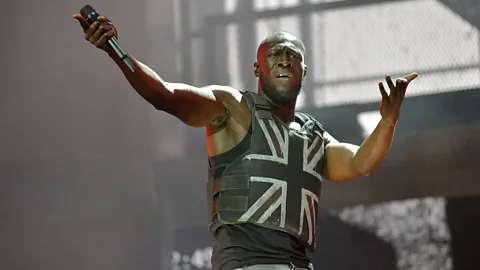
Banksy has employed the flag in his satirical murals, and in 2019, when Stormzy became the first black British solo artist to headline at Glastonbury, he took to the stage wearing a Banksy creation – a stab-proof vest emblazoned with a near-monochrome union jack. It was a commentary on social injustice, racism and knife crime in the UK. It also possibly served as a stylish riposte to the racist 1970s chant "There ain't no black in the union jack" (a phrase that in 1987 had provided the title for an influential book by Paul Gilroy).
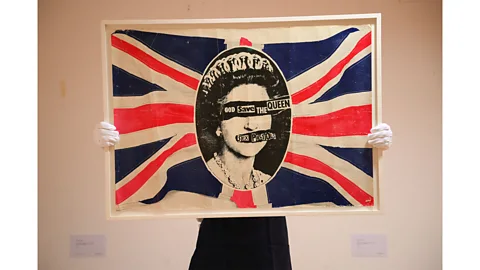
The emblem has been adopted over the decades by numerous musical artists, from The Who and the British mod movement in the 1960s to the punks in the 1970s – with the Sex Pistols featuring the flag ironically in the artwork for their anti-monarchist single God Save the Queen. Designer Alexander McQueen created a union jack dress coat for David Bowie which the singer wore on stage and on the cover of his 1997 album Earthling.
At the height of the Cool Britannia phenomenon, Patsy Kensit and Liam Gallagher appeared on the cover of Vanity Fair magazine, lounging on union jack pillows. In 2012, the London Olympics opening ceremony began with a Queen Elizabeth II lookalike floating into the stadium attached to a union jack parachute – it was a moment of affectionate whimsy and softly humorous patriotism.
 Getty Images
Now, Akbar worries that the flag's connotations may be undergoing one of its shifts. "Sadly, once again, with the rise of anti-immigrant anger and race hate, the flag seems to have been co-opted by the haters," she says.
On the other hand, the flag functions as a symbol of straightforward national pride for many across the country. Nick Groom says: "In terms of people reclaiming the flag, a child waving a plastic union jack at a street party or a country fair does as much to bring the flag back into the community as any statement by a politician. It is the people's flag."
--
If you liked this story, sign up for The Essential List newsletter – a handpicked selection of features, videos and can't-miss news, delivered to your inbox twice a week.
