'Lee Miller was the bravest person I ever knew': The pioneering photographer who captured the horror of World War Two

 Lee Miller Archives, England 2025. All rights reserved. leemiller.co.uk
The unflinching, surreal gaze of the US artist and war photographer Lee Miller bore witness to both beauty and brutality. Now she is the subject of a major exhibition at Tate Britain.
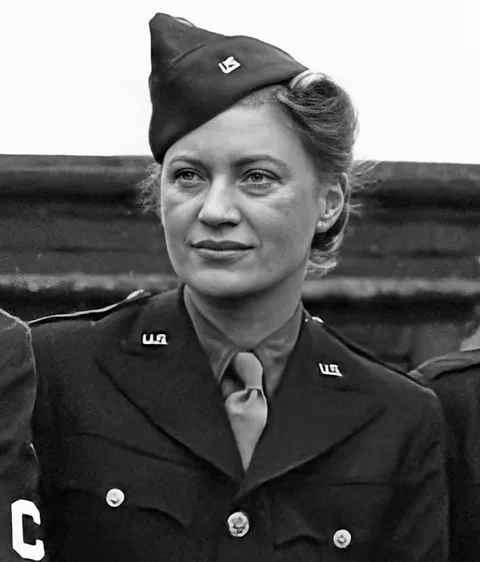
Lee Miller's vision spirits us across place and time. At Tate Britain's newly opened retrospective of Miller's work, we see the intense intimacy and extraordinary range of her practice, spanning high fashion, avant-garde effects, surreal viewpoints and brutal war reportage. At 20, she was a Vogue cover star, embodying roaring-20s panache; she became apprentice and lover to legendary Paris-based artist Man Ray (with whom she pioneered the otherworldly solarisation photographic technique), then swiftly established her own place behind the camera and an independent studio. She would later quip: "I'd rather take a picture than be one". By 1942, she was an accredited World War Two correspondent for the same glossy magazine she had originally modelled and shot designer outfits for.
 Alamy
AlamyMiller's images appear to code-switch and slip between boundaries – so sleekly, in fact, that their scope remains startling. Major international exhibitions – at Tate Britain and, from next month, at Vancouver's Polygon Gallery – as well as books and screen releases (notably the 2023 biopic Lee, starring Kate Winslet in the title role) reflect a modern mainstream reawakening to Miller. They also highlight a growing realisation: that she was, arguably, the most fearless photographer of the 20th Century.
Tate exhibition curator Hilary Floe spent three years immersed in Miller's work for this show. She tells the BBC: "What unites these vast and sprawling bodies of work that [Miller] creates? These three words kept haunting me: fearless, poetic, and surreal."
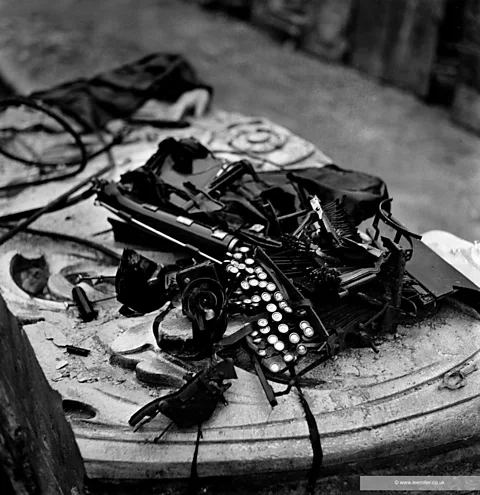
Those qualities are powerfully evident in Miller's World War Two photography; as a woman correspondent, she was restricted from frontline coverage – yet rather than limiting her perspective, she captured details that were urgent, eloquent and uncomfortably close. She found sharp allegories for violence (for instance, a shattered "Remington Silent" typewriter on bombed building remains). She photographed the German concentration camps Dachau and Buchenwald post liberation, starkly depicting both victims and perpetrators; in one shot, we are brought eye-to-eye with a beaten SS guard, his features dazzled by Miller's camera flash.
 Lee Miller Archives, England 2025. All rights reserved. leemiller.co.uk
"She became a war correspondent because she felt that bearing witness was incredibly important," says Floe. "And in doing so, she looked at things that affected her for the rest of her life. It's not that she was the only person in the camps, but she created very powerful images there with a very particular construction and intelligence behind them."
Unwavering vision
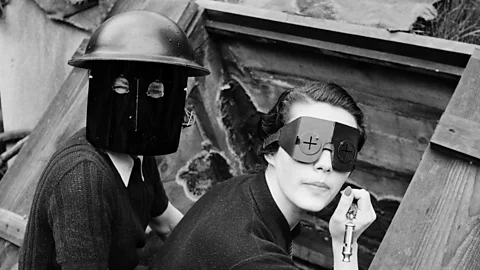
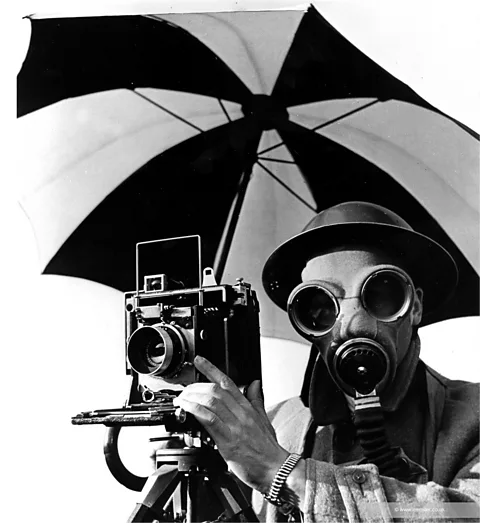
Some of Miller's wartime images are surreally stylish: her close friend and fellow photojournalist David Scherman poses in a gas mask standing behind his own camera (Miller and Scherman would also photograph one another bathing in Hitler's house, on the day of the Fuhrer's death); there is a weirdly futuristic chic to the two young women wearing fire masks in Blitz-era London. But Miller was also unafraid to capture the messy, troubling fall-out of life after liberation. The Tate exhibition includes another unforgettable portrait (unpublished at its time) of a young woman accused of being a Nazi collaborator, her head roughly shaven, her expression crushed.
More like this:
• 12 of the most striking images of the year so far
• Smoke and mirrors: Who was the real Andy Warhol?
• Hidden meanings in a US masterpiece
"It was fearless of Miller to portray the women in that way; she really broke the conventions around representation," says Floe. "She's inviting reflections about the nature of humanity and the aftermath of atrocity, and how we move forward."
 Lee Miller Archives, England 2025. All rights reserved. leemiller.co.uk
Such reflections are relatable today, Floe believes: "We live in a world of escalating international tensions, ramping-up defence budgets, and a growing far right. I think for [Miller], what was important to document was the consequences of those kinds of things, and the consequences of stigmatising minorities. She did not want this to be forgotten."
Miller's headstrong creativity is evoked by her wry quotes; she once explained of her work: "It was a matter of getting out on a damn limb, and sawing it off behind you." The urgency, audaciousness, and unexpected compassion that defines so much of her photography is also inextricably linked to her personal experience.
She was born in 1907 in Poughkeepsie, New York State; she began her global adventures in her youth, though her ultimate home was Farleys House in the East Sussex countryside, where she moved in 1949 with her husband, British painter and curator Roland Penrose, and their infant son Antony. It was only following Miller's death in 1977 that her family discovered a huge cache of her previously unseen negatives, personal letters and manuscripts.
Traumatic details
This proved a multi-stranded revelation. It uncovered traumatic details that Miller had never openly discussed – the childhood sexual abuse she had suffered (aged seven, she was abused by a family acquaintance) and the full extent of the World War Two horrors she had witnessed. For Antony Penrose, it also brought focus to his mother's undiagnosed post-traumatic stress disorder, and their icy relationship, which only thawed shortly before her death.
Penrose became his mother's biographer (his book, The Lives Of Lee Miller, inspired the recent biopic); he and his daughter Ami Bouhassane are now custodians of Miller's archives and also guides at Farleys House, where visitors can see artworks by Miller and her life-long friends (such as Man Ray and Picasso), contemporary art exhibitions, and some of Miller's personal effects – including the bespoke knuckledusters she carried during the war.
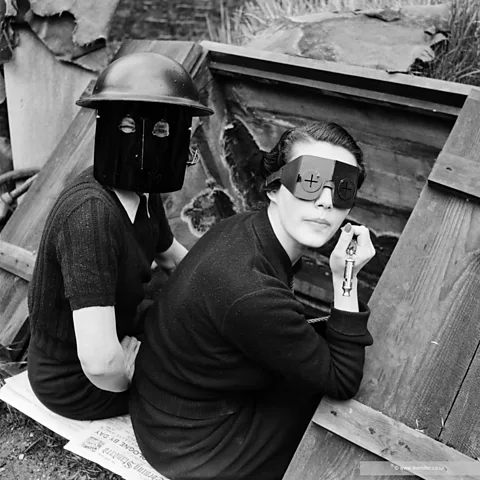 Lee Miller Archives, England 2025. All rights reserved. leemiller.co.uk
"She was not going to portray herself as a victim," Penrose tells the BBC. "But she had this empathy with people who had been abused; that was something I noticed in her as an adult, without understanding it."
Penrose also recalls anecdotes about the "dangerous games" his mother was encouraged to play in childhood: "They really were quite hazardous: aerial ropeways over huge drops," he says. "Lee and her brother had to have their wits about them, really assess what the dangers were, and how to survive them. This was only playing, but it laid a foundation in her that was very important.
"When she later found herself in very challenging wartime situations, she was probably scared witless, but she learned how to manage risks. John Philips, who was a Lifemagazine war correspondent, said to me: 'Lee Miller was the bravest person I ever knew… when things got really bad, she was the person we all wanted to be with. She never panics; she always had a plan – and she usually had whiskey and cigarettes.' He said she was just the kind of person that popped up in the most unexpected places at the most unexpected times."
This quality recurs throughout Miller's bodies of work, as the Tate exhibition illustrates. She regularly found extraordinary details in everyday scenes; in Untitled (man and tar, taken in Paris, circa 1930), tar oozes from beneath the pavement, forming an alien landscape. She was remarkably un-squeamish in her depictions; around 1930, she had also been documenting surgeries in a Paris hospital.
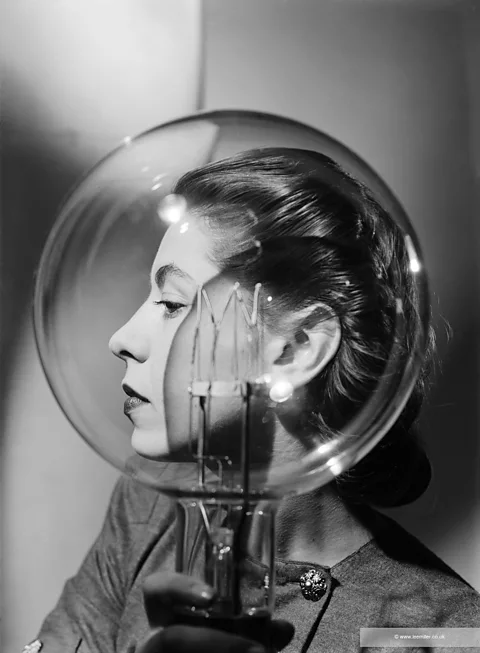 Lee Miller Archives, England 2025. All rights reserved. leemiller.co.uk
As a young woman, Miller also travelled freely across countries including Egypt, Palestine, Syria, Lebanon and Greece. "She was married to an Egyptian man [her first husband, Aziz Eloui Bey]; she was living in Cairo, and travelling very adventurously in the region: taking multi-day off-road trips in a car, in places with no gas stations, running water or sat nav. It enabled her to take extraordinary images," explains Floe. Her photographs from these expeditions include abstract landscapes (such as 1937's Portrait of Space, Al Buwayeb near Siwa), intimate portraits, and industrial cities; they subvert stereotypical views and exoticised narratives.
"That space of possibility in the work is what keeps us coming back to it," says Floe. It is another aspect of why Lee Miller remains sharply pertinent. She was constantly driven to bear witness; she met the world with an unwavering gaze, and her photography impels us to do the same.
Lee Miller is at Tate Britain, London, until 15 February, 2026;From the Lee Miller Archives is at Farleys House and Gallery, East Sussex, until 31 October;Lee Miller: A Photographer at Work is at The Polygon, Vancouver from 7 November -1 February 2026.
--
If you liked this story, sign up for the Essential List newsletter – a handpicked selection of features, videos and can't-miss news, delivered to your inbox twice a week.
For more Culture stories from the BBC, follow us on Facebook and Instagram.
