'It reinforced the idea that anything can happen': The glitch in Super Mario Bros that obsessed gamers

 Super Mario Bros/ Nintendo
Forty years ago, the series' original game was released by Nintendo. As well as trying to complete it, fans were desperate to access a secret world that became legendary.
Today, video gamers are always looking for the unexpected when they sit down to play. All the biggest titles feature easter eggs, secret areas, intentional "glitches" and other surprises woven into their expansive worlds: see, for example, Ubisoft's 2011 racing game Driver: San Francisco, where driving a Delorean (of Back to the Future fame) at 88mph will unlock a secret level called Blast From the Past, and The Sims 4 (2014), where typing in "motherlode" as a "cheat code" will instantly add a flood of money to your budget.
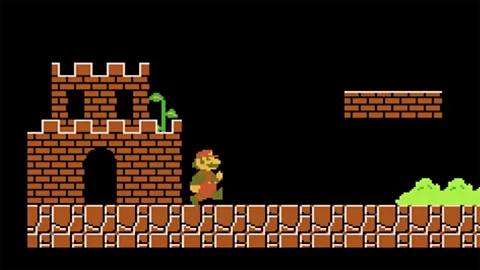
But the history of these unpredictable elements of gameplay goes all the way back to 1985. Nintendo's Super Mario Bros, the first game in the feted Super Mario series, was released on its flagship Nintendo Entertainment System (NES) 40 years ago this month. And a genuine error made its way into it. When coding the game, developers made a mistake that captivated gamers at the time and subsequently influenced the whole history of video game development.
 Super Mario Bros/ Nintendo
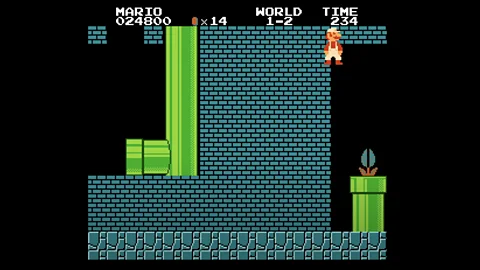
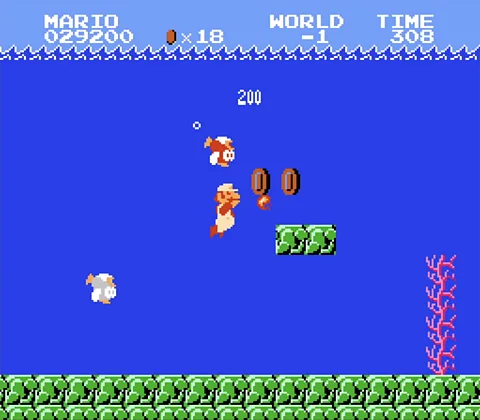
The glitch came early on in the game, and involved making the protagonist Mario – an Italian plumber tasked with saving a princess from a castle – jump at a particular wall at just the right angle. If you got it right, he would glide through the wall and into one of the Warp Zones: the areas through which Mario could transition between levels by jumping down a pipe. But if you sent him down a pipe in this Warp Zone, he'd arrive in a place that wasn't supposed to exist – an underwater level that looped back on itself to infinite effect. The only way out was to reset or die.
This coding error occurred in World 1 level 2, which was introduced on screen as "World 1-2". After Mario had glided through the wall and down the pipe in World 1-2, text would appear on the screen to indicate which new world and level he was entering, as per usual. But thanks to the glitch, there was a blank space where the world number would usually be, so it read as "World -1". This secret level therefore became known as the "Minus World".
Rumours of the phenomenon spread through word of mouth soon after the game's release, before entering gaming folklore in 1988 when American magazine Nintendo Power reported on it. "Explore the mysterious minus world," said the article, teaching readers how to access the hidden level. It's now regularly celebrated as "the greatest glitch of all time", but upon its discovery many questions arose: did Nintendo put the level there deliberately? Were there other secret levels in Super Mario Bros? Were there other secrets hidden in other games?
Nintendo's legendary auteur Shigeru Miyamoto denied that the Minus World was a deliberate feature of the game. But it added to Super Mario Bros's allure of unpredictability: here was a game whose gradually unfurling world was unlike anything that came before it.
"I remember finding [Super Mario Bros] kind of mind-blowing," says author and video games scholar Dr Brendan Keogh, who recalls playing it for the first time at a friend's house after school. "At that point, most of the games I was playing didn't have backgrounds, they were just black. So seeing Mario Brothers, where it's this very coherent world with fantastical creatures and fields and trees and bushes and clouds… It felt kind of limitless, in terms of what could be hidden that you haven't seen yet."
Some of the game's other "secrets" were put there deliberately. Punch through a ceiling, for example, and you might be able to jump on top and walk past an entire level. But then there was this one big, accidental surprise. Nobody is sure who first discovered the Minus World, but it could only ever have been by mistake.
 Super Mario Bros/ Nintendo
Complex technical explanations about why the glitch occurred permeate the internet. And even though the Minus World itself was not the most exciting level – particularly since it could never be completed – the whole thing captured imaginations around the world.
Scott Pelland, who worked as Publications Director at Nintendo in the 1980s and 1990s, says that the employees who had the job of answering phone calls from gamers – known as Game Counselors – were inundated with calls about the Minus World. "It was one of the most popular questions for [them] for quite some time," he says.
In a 2010 interview, Nintendo wizard Miyamoto conceded that, because the Minus World didn't crash the game (and perhaps because of the fervent lore surrounding it), it could actually be considered a feature of Super Mario Bros, even if it wasn't a deliberate one. Generations after the game's release, the glitch's influence on gaming culture is as striking as its immediate impact among Nintendo obsessives.
"It was the Minus World that first made us believe that anything was possible in video games," pronounced Edge magazine in 2015. This belief has inspired game developers to truly think outside the box. Take, for example, Frog Fractions, a browser-based game released in 2012. It started with a simple premise, whereby players would control a frog who caught bugs with its tongue, and, according to its blurb, it was an educational game that could teach children about fractions. But it wasn't. Because if you perform a special trick (no spoilers) in the initial bug-catching level, you are taken on an utterly unpredictable adventure through space, courtrooms, underwater tunnels and dance battles. Its creator, Jim Stormdancer (formerly Jim Crawford), tells the BBC that he was inspired to create this mind-boggling twist by the Super Mario Bros games, as he wanted to recreate the sense of disbelief felt by gamers who had discovered its secrets.
"What you get is the reinforcement of the idea that anything can happen," he says, in praise of the Minus World. "You can be playing this game for a week and suddenly you jump in just the right spot and there's something that you never knew was there." He remembers finding the Minus World for the first time as a young gamer. "I've glided through the bricks myself. It really lent to the feeling that this is a magical world that I'm reaching through the controller and touching."
 Rockstar Games
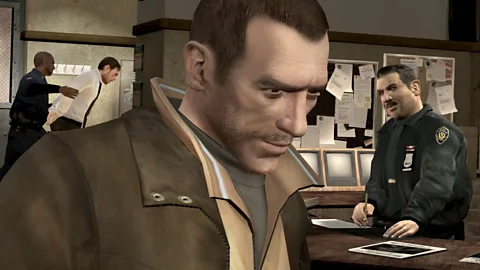
Ever since the Minus World, gamers have been driven to scour every virtual square-inch of their favourite games, on the off-chance that they might find other unexpected features resulting from coding mistakes. And there have been quite a few over the years. An error in Spyro: Enter the Dragonfly (2002) meant that you could jump straight to the final boss about 30 seconds into level 1, if you made the lead dragon character perform a move known as a "ground pound" near the right portal. Drive your car at a swing in Grand Theft Auto IV (2008) and you could send it shooting into the sky. Getting stuck in a crouch in Halo 2 (2004), then jumping at a particular bit of the game's geometry, would let you "superbounce" to otherwise inaccessible areas. There were backwards-flying dragons in The Elder Scrolls V: Skyrim (2011). Faceless characters in Assassin's Creed (2007). And "Missingno", a glitched jumble of pixels that you could catch in Pokémon Red and Blue (1996). These were all glitches, accidentally inserted by developers, and they were all lapped up by gamers.
Phenomena like these let gamers believe there is more to these fictional worlds than meets the eye. Perhaps gaming expert Danny O'Dwyer said it best in a documentary for his Youtube channel Noclip, in which he celebrated the mystery of games like Frog Fractions while arguing that mystery was now dissipating in an increasingly polished, glitch-free gaming world. "It's a feeling that seems to evaporate as the years pass us: that brief but powerful feeling that perhaps we don't know everything about the game we're playing."
--
If you liked this story, sign up for The Essential List newsletter – a handpicked selection of features, videos and can't-miss news, delivered to your inbox twice a week.
For more Culture stories from the BBC, follow us on Facebook and Instagram.