The yoghurt delivery women combatting loneliness in Japan

 Yakult Honsha
As loneliness deepens in one of the world's fastest-ageing nations, a network of women delivering probiotic milk drinks has become a vital source of routine, connection and care.
A woman in a neat navy suit and powder-blue shirt cycles purposefully down a quiet residential street in Tokyo. It's 08:30 but already balmy, and she's grateful for the matching visor that shields her eyes from the summer sun.
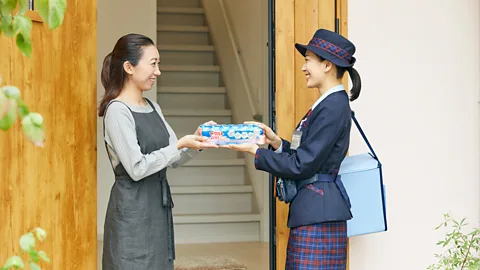
She arrives at her first stop, parks her bike and knocks on the door of a small wooden house with potted plants flanking the entrance. Inside, an elderly woman waits. Her face breaks into a broad smile as she opens the door – she has been expecting this visit.
Japan is the world's most rapidly ageing major economy. Nearly 30% of its population is now over 65, and the number of elderly people living alone continues to rise. As families shrink and traditional multi-generational households decline, isolation has become one of the country's most pressing social challenges.
The suited woman is a Yakult Lady – one of tens of thousands across Japan who deliver the eponymous probiotic drinks directly to people's homes. On paper they're delivery workers, but in practice they're part of the country's informal social safety net. In a country grappling with a rapidly ageing population and a deepening loneliness crisis, Yakult Ladies have become an unlikely source of community, helping to reduce the problem of isolation one drop-off at a time.
With their distinctive squat plastic bottles and shiny red caps, Yakult pioneered a genre. The probiotic drink was launched in Japan 90 years ago – long before "microbiome" became common parlance. But today, the women who deliver them are as important to the brand's identity as the product itself.
The initiative began unintentionally. When Yakult launched in 1935, the idea of drinking "bacteria" sounded bad – like something that would make you sick rather than healthy. To explain what the product was, the company needed salespeople to go door to door. Back then, the workforce was almost entirely men, but labour shortages led local distributors to hire women from their communities, and sales grew quickly.
These women appealed particularly to other women, who were more likely to make decisions about household groceries, and were often already known to the people they delivered to – a familiarity that helped foster trust.
Thrilled by this sudden increase in sales, the company decided to formally implement the programme. In 1963 the "Women's Delivery Sales Network" – now known as the Yakult Lady system – was formally established.
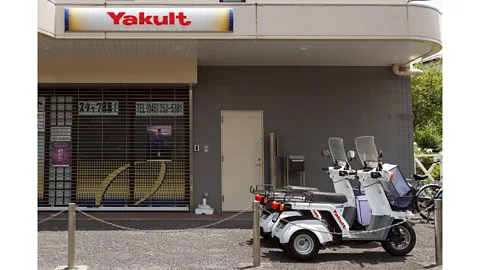
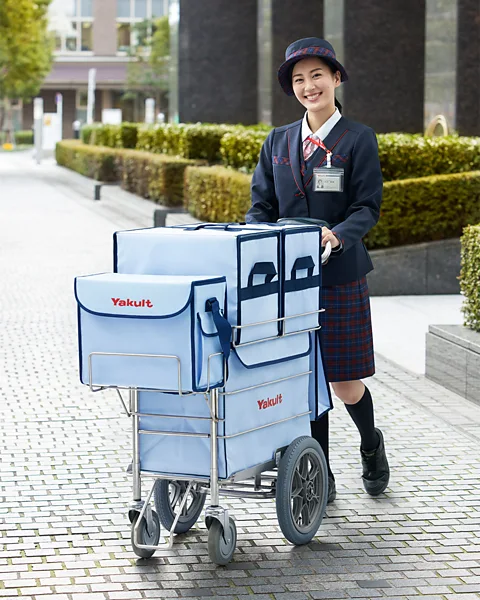
Yakult Ladies are easy to spot in the community. In their blue uniforms with signature red plaid trim, they've become almost as recognisable as the Yakult bottles themselves. They're often seen whizzing about their neighbourhoods on bikes, motorbikes, on foot or by car, making multiple deliveries each day. Most of them are self-employed, offering flexibility that attracts women balancing work and family.
"I make deliveries on Mondays, Tuesdays, Thursdays and Fridays," says Satoko Furuhata, who has been a Yakult Lady for 25 years. "Since I always take Wednesdays off, I essentially work a four-day week, which gives me a good balance between work and personal time and allows me to stay fresh."
Her day begins at 08:30 when she loads her car and sets off on her route. "I have different routes each day but I visit about 40 to 45 households per day," she says.
 Alamy
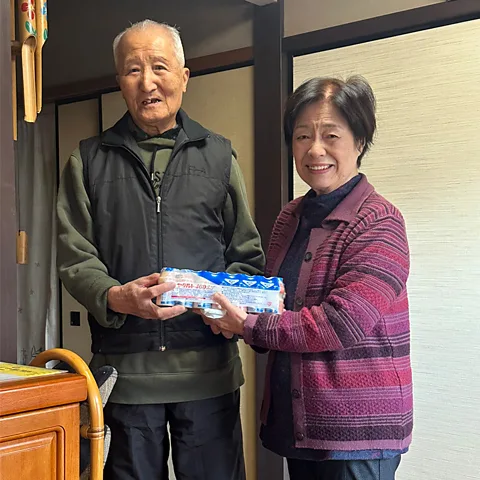
AlamyEvery Monday for the past quarter-century, Furuhata has visited the same customer (who wants to remain anonymous) who is now 83 and lives alone in Maebashi, 100 miles north-west of Tokyo. Since her children have long left home, the elderly woman has come to treasure the visits. "Knowing that someone will definitely come to see my face each week is a tremendous comfort," she says. "Even on days when I feel unwell, hearing her say, 'How are you today?' at my doorstep gives me strength."
It has become such a long-standing routine that she avoids scheduling anything else that time. "Monday is my 'energy charging day'," she says. "I genuinely look forward to her visits. When the doorbell rings and I hear her cheerful voice, it lifts my spirits instantly."
They chat about many things: their families, gardening and growing flowers, local news and health topics they've read about in newspapers or seen on TV. "These may seem like small conversations, but they make me feel and realise that I'm not alone."
Gut health – and human health
Yakult is a fermented milk drink that contains a specific strain of lactic acid bacteria cultured by Dr Minoru Shirota, Yakult's founder, in 1930. When the scientist began studying medicine at Kyoto University in 1921, Japan was still developing economically, and many children were dying from infectious diseases. Appalled by the situation, he committed himself to the study of disease prevention, which led him to focus on microbiology – specifically helpful bacteria that could suppress harmful bacteria in the gut.
But when Yakult launched, no one understood it, and uptake was slow. Despite Japanese cuisine already consisting of many foods with live microbes – miso, natto, traditional soy sauce – there was little awareness of their contribution to health.
"The term 'probiotics' did not yet exist," says a Yakult spokesperson. "Gaining public understanding and acceptance took time."
 Yakult UK
It took many years before the product really took off, but by 1971, eight years after the Yakult Ladies had been formed, sales reached 15 million bottles per day in Japan. Shirota's mantra of "healthy gut, long life" began to be repeated by mothers to their children, for whom the idea of eating fermented products for health became as normal as eating vegetables.
Haruko Kawabe, 33, from Tokyo says: "We grew up with Yakult. My mum always brought it home from the shop or from her workplace and I would see Yakult Ladies riding around on their bikes constantly when I was a child. I always knew it was important to take care of your gut."
Interest in the gut microbiome has surged globally in the past decade. However, it's not just diet that affects gut health. Stress and chronic loneliness may negatively affect gut health, explains Dr Emily Leeming, a microbiome scientist. "We live in a microbial world, constantly exchanging microbes back and forth between each other. That's one reason why loneliness is linked to lower gut microbiome diversity. It's also likely due to stress too, with loneliness causing a low-grade stress response that can also negatively impact your gut microbiome."
Yakult did not design its delivery network as a public health intervention. But over time, the social dimension of the visits has taken on growing significance.
"I've stayed healthy without major illnesses and people often tell me how energetic I am," says Furuhata's 83-year-old customer. "I believe that's because I've been drinking Yakult for many years. But it's not just the drink… receiving Mrs Furuhata's visits [is also] important to my health routine."
Watching over a greying nation
In Japan, the number of people over 65 living alone is expected to rise to almost 11 million by 2050, according to the National Institute of Population and Social Security Research.
The country even has the term kodokushi or "lonely death", which refers to the tragic cases of people dying alone at home with no one noticing for months, and sometimes years. It's a deepening crisis. According to National Police Agency data, 40,913 people died alone at home in Japan from January to June 2025, an increase of 3,686 from the same period in 2024. In 2021, Japan's first "Minister of Loneliness" was appointed to government, and there's a task force focused on social isolation.
But on the ground, Yakult Ladies are doing their bit to help blunt the problem.
 Yakult Honsha
Asuka Mochida is a Yakult Lady from Gunma Prefecture. Nearly all her customers are elderly, and she feels a deep sense of pride in being able to offer them both companionship and a watchful eye.
"Yakult Ladies are not just people who sell products," says the 47-year-old. "We are watchers in a sense, people who look out for others. We notice small changes in health or lifestyle."
More like this:
The maternal figures offer a friendly face, weekly check-ins and, for many older residents, a lifeline of human connection. They also notice subtle changes in a customer's routine. If someone fails to answer the door, they may alert family members or seek assistance.
"For elderly customers or those living alone, the reassurance of seeing a familiar face is incredibly important," says Mochida. "Japan has a culture of watching over others and one's community. I think Yakult Ladies put that culture into practice in a natural, sustainable way. It's a job where responsibility and kindness overlap."
It's also a job that can come with high levels of satisfaction. "Even on busy days when I can sometimes only talk for a moment, a customer once told me, 'Just seeing your face gives me energy.' That made me realise that even if I'm not perfect, simply being there can make a meaningful difference."
 Yakult India
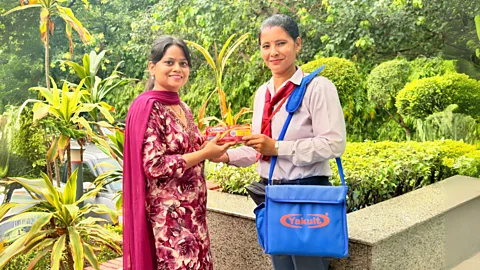
There's currently more than 31,000 Yakult ladies in Japan. The model has also been replicated overseas, with nearly 50,000 more in countries such as China, Indonesia, Malaysia, Brazil and Mexico. Instead of "ladies" they're affectionately known as "Yakult moms" or "aunties" and have the same nurturing and watchful position, with their role in society just as treasured.
Whatever their name, these women are united by a similar set of skills and traits, such as "maintaining a genuine smile and positive energy", according to Furuhata.
"The ability to listen and to notice things," adds Mochida. "Being attentive to small changes is essential."
In a country grappling with demographic change and rising isolation, that brief exchange at the doorstep can carry more weight than a small red bottle suggests.
--
If you liked this story, sign up for The Essential List newsletter – a handpicked selection of features, videos and can't-miss news, delivered to your inbox twice a week.
