Fifty courses and no leftovers allowed: Inside Italy's sacred Panarda feast

 Alamy
AlamyEach year in the village of Villavallelonga, friends and family gather to honour a local saint with a 50-course meal where no forkful goes uneaten – just as they have for centuries.
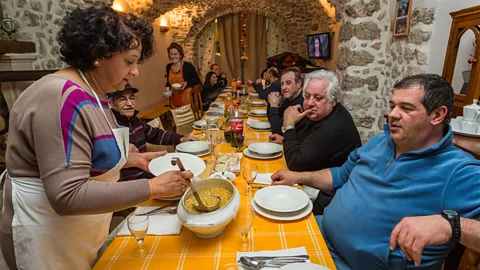
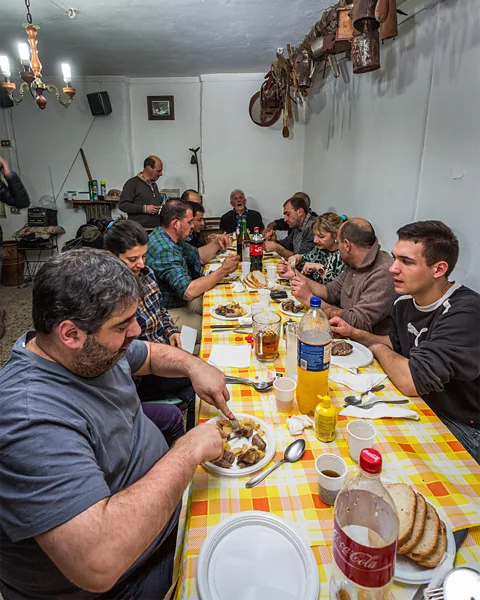
It's just past 23:00 when the pasta bignè (fried dough swimming in hen broth) is cleared away. The rustic soup is the 22nd course my fellow 42 diners and I have been served since taking our seats in Lucia Corona's dining room. Now comes the frascareglie – a humble "false polenta" made from water and flour and smothered with fragrant mutton ragu. We've been sitting at the table for three hours. There are 28 more courses to go.
Dinners that last hours are typical in Italy, but this is no typical dinner. This is the panarda, the communal meal held every 16 January on the feast of Saint Anthony Abate in the 900-person mountain village of Villavallelonga, Abruzzo. There are 50 button-popping courses, all to be eaten: no shortcuts, no excuses. It is one of the most distinctive communal food rituals in central Italy – and one of its oldest.
 Alamy
AlamyThe week when no one sleeps
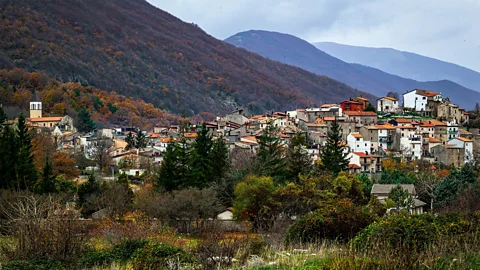
Deep in the central Apennines, Villavallelonga is characterised by medieval stone houses and narrow stairways. It remains one of Italy's lesser touristed mountain villages. Perhaps this is why the week of Saint Anthony Abate – from 11 to 17 January – feels so much like stepping back in time.
Plan your trip:
When: The panarda takes place on 16 January during the feast of Saint Anthony Abate with events running from 11 to 17 January, including music, communal food and a masked procession marking the start of Carnival.
Getting there: Villavallelonga is best reached from Rome by train to Avezzano or by rental car. From Avezzano, it's about 30 minutes by car; bus services are limited.
Where to stay: Accommodation in Villavallelonga is scarce; base yourself in Avezzano or Celano, where hotels and B&Bs are more readily available.
"It matters more than Christmas, feels more immersive than Carnival and is louder than New Year's Eve," says Vittoria Di Ponzio, Villavallelonga's deputy mayor. "For a week, the whole village takes part."
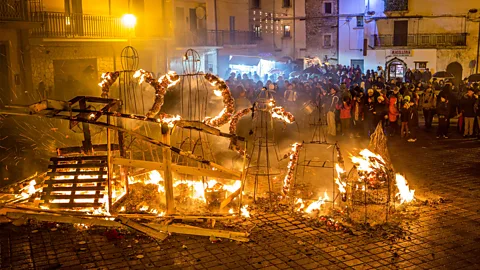
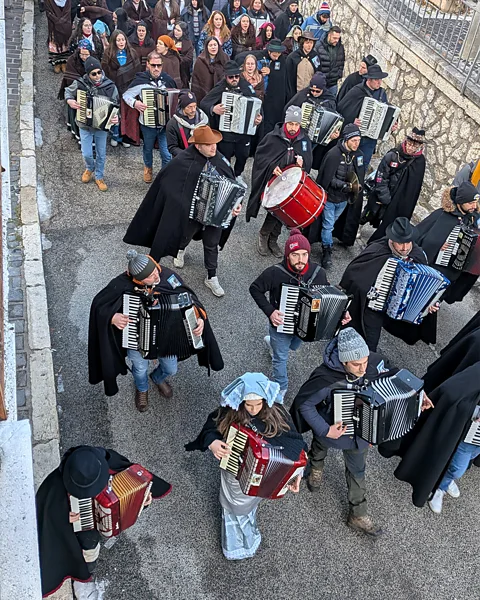
The first five days, the village comes alive at night. Fireworks crack through the dark. Families gather around outdoor fires, sharing dishes simmered in giant pots. Young adults roam the streets with accordions and drums, singing the canzone di Sant'Antonio (Saint Anthony's Song) in exchange for plates of fava beans and wine. On the evening of 17 January, the celebrations conclude in the main piazza with pasta all'amatriciana (pasta with tomato sauce and cured pig jowl) and the burning of the pupazze (towering ritual figures built over the preceding months made from wood, fabric and papier-mâché).
"It's the most intense week of the year," says local student Nicola Palozzi, between bites of sausages with chicory. "We barely sleep, but we wouldn't miss it for anything."
He then sets his fork down, picks up his accordion and joins in the music.
 Alamy
AlamyA feast shaped by miracles, hunger and heritage
The earliest written records of the panarda date to 1657 and describe a ritual linked to the end of winter. At its core are two founding legends and two families.
According to tradition, the custom began when the Serafini, local landowners, pledged to offer an abundant meal to the community if Saint Anthony Abate freed them from a pact with the devil.
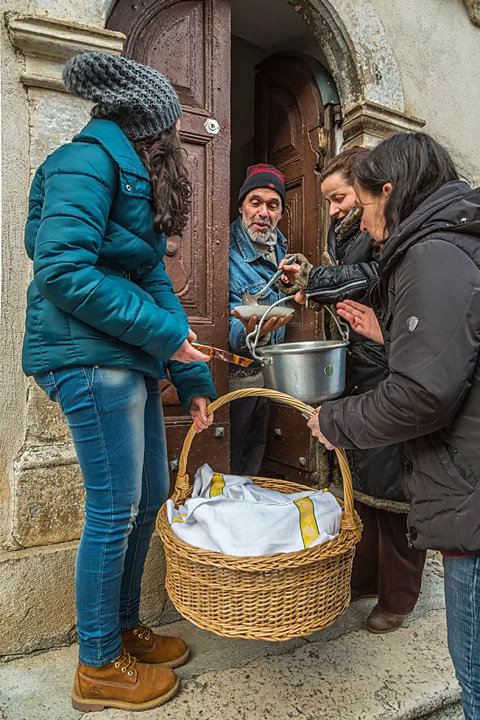
Another legend tells that it was the Bianchi family, instead, who vowed to distribute the favata – fava beans and bread – to the townspeople at dawn on 17 January, from house to house, after Saint Anthony saved a child taken by a wolf.
"But for us, panarda isn't folklore," says local official Constantina Ferrari. "It's how we recognise ourselves. Even if you live elsewhere, this is where you feel you still belong."
At first, the panarda was offered only to the poorest villagers. Today, the guest list has evolved to include anyone who wishes to take part, but the rule remains unchanged: everyone at the dinner eats the same food, in the same order, at the same pace.
 Martino De Mori
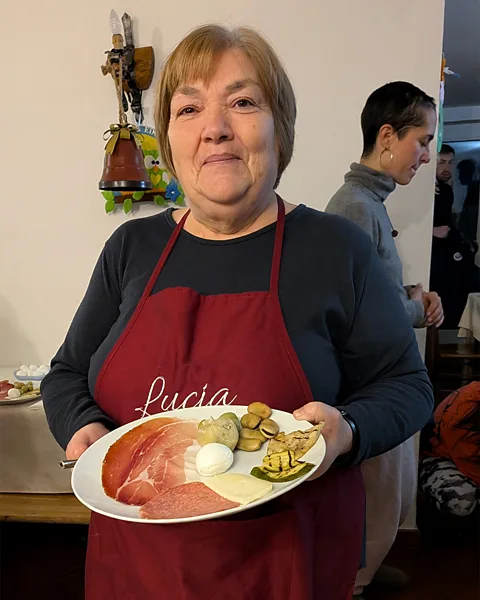
"Here, you don't choose to host it – you inherit it," says Corona, my panarda host, as she weaves between three long tables to serve course number 37: lamb cutlets with green salad. "It's an honour, and you have to take it seriously."
While the descendants of the Serafini family host the official panarda, the same ritual dinner is held simultaneously in many other homes across the village.
Guests also follow unwritten rules: every course must be eaten, and once you take part, you are expected to return year after year – always to the same panarda.
"There are no tickets, but our guiding principle is that no one should be left out," says Cristina Mastrella of the Villavallelonga Pro Loco organising committee.
How do you get an invite? "The Italian way," she says. "Ask around. Someone will always find a place for you."
Every dish is mandatory
Here at the Corona home, Montepulciano and Pecorino wines are flowing steadily. Each hosting family follows its own menu, but some dishes are non-negotiable: antipasti of cured meats, cheeses, olives and fava beans; then the pasta courses – pasta bignè and the maccheroni di Sant'Antonio (thick, square-cut spaghetti made by hand and dressed with slow-cooked mutton ragu). Lamb takes centre stage among the mains, followed by a parade of desserts and bitter gentian liqueur.
Ask why there are 50 dishes and people will shrug.
But there is a historical reason. In a landscape where villagers were often exposed to hunger, cold and isolation, abundance took on a protective meaning. Eating well – and eating a lot – once a year became a way of pushing misfortune away; of asserting that there was enough to share, at least for one night.
 Alamy
AlamyAnd then there's the Italian-style obligation.
"Eating everything is a duty," says Corona as she moves briskly among the tables. "It's a sign of respect – for the community and for the people who have spent days cooking for you."
Fifty is a benchmark rather than a commandment: some panarde stop at around 40 courses, others go well beyond 60, depending on the house.
No one will force you; you're just very firmly encouraged. If you truly cannot continue, your plate will be quietly removed… and in its place, a spicy serving of side eye.
Despite the volume of food, there are no recorded stories of people falling ill after the panarda. Plates are not necessarily small, but courses are paced, alternating richer dishes with simpler ones, allowing the meal to unfold over many hours rather than overwhelm at once.
"Don't be afraid – just eat," laughs Candiloro Ricci, who emigrated to Canada more than 60 years ago and, like many others, returns to "Villa" every January. "You won't find flavours like these anywhere else."
A village at risk
Villavallelonga sits inside the mountainous Abruzzo, Lazio and Molise National Park, famous for its wild wolves and black bears. The air is clean, the water abundant, the silence profound.
All that beauty comes at a cost; more than half the houses in the historic centre now stand empty.
"Living in a protected, intact environment is a privilege," says Villavallelonga mayor Leonardo Lippa, "but it also makes everything more difficult. We've been losing residents for decades. Services disappear, schools shrink, opportunities vanish."
Young people leave for Rome or North America, following paths traced by earlier waves of emigration. As a result, the panarda has found life across the ocean.
"It's not just a dinner," says Francis Cretarola, a Philadelphia restaurateur whose grandfather emigrated from Abruzzo's Teramo province. "What really matters is sharing. Sitting down together, slowing down, taking care of one another – these are things our world is gradually losing."
 Alamy
AlamyTo embrace the slower, more grounded way of life his grandfather once described, Cretarola returns to Abruzzo for several months each year and now recreates the panarda feast at his restaurant, Le Virtù.
Last year, Cretarola and his team served 42 dishes over a single day to 40 diners, turning the ritual into a marathon celebration of pan-Abruzzese cooking.
More like this:
Now here in Villavallelonga, he is plotting menus for this year's ticketed edition, which will take place on 14 June, running from 12:00 to 20:00 and featuring more than 40 courses and 10 Abruzzese wines."Panarda should exist everywhere," he says. "Only here does a meal truly become a celebration of life. And only here does everyone eat for free."
The Philadelphia version, he admits, does have a price – with part of the proceeds donated to a nearby food bank.
Food writer Domenica Marchetti, who has attended both the Abruzzese panarda and its Philadelphia counterpart, agrees. "The spirit is the same – the generosity, the way barriers fall between people at the table," she says. "When it was over, I felt as if I were surrounded by the Apennines, even though we were still in South Philly."
Here in the Apennines, the panarda remains a powerful gravitational force – one that the community hopes can anchor a form of slow tourism rooted in food, walking and shared experiences.
As interest grows, the idea of a public panarda night is sometimes raised. The challenge lies in reconciling a tradition meant to be free with the practical costs of feeding a large crowd. It's a challenge many in Villavallelonga say they would be willing to take on.
 Martino De Mori
Until next January
It is now 02:30, and across Villavallelonga's 90 panarde, people are still eating. Plates of fritters, fruit tarts, biscuits and cream-filled pastries are circulating, while the Corona's dining room hums with conversation.
A group of musicians bursts into the room, singing Saint Anthony's Song; its verses repeated like a mantra.
"It all feels like a small miracle," Cretarola says. "An antidote to the anxieties of modern life. I just hope it stays this way."
"Tomorrow we'll burn the pupazze– and that's when it hits me," says Angelo Ricci, a young pupazza craftsman, touching his chest. "Because I know I'll have to wait a whole year for it to come back."
--
If you liked this story, sign up for The Essential List newsletter – a handpicked selection of features, videos and can't-miss news, delivered to your inbox twice a week.
