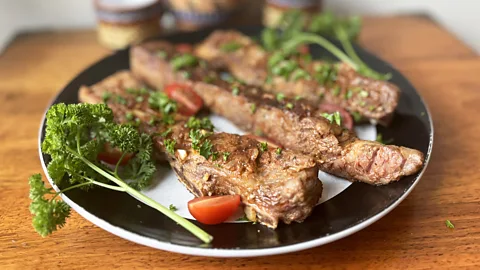
Yiddishe Ribbenes (grilled Jewish ribs)

 Eliot Stein/BBC World's Table
Award-winning author Michael Twitty blends African Atlantic flavours with Jewish foodways, incorporating surprising ingredients like horseradish, ginger, cinnamon and paprika.
A Michael Twitty recipe is always more than the ingredients and instructions written on the page. There's heart, soul and a sprinkling of dos pintele yid – a quintessential essence of Jewishness. That's why his recipe for Yiddishe Ribbenes goes well beyond its literal translation, "Jewish ribs".
"Yiddishe Ribbenes is first and foremost a product of my fever dream fusion," he said. "It sits at the intersection of possible and fantastical."
Before sharing this dish, Twitty said, "I hope this recipe adds to the fun of re-imagining the Afro-Atlantic art of barbecue as part of Yiddishkeit [Jewishness]."
Yiddishe Ribbenes sounds traditional, but it isn't. This is Twitty taking something akin to Southern US barbecue with its Black Atlantic roots and blending it with the flavours of Ashkenazi cuisine. The latter is itself an umbrella that encompasses ancestral Jewish kitchens across central and eastern Europe, where Jewish civilisation weaved into the majority culture of their non-Jewish neighbours.
Twitty first developed the recipe in 2012 for his blog, Afroculinaria. He drew from Ashkenazi traditions of handling meat. The paprika comes from south-eastern Europe, the cinnamon is a nod to central European and Lithuanian Jewish communities, and the ginger is a taste of German Jewish cuisine.
"The point is to get to the flavours and spices that are not only indigenous and pungent, like chrain – a condiment of horseradish, vinegar and beets along with bay leaf, onion and garlic; but we also have salt, pepper, ginger, cinnamon," he explained. "Finally, this wasn't the African Atlantic with its Old World African spices and New World capsicums; but we did have paprika in south-eastern Europe, which can offer sweet and hot varieties."
About Michael Twitty
Michael Twitty is the preeminent Black American and Jewish culinary storyteller, focusing on historical and contemporary foodways. His book Koshersoul: The Faith and Food Journey of an African American Jew recently won Book of the Year from the National Jewish Book Awards and is Twitty's third book and the second in a series that explores his identity through food.
His first, The Cooking Gene: A Journey Through African American Culinary History in the Old South, took readers into his life as a historical interpreter and traced his life through Southern US cuisine and his ancestry. In 2018, he received the James Beard Foundation Book of the Year award.
"I know for a lot of readers, it's really not their way to do the cinnamon, ginger, paprika thing [for ribs]," he wrote on Afroculinaria. "However, one of the things I found out a long time ago in researching Ashkenazi food traditions was the relative high flavour content even in small or isolated communities."
"Cinnamon might be tucked inside with meat in a matzah ball or used to spice a fish," he continued. "Ginger was for baked goods and occasionally goose or other meats. So there is very little interpolation going on here. I just decided to put it all together in small amounts that don't overpower to see what would happen in one dish."
Nowadays, Twitty looks to grill his ribs over something like an applewood or cherrywood commonly found in Europe to amplify the mildness and sweetness of the dish instead of the hardwoods, like hickory, oak and pecan that are traditionally used to cook Southern US barbecue.
"I wanted something that was rooted but rootless, which is kind of exactly the general origin story here of much of [the] Jewish Diaspora and African Atlantic foodways," he said of his Yiddishe Ribbenes. "This is what could have been if the cultures could have blended [...] naturally without the stressors of enslavement and exile. This is less a recipe than a conversation."
Twitty is also looking to challenge the common stereotype that Ashkenazi cooking has no flavour or colour. Additionally, he is pushing back against the notion that African Atlantic cuisine is simply plebeian, proletariat food born out of slave cabins and scraps. Instead, he sees it as a dynamic and nuanced tradition where ancient and modern elements come together to deliver the message that Black food across the Americas was strategic, aimed at keeping a larger tradition alive.
 Noah Fecks
"This recipe is an act of translation," he said. "In the historic [US] South, African Americans who worked as cooks and domestics for Jewish families created a cuisine that merged worlds. It was a cuisine enjoyed by thousands upon thousands, but as people have rearranged themselves and moved around, that tradition has thinned."
At the end of the day, this recipe is Michael Twitty on a plate.
"I locate myself in a place of maintenance and reconstruction, not just because of that history, but because I am African American and a Jewish queer man," he said. "This is also self-creation and curating the table that is reflective of multiple histories and presences across time and space. This is where cooking necessarily is about sharing, generosity and hospitality but also self-appreciation and love."
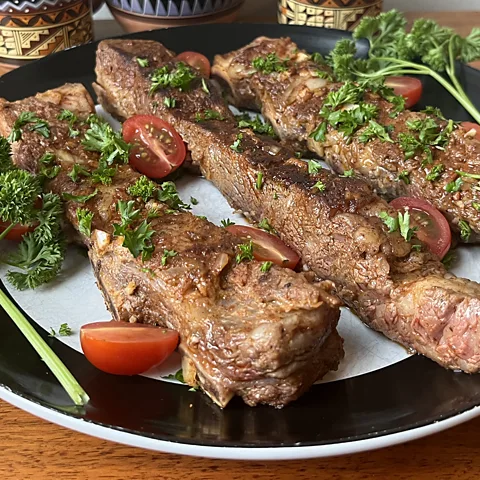
For the recipe, Twitty calls for a "flanken" short rib, known in the Jewish world as "Miami ribs". In other words, avoid stout, chunky short ribs. Flanken are long, relatively flat and thin, which he says make them ideal for grilling as opposed to thick-cut short ribs that require long, slow cooking or braising.
Twitty notes that his marinade can be used with beef back ribs, chicken, lamb or goat, but reminds readers that the cooking method will change depending on the type and thickness of the meat.
 Eliot Stein/BBC World's Table
By Michael Twitty
(serves 4)
Ingredients
2 pounds (or just under 1kg) short ribs, flanken style
1 tsp black pepper
1 tsp ginger
2 tsp paprika
½ tsp cinnamon
1 tsp kosher beef or chicken bouillon
1 small onion, finely chopped
2 tbsp garlic, finely chopped
2 tbsp vegetable oil
2 tbsp white vinegar
1-2 tbsp prepared white horseradish
1-2 tbsp brown deli mustard
1 tbsp brown sugar
Sprigs of fresh parsley, marjoram, or chives, for garnish (optional)
Flake salt, to taste
Method
Step 1
Wash the meat and pat it dry.
Step 2
Mix together the pepper, ginger, paprika and cinnamon and rub into the meat.
Step 3
Mix together the rest of the ingredients (except the optional garnish herbs), pour over the meat, and marinate 4-6 hours.
Step 4
Prepare your grill according to the manufacturer's instructions. If using a pellet smoker/grill, consider using a mixture of oak and cherry or cherry and apple pellets. If using a charcoal grill or smoker, use oak and cherry or cherry and apple wood chips or packets to get a smoky flavour.
Step 5
Grill meat over medium heat, 5-7 minutes per side.
Step 6
Wrap loosely in foil and allow to rest for 10 minutes; check for doneness.
Step 7
If you want, garnish with fresh herbs, or use sprigs to mellow with the flanken ribs as they rest in the foil.
Step 8
Sprinkle with flake salt to finish, but use sparingly.
BBC.com's World's Table "smashes the kitchen ceiling" by changing the way the world thinks about food, through the past, present and future.
---
Join more than three million BBC Travel fans by liking us on Facebook, or follow us on Twitter and Instagram.
If you liked this story, sign up for the weekly bbc.com features newsletter called "The Essential List". A handpicked selection of stories from BBC Future, Culture, Worklife and Travel, delivered to your inbox every Friday.
