Inside Italy's secretive food confraternities

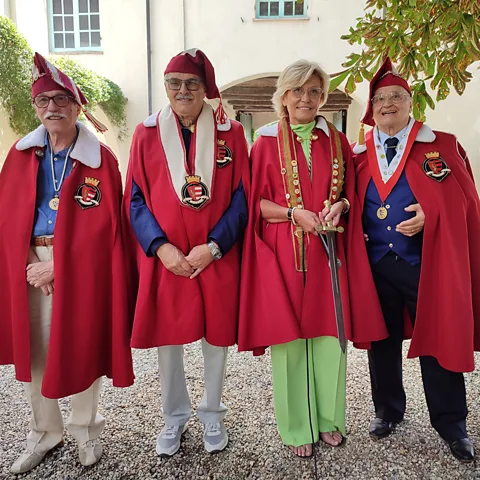 Andrea Ivaldi di Gavi
Across Italy, ceremonial brotherhoods are sworn to protect historic dishes – from salted cod stew to prized cured meats – using medieval rituals, velvet robes and fierce culinary devotion.
I met the vice-president of the confraternity of salted cod stew over dinner at a risotto festival in Verona. I couldn’t help imagining him at secret candle-lit tastings and initiation ceremonies involving unusual uses of fish. Instead, he spent the first course intoning the perils facing the dish's ancient recipe: climate change, globalisation, modernity.
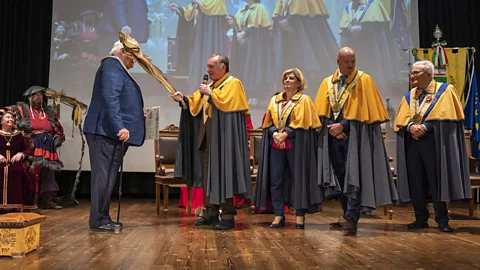
His tirade left me feeling rather glum – until he draped himself in a golden velvet robe, donned a society medallion and took to the stage. With pomp and passion, he enthralled the room with the wonders and secrets of Vicenza's humble dish.
Mario Calgaro, who is a lawyer when not extolling the virtues of salted fish, joined La Venerabile Confraternita del Bacalà alla Vicentina (The Venerable Confraternity of Baccalà from Vicenza) in 2012. The culinary association was formed in 1987 to safeguardand promote dish's original recipe, whose origins stretch back to the 15th Century.
Dozens of these esoteric gastronomic organisations exist across Italy, solemnly sworn to the protection of historic foods, preparations and dishes. There's the Archbrotherhood of the Supreme Culatello (a cured meat from Emilia-Romagna), the Order of the Knights of Polenta from Bergamo and the Academy of Spit-Roasted Meat.
 Getty Images
Their sacred mission can seem anachronistic in an age of globalised tastes, fast food and high-paced life – salted cod stew alone takes four days to prepare. But for these groups, gastronomy is an intangible cultural heritage worth defending from oblivion, a view reinforced by Unesco's recent recognition of Italian cuisine.
Grand Masters and medieval rituals
There are more than 100 culinary confraternities in Italy, promoting hyperlocal foods, from the Alpine cjarsons – raviolo-like parcels filled with ingredients ranging from raisins, dark chocolate and cinnamon to spinach and grappa – to the dried red peppers known as zafarani cruschi from Basilicata and Calabria in the south.
They take their quest seriously. Brotherhoods are led by Grand Masters and Doges (in the case of the Archbrotherhood of the Supreme Culatello, the president is an actual prince), members swear allegiance and uphold ancient rites. Piedmont's Order of the Knights of the Raviolo and Gavi wine, for instance, knight their members in a ritual that could be straight out of a medieval storybook.
The raviolo itself (this particular version is filled with beef, sausage and borrage or endive, and eaten in a meat sauce or a culo nudo – plain) is said to have been invented between 1070 and 1202 in an inn along the much-trafficked road between Genoa and the Po Valley; then ruled by the Marquises of Gavi.
 La Venerabile Confraternita del Bacalà alla Vicentina
The knighting ceremony follows surviving records of Gavi traditions, explains Master Roberto Dellacasa. During the Chapter, the Chancellor calls forward the neophyte and presents him to the Knights. The candidate pledges to respect the Statute and to pursue the Order's purposes. He then kneels, and the Grand Master proceeds with the investiture. The medieval broad sword descends first on the shoulders, symbols of strength and sentiment, and then on the head, as if to augur wisdom.
(Dellacasa confirms that the sword doesn't actually date from the Gavi reign, but notes it is a hefty instrument all the same, and he is responsible for hauling it from event to event.)
The story of salted cod
While the rituals can verge on theatrical, they are fitting given how many of the foods these confraternities protect have centuries-long histories. Vicenza's baccalà traces its origins to a maritime disaster in 1431.
That year, the Venetian merchant Piero Querin set sail from Crete with a cargo of sweet wine, spices and cotton, bound for Flanders. But his dreams of wealth were dashed by a tragic shipwreck. Most of the crew perished, but Querin's lifeboat washed up on the island of Røst in Norway's Lofoten archipelago, where locals came to the rescue with their staple food: cod air-dried for months until it became rock-hard.
Querin returned to Venice with this curious new food, which soon became a godsend for poorer households – a nutritious, affordable food that could be preserved for long periods and stretched to feed many mouths.
 Getty Images
The future is not rosy
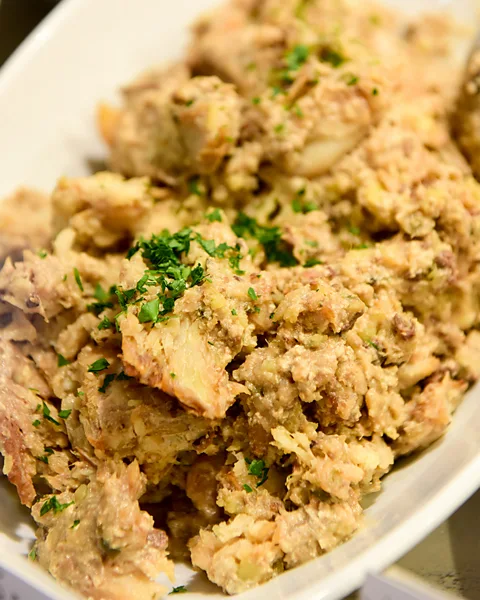
Today, the role of the confraternities is not just to honour the past, but to secure a future for these historic dishes. Many of the foods are defined by laborious preparations. For baccalà, the fish needs to be soaked in water for three days, changed every four hours. Only then can it be cooked – a slow, six-hour process with onions, salted sardines, milk and parsley.
Until the 1960s, meat was banned on Fridays under Vatican law and Calgaro recalls that most families would cook baccalà on that day, beginning at 06:00. "The pace of modern life doesn't allow for this now except for special occasions," he laments. Rising temperatures are also reducing cod stocks in the Arctic Ocean.
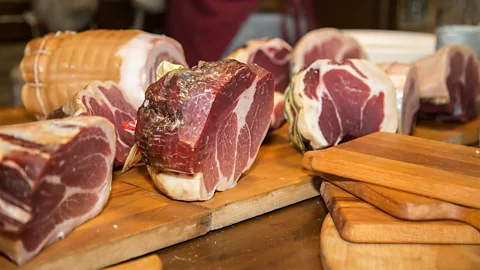
Cured meats present similar challenges. In Lombardy, the Confraternity of Cotechinomagro protects a large pork sausage cooked by simmering over a low heat; while in Emilia-Romagna another association champions Spalla Cruda di Palasone, a salami made from the pig's shoulder and neck.
The Archbrotherhood of the Supreme Culatello, also based in Emilia-Romagna, promotes Culatello di Zibello, a PDO-protected cured meat made from pork loin encased in a pig's bladder and aged for at least 12 months. Like most confraternities, they host events to promote the product.
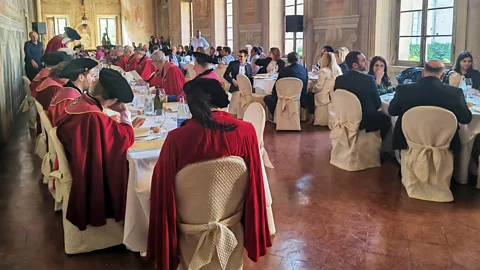
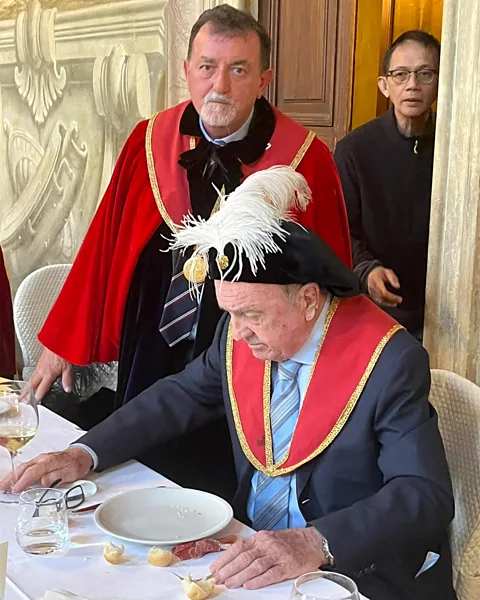
Their defining event is La Gran Tenzone dei Culatelli (The Great Battle of the Culatelli), during which the "supreme culatello" of the year is crowned. The judging is a tense business, the specimens analysed with a fastidiousness akin to wine tasting. Grand Master Alberto Spisni (who is also a member of the National Organisation of Cured Meat Tasters) explains that all five senses are required in the process.
 Alberto Spisni
It begins with tapping the exterior of the culatello with a small wooden hammer, listening to check that no air has entered inside and compromised the meat.
"Touch is then used to evaluate the consistency, which should be soft and not very oily. We then look for the right colour, which is antique pink, and smell for the olfactory profile, which should be undergrowth and dried fruit," Spisni says.
More like this:
• Italy's smaller, smarter alternative to Venice
• Is the future of French cheese at stake?
• The Italian city where life is sweetest in winter
Finally, they judge the taste, where "sweet should prevail over salty, and the aromatic bouquet should reflect the olfactory profile and possibly expand it." Dressed in their red robes and black caps, the members of the brotherhood make detailed notes on each outstanding candidate. "It's easier to find the holy grail than the supreme culatello," one judge remarked in a television segment on the event.
For the Knights of the Raviolo and Gavi, President Clementina Dellacasa is pushing for a "rejuvenation" of the order to ensure its relevancy in the modern age. Her objective is to diversify events, introducing adjacent themes like archaeology, music and cinema to place gastronomic heritage within a continuing cultural and territorial context. Her dream is to welcome a younger cohort of knights, as well as foreign members. "I'd love to have different tables, one speaking English, one French, maybe one in dialect," she says.
 Alberto Spisni
'A great excuse for a party'
Perhaps the greatest weapon of the confraternities against the demise of their precious foods is that their task is undertaken with pleasure and a certain wry amusement. There are moments of self-deprecating humour – the confraternity of salted cod knights its new members with an actual preserved fish. And the grandiose language is not accidental: the phrase "supreme culatello" is undeniably funny in Italian, given that the name of the cured meat refers to the rear end of the pig.
These associations have the character of social clubs; participation is voluntary (and often by invitation) and members join not least for the like-minded company and a genuine love of food. As Spisni says, "confraternities are a great excuse for a party".
--
If you liked this story, sign up for The Essential List newsletter – a handpicked selection of features, videos and can't-miss news, delivered to your inbox twice a week.
For more Travel stories from the BBC, follow us on Facebook and Instagram.
