The return of Britain's meat-eating plants

 Maurice Ford/Getty Images
Once common around Britain, carnivorous plants have suffered a dramatic decline over the last century. However, a young ecologist is on a mission to bring these dramatic species back.
When I arrived at what's left of the Manchester mosses, fragments of the vast expanses of saturated, lowland peatlands that once formed much of the countryside around Manchester, I found I wasn't alone. I was there to meet Joshua Styles, one of the most inspiring young naturalists of his generation, but instead found two teenage boys smoking weed in a battered VW Polo. We acknowledged one another cagily before they headed back towards town. Few people bother coming out here – at first glance, there's little to see.
{"image":{"pid":""}}
Where to see them:
Visitors to the Highlands and islands of Scotland may be fortunate to stumble across great sundews, as these remote, wild corners of Britain remain a stronghold for carnivorous plants.
In southern England, damp areas of the New Forest support the more commonplace round-leaved sundew.
Styles, however, knows better. He's got an eye for the overlooked. Even as a young boy growing up in north-west England, Styles was obsessed with plants. Other kids might have focused on football, but Styles simply had to know the name and habits of every wildflower he could find. In 2017, then a 22-year-old ecology graduate, he founded the North West Rare Plants Initiative (NWRPI), an organisation devoted to halting the decline of the rarest plant species in north-west England.
He's a man on a mission, determined to singlehandedly restore the lost plants of this austere, flat landscape, one by one. Chief among these are some of the most dramatic species to be found anywhere in Britain: carnivorous plants. The Manchester mosses were once home to an array of meat-eating plants that turned the tables on the animal kingdom, spurned a vegetarian lifestyle, and preferred their food freshly served, alive and kicking.
Styles arrived and wasted little time in donning a pair of rubber boots. Where we were heading on foot wasn't for the ill-prepared – Styles has been reintroducing sundews and bladderworts into a waterlogged wonderland, a recovering landscape of peat bogs and marshes.
 Jon Dunn
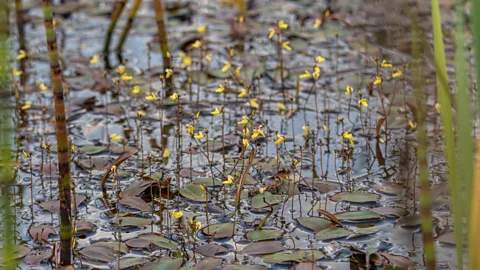
I understood his caution. To the untrained eye, bladderworts are easily overlooked except when they raise their glorious lemon-yellow flowers above the water's surface. Sundews, on the other hand, glisten and quiver on the surface of the mosses and are as arrestingly beautiful as they are strange. For this reason, the precise location of the reintroduction of these plants by Styles is a closely guarded secret. Plant collectors, like the collectors of rare bird eggs, remain a threat to endangered species to this day. Green-winged orchids became extinct in Cheshire when thieves dug up all the plants at their last remaining site in 1980.
Solemnly sworn to secrecy, I followed Styles onto the squelching mosses. "It's a sad story," he told me, "Great sundews became locally extinct here 150 years ago, and they're endangered across England as a whole."
You may also be interested in:
• England's disputed national treasure
• Australia's remarkable animal discovery
• The UK's forgotten 'fifth' nation
The mosses are almost but a memory. Where once there were hundreds of acres of bogs and marshes around Manchester, there's largely now a uniform patchwork of agricultural fields. It may look bucolic, but the loss of biodiversity that came with the draining of the mosses was colossal. Lowland peatlands have acidic, wet soil that's deficient in nutrients, but that's not to say they're sterile. A host of specialised plants and insects can thrive in these conditions and, where plants and insects abound, other wildlife does too.
"Plants are the fundamental basis of all life on Earth," Styles said. "We lose them at our peril. One in five indigenous plant species in the UK are under threat of extinction. Every year, on average, one plant species becomes extinct in each county throughout England."
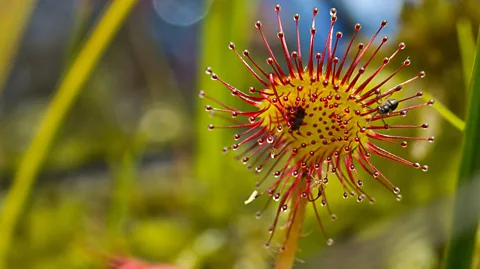
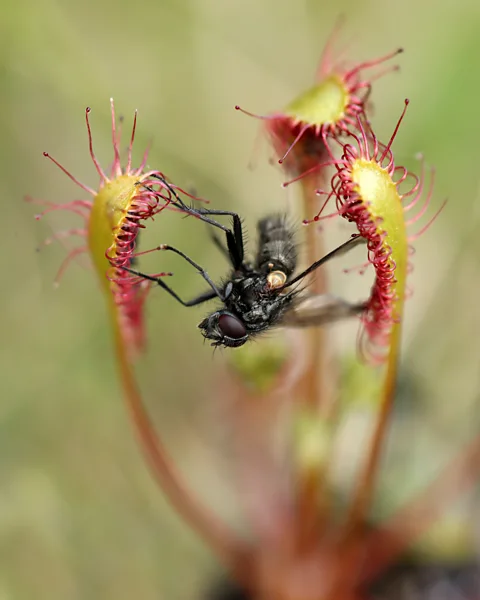
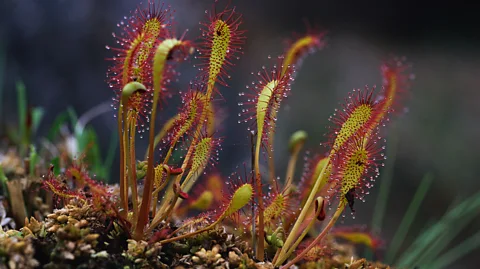
In the Manchester mosses, chief among those lost plants were a glittering host of sundews, with ruby-red and emerald-green leaves that glistened with tiny, sticky pearls of mucilage, a translucent, sweet substance the plants create at the tips of fine hairs that cover the surface of their leaves. Lured to settle on the leaves, an insect would find itself stuck, unable to fly away from the vegetable glue that entrapped it. The sundews' leaves slowly curl around their unfortunate prey, releasing enzymes that dissolve the insect, releasing the nutrients within. The ground in which the sundews grow may be nutrient-deficient, but there's more than one way to feed if you're a plant who's evolved a taste for animal prey.
 Stephen Barlow
Charles Darwin, the great naturalist who unlocked the secrets of evolution in the 19th Century, was obsessed with sundews. He grew them for years, conducting experiments involving them and a succession of unfortunate insects. In 1860, he wrote, "At the present moment, I care more about Drosera [sundews] than the origin of all the species in the world", a bold statement coming from the author of the seminal On the Origin of Species.
However, the story of the sundews, and other carnivorous plants besides that shared the damp surroundings of their north-westerly home, begins some 10,000 years before they caught Darwin's eye, at the time when the bogs of north-west England began to form. On the surface of those early mosses, a tapestry of sphagnum moss and other acid-loving plants abounded and, year by year, added just a little bit more fallen organic matter to the heavy black mass of saturated peat upon which they grew – an incremental accretion of plant material that, thanks to the wet and acidic ground conditions, didn't rot, and instead compressed to form peat, locking millennia of carbon safely in the ground. Peat bogs cover just 3% of the Earth's surface, but they store more carbon than all the planet's forests combined.
Yet what took millennia to form was the work of short decades to undo. As Manchester grew as a city, drainage channels cut by man began to bisect the mosses, slowly but surely drying the elevated peat around them. Peat was extracted and sent into Manchester and, in return, Manchester's inhabitants fertilised the drying, nutrient-poor soil. By the 1880s, the city was producing 200,000 tons of refuse annually, 75% of which was coyly known as "night soil". Much of this was transported into the mosses and spread as fertiliser on what was perceived to be an unproductive wasteland. In time, much of the former peat bog became fertile, workable agricultural land.
Peat extraction, for fuel and compost, continued there well into the 20th Century, by which time 98% of the Manchester mosses had been destroyed. It's only in recent decades that the scale of the loss of habitat and biodiversity has become recognised, let alone steps taken to address it.
Lancashire Wildlife Trust (LWT) has spearheaded the drive to save what's left, working with landowners to improve the condition of the fragments of peatlands they own, campaigning for protection of peatland sites and, critically, purchasing key peatlands to protect them from destruction, restore them to their former glory and conserve them for future generations.
 Jon Dunn
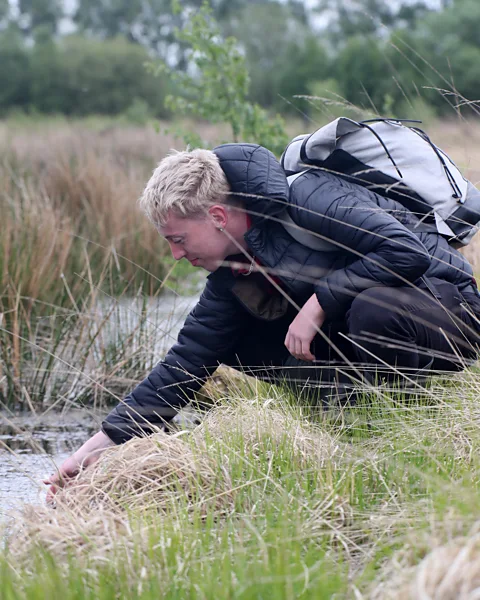
Thanks to LWT practicing conservation at a landscape scale, Styles has found a stage on which to perform the vital work of returning the small plants that decades of exploitation have destroyed. My arrival there coincided with a monitoring visit during which Styles could see how his precious carnivorous charges were faring after a winter alone in the bog. It's clear he feels personally responsible for their survival – as well he might, having cultivated each introduced plant with the loving care a parent shows their child. But he also has a practical, professional botanist's view of what he's doing here.
"There's a pressing need to conserve individual species and habitats at not only a national, but also a regional level," he told me. "This is an outlook often lacking in the conservation world, where there's a generally strong focus on animals."
The NWRPI champions the overlooked plants that make up the building blocks of the environment. Crucially, Styles is at pains to stress that the plants he reintroduces are part of a considered process, with strong justification of why a reintroduction is necessary, forethought towards the continued management of the area of introduction, and the consent of relevant landowners and statutory authorities. After just a few years, his hard work is already paying off.
An early success came with lesser bladderwort, a carnivorous plant that is, despite being a gravely endangered species in England, a frankly unassuming character. It's fully aquatic, forming long straggly strands in bodies of open water. It does, however, have hidden depths. Along those submerged stems are tiny, bladder-like traps that, triggered by a small invertebrate entering them, snap closed in 1/10,000th of a second. Digestion then commences.
Working with the Wildlife Trusts and Natural England, in 2018 Styles took five strands from one of the few remaining local populations of lesser bladderwort. He cultivated these and, later that year, the resulting plants were reintroduced into areas of the Manchester mosses managed by LWT. From those five initial plants, in 2019 Styles found the lesser bladderwort forming dense carpets at the initial release site, estimating there to be 29,000 plants. These formed the nucleus for further introductions on the same site and, in 2020, there were more than 200,000 plants thriving there.
"A healthy ecosystem is full of biodiversity and Josh's work really supports that," said Jo Kennedy, partnership co-ordinator at Great Manchester Wetlands Nature Improvement Area. "Who'd have thought that just a few miles from Manchester city centre there would be a whole world of carnivorous plants making a comeback?!"
To Styles' obvious delight, his great and oblong-leaved sundews were doing well, too. It had been a long, cold spring, so the plants were still small and had not yet fully formed the fatally attractive lush clumps of glistening, deadly leaves that will lure insects to a sticky end, but Styles knows each plant individually and was pleased to find they had not only survived since he planted them, but had started to reproduce.
"In 2019, I reintroduced the first 10 plants to the mosses – they've increased fourfold at that one site alone. In total, this year, there are now at least 85 great sundews in the mosses."
And what of the lesser bladderwort, I asked. How's that doing?
"I suspect that we may be over 1,000,000 plants this year, which is grand news. We may need a canoe to investigate all pools properly at this rate… Forget tree planting – peat bogs are where it's at!"
His enthusiasm was infectious and it was easy to be swept along with him. The meat-eating plants of the north-west's peat bogs have found their champion – the revolution will be botanised.
Hidden Britainis a BBC Travel series that uncovers the most wonderful and curious of what Britain has to offer, by exploring quirky customs, feasting on unusual foods and unearthing mysteries from the past and present.Join more than three million BBC Travel fans by liking us on Facebook, or follow us on Twitter and Instagram.
--
If you liked this story, sign up for the weekly bbc.com features newsletter called "The Essential List". A handpicked selection of stories from BBC Future, Culture, Worklife and Travel, delivered to your inbox every Friday.
{"image":{"pid":""}}
